Doctors Want Their AI Dividend

Doximity’s 2026 Physician Compensation Report told a familiar story with an unexpected plot twist. Modest raises are still getting outpaced by not-so-modest inflation, but physicians now want a slice of all the AI-driven productivity gains.

Average physician pay rose 2% in 2025. The headline stat from nearly 23k surveys marked a significant slowdown from +3.7% the year before. It also trailed full-year inflation of 2.7%.

  • Neurosurgery once again led all specialties at $829k, interventional radiology grew fastest at 10.8%, and radiology was the only specialty to crack the top 10 for growth two years running.
  • The surgical specialist premium over primary care widened to 90.1% (from 87.3%), reversing three years of narrowing, while the gender pay gap sat unchanged at 26%.

The bigger story was AI’s growing impact. When Doximity asked who should primarily benefit financially if AI lets physicians complete more clinical work in the same amount of time, physicians primarily nominated themselves.

  • 44% said physicians (rising to 50% among PCPs), 20% said the gains should be shared, 17% picked patients, 11% picked their employers, and a whopping 2% picked payors.
  • There’s less agreement on the mechanics. 36% said physician compensation for a service should change if AI substantially reduces their time or effort for that service, while 43% said it should stay put.

Burnout is the bargaining power. The report lays out some compelling reasons why physicians feel they deserve some AI upside, and why they might actually be able to get it.

  • 82% of docs report being overworked, 66% are considering a career change, and the share considering early retirement jumped from 34% to 46% in a single year.
  • Those are some scary numbers all around, and despite all of the new tech promising to make life easier, 76% of physicians would trade lower pay for more autonomy or work-life balance.
  • Health systems and physician employers could try to bank all the AI efficiency gains for themselves, but they’re negotiating with a workforce that’s already eyeing the exits.

The Takeaway

Most payment models in healthcare ultimately put a price on physician time, so there’s inevitably going to be some serious discussions when AI starts impacting that time. Doximity’s report just showed that physicians are already pulling up chairs to the negotiating table.
The Hidden Bias in Portal Message Triage

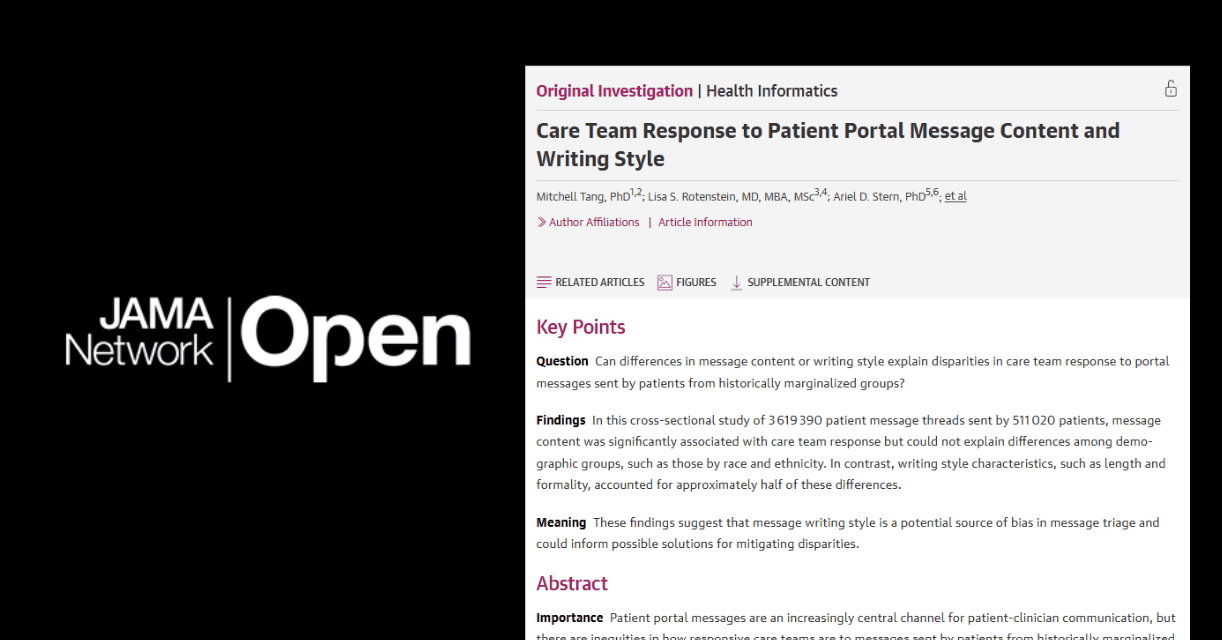
Most patients assume that a portal message sent to their doctor goes to their doctor, but a new study in JAMA Network Open suggests that how it’s written could decide whether it ever gets there.

Here’s the setup. Portal messages land in a shared pool where a triage nurse or medical assistant makes a snap call: handle it themselves, or forward it to the doc.

  • Researchers analyzed 3.6M portal messages at Mass General Brigham, finding that just 32% got a reply from the clinician they were addressed to (77.5% heard back from anyone).
  • Prior work from lead author Mitchell Tang showed that historically marginalized patients fare worse in that process, and the new data agrees: Black patients were 3.7 percentage points less likely than White patients to hear back from their own clinician.

It isn’t the advice patients ask for. The authors ran NLP across a million threads to separate message content from writing style, and content explained just 5.7% of the Black-White response gap.

It’s how they ask. Writing style – length, sentiment, punctuation, and especially the greeting – explained 48% of the Black-White gap, 34.9% of the Hispanic-White gap, 60.5% of the education gap, and 42.8% of the Medicaid-commercial gap.

  • Messages opening with the clinician’s name (“Dear Dr. Tang”) got a response from that clinician 38.7% of the time versus 25.7% with no greeting, and Medicaid patients were far less likely to use one.
  • Longer messages and expressive punctuation also outperformed, while messages containing “please” fared worse. Manners are apparently negotiable, but name-dropping is not.

Here’s the good news. The authors see style bias as far more fixable than demographic bias.

  • Triage teams probably don’t know it exists, portal composers could help structure messages, patient-facing AI can assist with drafting, and AI triage could extract the clinical signal from the stylistic noise – as long as models trained on human triage don’t inherit the same habits.

The Takeaway

Triage teams are making split-second calls to tackle skyrocketing message volumes, so polish is getting mistaken for priority. Health systems now have a clearly labeled bias to design out of their in-baskets, but until they do, patients should probably brush up on their portal etiquette.

Blue Ribbons and AI Agents at Epic UGM

Epic’s “Meet Me at the Midway” User Group Meeting had everything a county fair needs: a cowgirl CEO, a blue-ribbon AI roadmap, and a giant elephant in the room.

Ergo was the main attraction. Judy took the stage in full cowgirl costume to deliver her keynote on “healthcare intelligence,” which now has a name, a November ship date, and a live pilot at Ochsner.

  • Ergo is an AI system that surfaces intelligence across Epic’s Art clinical copilot, Emmie patient-facing assistant, Penny revenue cycle agent, and Cosmos research database depending on what each visit calls for.
  • Judy shared an “Ergo visit” example where Art pulled relevant info from the chart ahead of time, Emmie talked with patients in MyChart before the visit, and the two combined to generate discussion topics for the physician. Déjà vu.

Curiosity stole the show. Cosmos Curiosity is a new generative model trained on 320M deidentified patients and 23B encounters that simulates what happens next for a patient – such as health trajectories, whether they’ll be readmitted, and why.

  • Twenty orgs are already validating Curiosity ahead of a March 2027 release inside the EHR.

Scale got the most spotlight.

  • Agent Factory is off to a hot start and now lets health systems shape 120+ out-of-the-box AI features, or build their own agents for specific use cases without having to code them from scratch.
  • Chart with Art is now live across 70+ specialties and 60+ orgs, and Penny is autonomously coding radiology and ED visits.
  • Real-time prior auth checks are already live at four systems, with UnitedHealthcare, Aetna, Network Health, and 16 more payors testing.

Now for the elephant. Although UGC brought plenty of big news, Epic was grabbing headlines for all the wrong reasons in the months leading up to the event. 

  • The FTC is reportedly probing Epic’s non-competes and third-party data blocking, the same allegations behind other lawsuits that might sound Particul-arly familiar.
  • Epic’s heir apparent Sumit Rana, AI chief Seth Hain, and Care Everywhere architect Dave Fuhrmann all left in the month before UGM, which may have been because they lost an internal debate over building-vs-partnering on AI. Epic denies it happened.
  • Judy is 83, succession is still an unspoken question, and the closest thing to an answer is R&D lead Seth Howard saying that Epic “would never” hire an outsider.

The Takeaway

Judy likes to say that “health IT is more complex than rocket science.” That doesn’t seem to do much for employee retention, but it also didn’t stop Epic from shipping 84 new AI tools in just the last year. UGM 2026 should keep the pace if a few elephants can be addressed. Ergo, stay tuned.

ARISE’s New MASTerclass on Keeping Up With AI

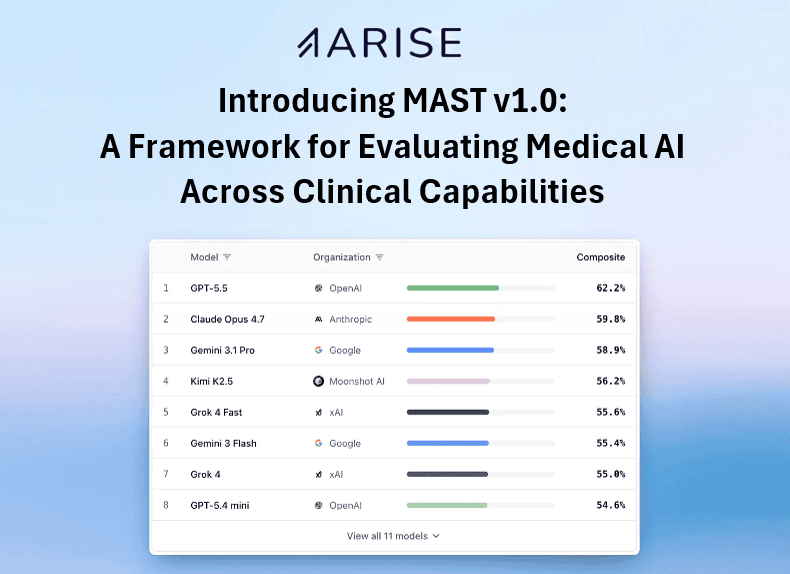
The folks at ARISE have done it again with their new Medical AI Superintelligence Test (MAST) that enables real-time grading of AI performance across clinical capabilities.

MAST isn’t just a static report. It’s a “living” system that’s built to keep up with AI’s development. The goals are twofold:

  • First, to aggregate the field’s highest quality benchmarks into a shared infrastructure that’s actively maintained.
  • Second, to enable cross-benchmark inference, allowing for more thorough characterization of model performance and the underlying traits which drive it.

The models are evaluated across six domains:

  • Diagnosis, using SCT and NEJM’s CPC.
  • Management, using SCT and NEJM’s CPC.
  • Safety, using NOHARMV2.
  • Radiology, using ReXrank.
  • Multimodal, using MIDAS.
  • Agentic, using MedAgentBench v2 and PhysicianBench.

What would a launch be without a taste of the results? First, MAST breaks down AI agents into clinicians and generalists, allowing fair comparisons with other models in their class:

  • Glass Health’s Glass 5.6 Max took the cake for the clinical models, outperforming all other developers in every category – including diagnostics (79.2%), management (79.5%), and safety (75.8%).
  • Open AI’s GPT 5.5 was the blue-ribbon generalist, nabbing top marks in management (76.3%), agentic capability (56.7%), and safety (73.8%), beating out competitors like Anthropic and Google.  

There’s also a personality test. No, it isn’t Myers-Briggs. This one captures the distinct clinical profiles of the models (small specialist models may outperform larger generalist systems on narrow modalities, while remaining less capable across the broader clinical suite).

  • For example, Google’s Gemini 3.5 Flash was slightly better at radiology and imaging tasks, but didn’t come close to meeting the mark on care management.
  • Meanwhile XAI’s Grok 4 Fast was pretty good at both management and radiology, but gave a middle-of-the-road performance for safety and diagnostic jobs.

So, what’s it mean? Developers no longer have time to study for the next big test when MAST is reevaluating them against every new benchmark. It’ll start being very apparent who’s actually in the lead.

The Takeaway

The ARISE network has done it again. MAST’s live updates match the pace of AI development, giving clinicians real-time feedback on which model to choose for what task.

Khosla Says AI Should Replace Human Physicians

Will autonomous AI deliver better medical care than physicians by 2030? 

Who knows, but that didn’t stop Vinod Khosla from saying it in JAMA (and starting an angry mob of doctors in the process).

When Khosla talks, people listen. The VC heavyweight has a long track record of nice picks in healthcare – Abridge, Headspace, Sword, and most recently Bunkerhill

  • His predictions carry a lot of weight, especially when he makes them in a respected journal with co-authors like former White House health policy adviser Zeke Emanuel and Curai Health CEO Neal Khosla (maybe genius runs in the family).

The latest forecast ruffled some feathers. It’s easy to see why: “AI alone will provide better medical care than physicians, or even physicians working with AI.” 

The article argues that AI already rivals or outperforms doctors at five cognitive medical tasks:

  • gathering patient information
  • choosing tests 
  • making diagnoses
  • prescribing treatments
  • managing chronic diseases

Those are some big ones. The authors cite plenty of evidence to back that up (some might say low-quality evidence), then go on to predict that the gap will only widen from here.

  • The argument is that AI is rapidly improving, whereas physicians are increasingly threatened by AI-induced deskilling.
  • They also make the case that once AI beats physicians at a task, including a human in the loop will only degrade performance. In other words, AI-only care will outperform human-AI hybrid care.

Fair points for the techno-optimists. Not fair enough for the doctors.

  • Everyone agrees that getting the diagnosis right matters. Choosing the right test matters. Recommending the right treatment matters.
  • But so does understanding what a patient values, knowing when something doesn’t feel right, and having the instinct to act on it.

Performing medical tasks isn’t the same as practicing medicine. AI might be better at one, but you’ll get an angry mob if you say it’s better at both.

  • If serendipity is on your side, you might also get a beautiful new framework for physicians’ role in the age of AI, straight from DiMe and the same AMA that runs a certain journal that isn’t afraid to print hot takes.

The Takeaway

Average views produce average returns, and Khosla didn’t make his fortune by following the herd. That said, this might be the most contrarian view we’ve ever seen, so luckily we only have to wait until 2030 to find out if doctors are all out of the job.

AMIE Graduates From Chatbot to Video Visits

The moment has arrived. AI is now as good as physicians at conducting real-time video consultations – so long as patients stick to the script.

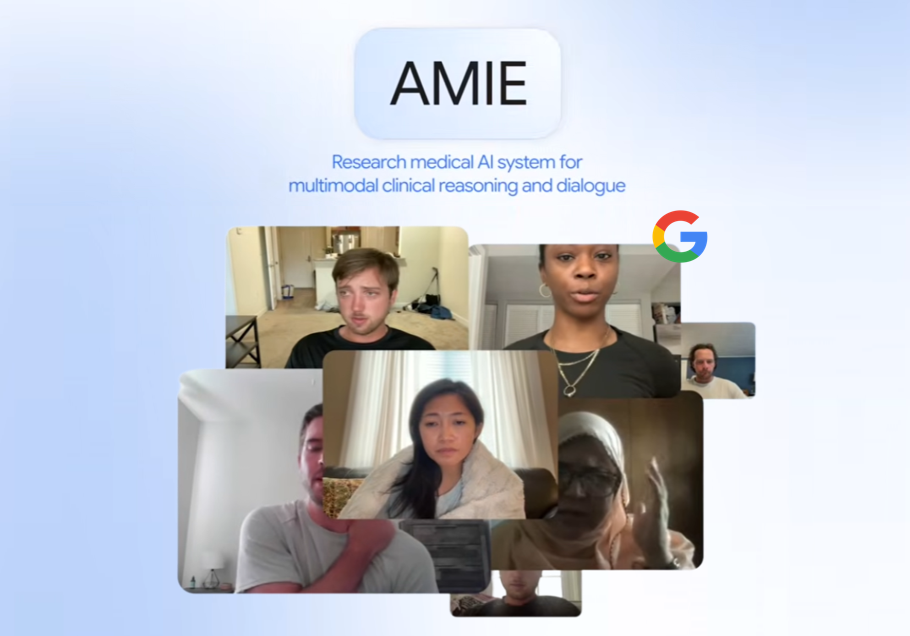
There’s a new expert in town. It’s Google’s flagship medical AI researcher named the Articulate Medical Intelligence Explorer, but its friends call it AMIE for short. 

AMIE gets its eyes and ears from a three-agent architecture built on Gemini and Project Astra, which splits the job so no single model has to think and respond at the same time:

  • A Talker agent keeps the conversation flowing with low-latency responses.
  • A Planner agent continuously updates the differential diagnosis and clinical goals.
  • A Perception agent watches the live audio-video stream for clinically relevant cues.

Google put AMIE through the wringer. A randomized study pitted AMIE against 10 board-certified PCPs across 100 telehealth scenarios enacted by 15 professional patient actors, with 20 independent physicians grading the encounters.

AMIE matched or beat the PCPs across the board:

  • Overall clinical rubric score: 83% vs. 68%
  • Top-1 diagnostic accuracy: 91% vs. 77%
  • Perception and examination: 74% vs. 47%

The physical exam gap was the eye-opener. AMIE proactively coached patient actors through maneuvers like range-of-motion tests and self-palpation, while the human PCPs mostly fell back on verbal history-taking.

  • Patient actors preferred AMIE for assessing and explaining their conditions, but still preferred humans for rapport, with interviews describing AMIE as having awkward pauses and odd conversational cadence.

Here’s the disclaimer. These were patient actors following scripts, not real patients. The physicians had to keep their cameras off, and AMIE still whiffed on subtle signals like tremors, nystagmus, and affect – the exact cues where perception matters most.

  • That’s not exactly real-world validation, but that’s already underway through a feasibility study with Beth Israel Deaconess and a nationwide study with Included Health.

The Takeaway

When AMIE first prompted predictions that patients would soon see an “AI doctor” before a human one, the missing physical exam was the go-to rebuttal. That gap just got noticeably smaller, and it doesn’t feel like we’ll be able to write too many more of these before it disappears completely.

Commure in the Crosshairs

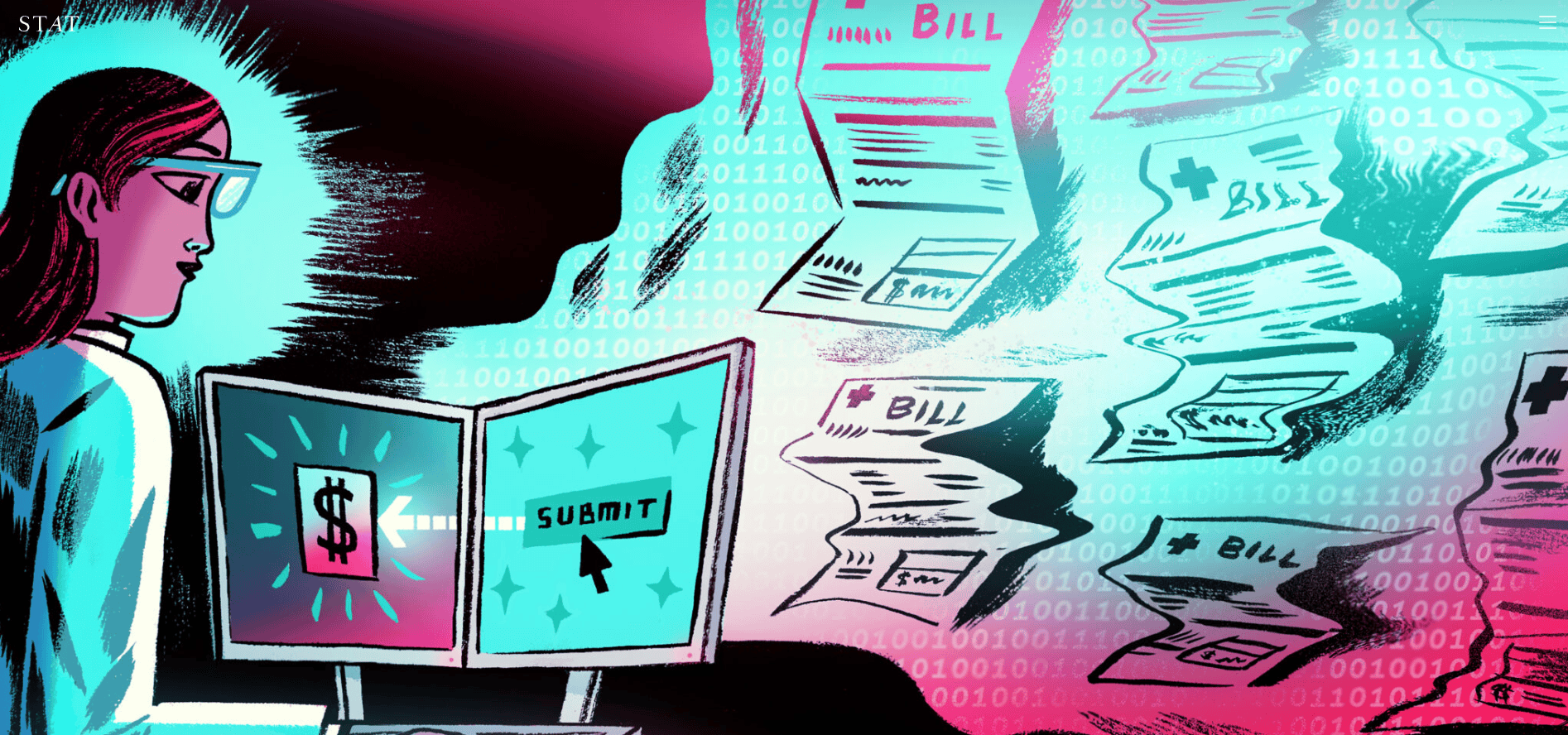
Nobody’s having a longer week than Commure after STAT published a scalding investigation into the company’s growth (at all costs) engine. Turns out it’s a lot easier to be a happy customer when you’re getting paid to be one.

Here’s the backstory. Commure set out in 2020 to build an AI operating system for healthcare that takes power away from payors and hands it back to clinicians. 

  • CEO Tanay Tandon summed up the Robin Hood pitch on the YC podcast by saying he’d love a world where UnitedHealth’s market cap is a fifth of what it is today, but every doctor is a millionaire.
  • Fast forward a few years and $800 million VC dollars (acquisitions are expensive), and Commure’s grown into a $7B juggernaut helping 130+ health systems automate administrative tasks.

Now comes the investigation. STAT revealed that Commure offers large incentives to clinics and other parties that refer its products to new prospects.

  • One physical therapy clinic’s contract required it to refer $750k of new business within a year, or face a $66k “referral obligation fee.”
  • Affiliate partners earn 2% of any contracts they bring in, so they have plenty of motivation from both carrots and sticks.
  • The catch is that STAT found some especially enthusiastic customers that deliver booth testimonials in company quarter-zips, have Commure email addresses, and hang out in internal Slack channels.

That gets shaky when you have mixed reviews. Some customers credit the platform with driving massive collection boosts. Others either “don’t have a positive thing to say about it” or have absolute horror stories. 

  • The article cites particularly unflattering reviews from a Wyoming rehab clinic that fell $500k behind on collections after handing the keys to Commure, as well as an Arizona FQHC that watched $1M in dental claims get denied without receiving a single notification about the issue.

That could be a problem. Former federal prosecutors told STAT that paying for referrals to products funded by Medicare or Medicaid doesn’t sit well with the anti-kickback statute.

  • This isn’t the DOJ’s first rodeo, and some major players have been lassoed into settlements over kickback allegations.

Commure’s response? Everything is fine, and everybody is doing it. The company called its referral practices industry standard, chalked the complaints up to a small minority of customers, and lashed out at STAT for giving readers a distorted view of the business.

The Takeaway

Commure’s internal mantra is apparently “speed above all else,” so maybe a few not-technically-kickbacks are just the cost of doing business. A jury might not see it that way, but then again Commure isn’t on trial (at least not yet).

AI Will Bend the Cost Curve, for Better or Worse

A new paper in NEJM Catalyst makes the case that AI might finally bend the cost curve in healthcare, just not in the direction patients were hoping for.

“Show me the incentives and I’ll show you the outcomes.” National health expenditures jumped 60% to nearly $5T per year in the last decade, and widely cited estimates from McKinsey suggest AI could shave about $360B off the annual total. 

  • Venrock’s Bob Kocher and Brian Zhao teamed up with USC’s Erin Duffy to explore the areas where those savings will allegedly materialize, and they found the same overarching problem with all of them.

You get what you pay for, and fee-for-service pays for volume. No matter where they looked for potential savings, the authors believe AI is even more likely to have the opposite impact.

  • Drug Development – Faster AI-driven discovery means more new drugs and more eligible patients, but a healthier population doesn’t happen overnight. The net effect for the foreseeable future is more pharma spending, not less.
  • AI Scribes – Under FFS, freeing up physician capacity is a direct path to more visits, which is a hop and a skip away from more fees, tests, referrals, and prescriptions.
  • DTC “AI Doctors” – Could be deflationary if they replace pricier human encounters, or inflationary if every chat ends in an escalation and a testing cascade. Early evidence points to cascades.
  • RPM and CCM – AI dramatically cut the cost of delivering remote care by reducing the clinician time needed to analyze the data, but blanket deployment means more billable monitoring and more incidental interventions (see: United Healthcare’s now-paused move to narrow RPM coverage to two conditions).
  • Admin Automation – The AI-generated savings are real, but in consolidated hospital and insurance markets, that translates to higher margins, not lower prices.

Flip the model, flip the outcome. Every one of those buckets cuts the other way under value-based care arrangements, where the AI force multiplier is more likely to get pointed at complex patients and preventive care rather than volume and more volume.

  • At-risk providers are already using AI to expand access, improve screening, and deliver better treatment. The AI upside is there, it’s just not showing up in the places most people are looking.
  • The authors’ most direct policy fix is simple: more value-based care, and more outcomes-based reimbursement efforts like CMS’s new ACCESS model.

The Takeaway

While AI holds enormous potential to improve healthcare, this paper highlights exactly why it takes more than new tech to bend the cost curve. It also takes the right reimbursement models wrapped around it.

App-Based Interventions Can’t Do It All

Anxiety, obesity, diabetes — there’s apps for all that and more. But which risk factors and outcomes actually respond to smartphone-based interventions? A new paper in The Lancet Digital Health separates helpful software from homescreen clutter. 

Mountains of data went into this study. The umbrella review and meta-analysis covered 78 systematic reviews, 496 primary studies, and over 177k participants. 

Apps came out looking pretty good. They made a dent in 21 of 31 outcomes. 

  • Users got moving, adding to their step counts and exercise time. 
  • BMI, weight, and waist size (but somehow not body fat percentage) fell.
  • On the mental health front, anxiety, mindfulness, and stress saw the most positive movement, with depression and wellbeing just behind.
  • Glucose levels improved — more than any other metric, at that. 

But the study was a heartbreaker for cardiovascular disease apps (and a grab bag of other categories)

  • Blood pressure was the only CV outcome that responded to apps.
  • Cholesterol, triglycerides, and CV disease mortality didn’t budge.
  • Fruit and veggie intake, smoking, and hospitalization were also unchanged. 

Here’s where the lessons on better building and deploying apps come in. Researchers, clinicians, developers, and policymakers, take note.

  • Tracking and monitoring were most useful when it came to physical activity, glucose management, nutrition, and medication adherence. 
  • Educational content went a long way for mental health. 
  • Support from healthcare professionals or a community was broadly helpful. 
  • Goal-setting and behavioral planning were generally underused. 

Some outcomes might just be harder to achieve, though. 

  • The researchers theorize that apps are good at short-term behavioral changes, but struggle with conditions that require intensive, multifaceted care.

The Takeaway

App-based interventions are cheap, non-invasive, and low commitment, but this study shows they’re not useful for all conditions. Take that how you will, either as a sign to ditch smartphones for some types of care or double down with better features. 

Get the top digital health stories right in your inbox