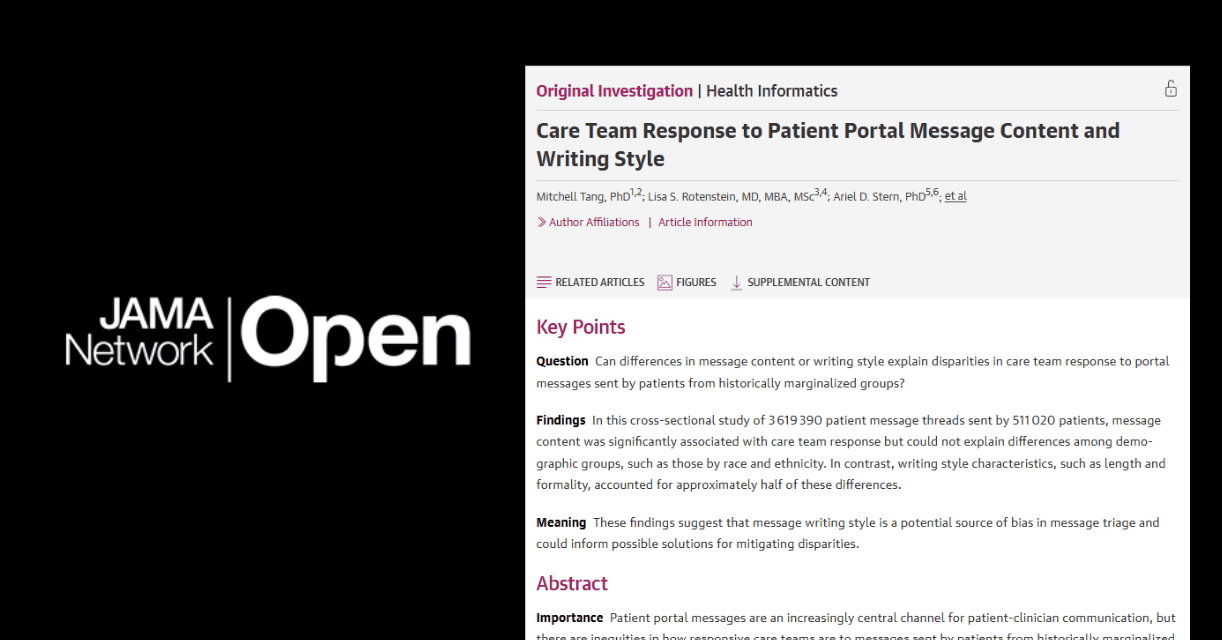
Most patients assume that a portal message sent to their doctor goes to their doctor, but a new study in JAMA Network Open suggests that how it’s written could decide whether it ever gets there.
Here’s the setup. Portal messages land in a shared pool where a triage nurse or medical assistant makes a snap call: handle it themselves, or forward it to the doc.
- Researchers analyzed 3.6M portal messages at Mass General Brigham, finding that just 32% got a reply from the clinician they were addressed to (77.5% heard back from anyone).
- Prior work from lead author Mitchell Tang showed that historically marginalized patients fare worse in that process, and the new data agrees: Black patients were 3.7 percentage points less likely than White patients to hear back from their own clinician.
It isn’t the advice patients ask for. The authors ran NLP across a million threads to separate message content from writing style, and content explained just 5.7% of the Black-White response gap.
It’s how they ask. Writing style – length, sentiment, punctuation, and especially the greeting – explained 48% of the Black-White gap, 34.9% of the Hispanic-White gap, 60.5% of the education gap, and 42.8% of the Medicaid-commercial gap.
- Messages opening with the clinician’s name (“Dear Dr. Tang”) got a response from that clinician 38.7% of the time versus 25.7% with no greeting, and Medicaid patients were far less likely to use one.
- Longer messages and expressive punctuation also outperformed, while messages containing “please” fared worse. Manners are apparently negotiable, but name-dropping is not.
Here’s the good news. The authors see style bias as far more fixable than demographic bias.
- Triage teams probably don’t know it exists, portal composers could help structure messages, patient-facing AI can assist with drafting, and AI triage could extract the clinical signal from the stylistic noise – as long as models trained on human triage don’t inherit the same habits.
The Takeaway
Triage teams are making split-second calls to tackle skyrocketing message volumes, so polish is getting mistaken for priority. Health systems now have a clearly labeled bias to design out of their in-baskets, but until they do, patients should probably brush up on their portal etiquette.