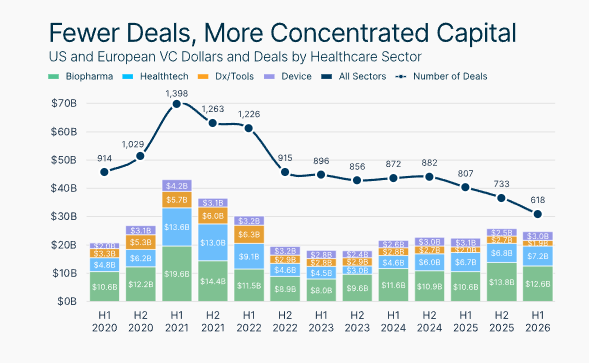
Silicon Valley Bank’s H1 2026 check-in showed bigger investments are going into fewer pockets as the AI power hour continues to motor a red-hot healthtech market.
The first half of 2026 told a familiar story. Checks are bigger than ever before, but it’s getting harder to cash them.
- One number is up: Healthtech’s $7.2B H1 set the sector up to outdo its 2025 funding ($13.5B).
- The other’s down: If H1’s 203 transactions are predictive of the latter part of the year, total deals could fall by nearly a third from 2025, down to a multi-year low.
- The top six transactions accounted for about 50% of H1 investment.
Funders resurrected “payviders” and skyrocketed late-stage rounds. Last year was rocky for AI-native insurers, but U.S.-focused Devoted and Paris-based Alan got back on track pretty quickly.
- Devoted reeled in a $366M Series F round, while Alan caught the biggest fish: a $554M Series G.
- Median series C+ pre-funding valuations more than doubled since last year, jumping from $3.81B to an almost-otherworldly $8.7B.
- Series A funding medians also grew 40% from last year, while the middle-of-the-road Series B round dropped 10%.
Growth happened because AI stayed in the driver’s seat. The top seven Series A funding rounds were brought in exclusively by AI-enabled technologies.
- SVB pinned healthtech’s success on agentic solutions tackling areas like streamlined revenue cycle management and data infrastructure.
- Measurement-based care is sticking around. Investors only had time for companies that showed their AI-based solutions provided real-world benefits to clinicians and patients.
Are you in… or are you being acquired?
- Exits accounted for a slim $682M so far in 2026, with Kaia Health’s exit being the only one with a return on investments (acquired by Sword for $285M).
- M&As are carrying their weight, though. The four H1 M&As put 2026 on pace for a five-year high.
Still, some funds are getting harder to come by. Venture capitalists are tightening their purse strings, as their portion of the investment total is expected to reach a decade low of $10B this year.
And for as good as healthtech is looking, biopharma was the boss (shoutout to our newest sibling, The Bio Wire), bringing in $12.6B.
The Takeaway
The future of investments continues to change as VCs grow quiet and fewer companies bring in bigger checks. Nevertheless, H1 2026 was good for healthtech, mainly because AI-powered companies have the numbers to back their impact.