Epic Dominates, But Don’t Discount Competitors

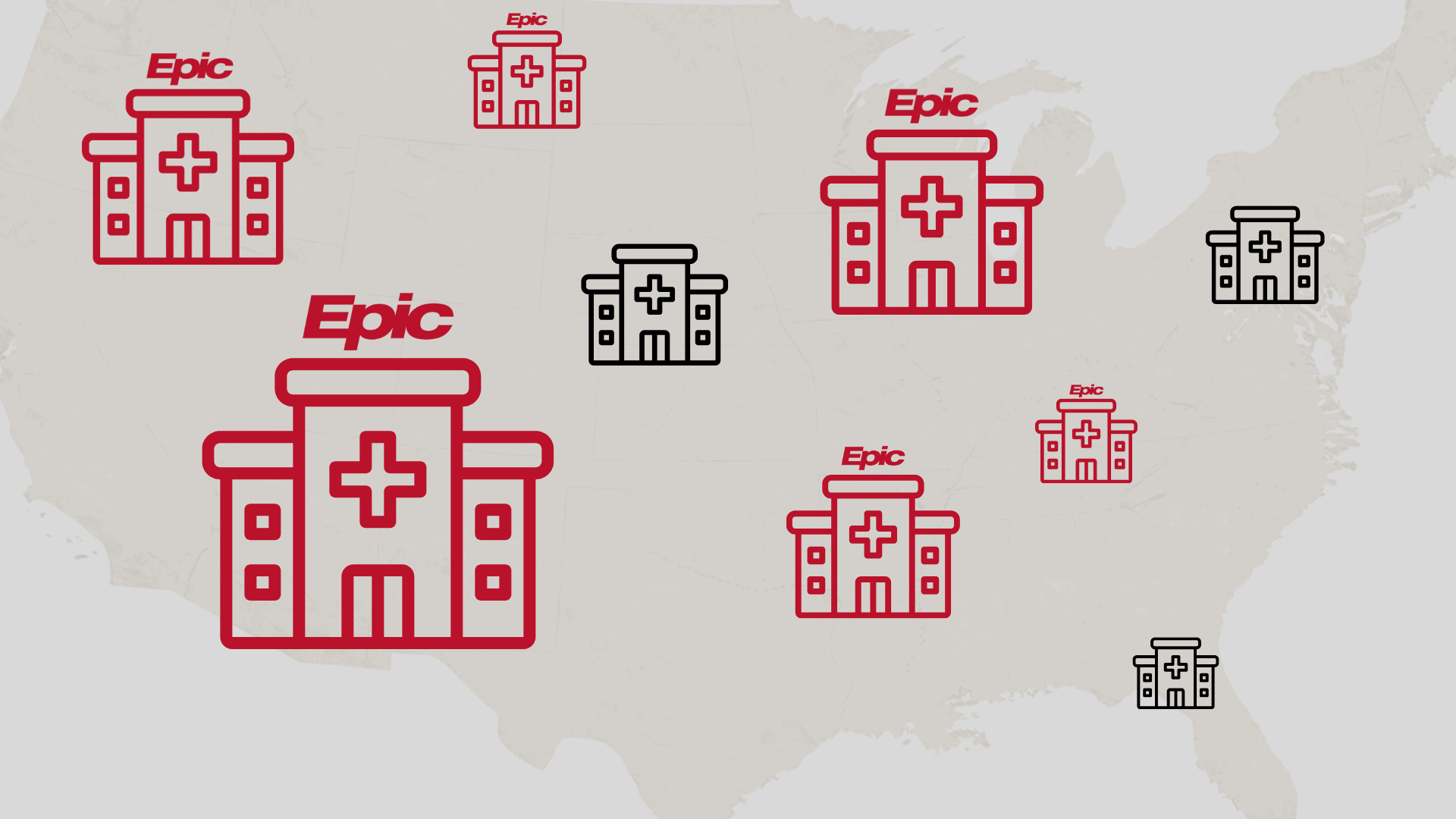
Epic’s empire has reached, well, epic proportions. The software goliath’s grip on health systems gets tighter by the day, but a new report from startup studio Redesign Health doesn’t count out David just yet. Pencils up, founders. 

Redesign Health talked to the big wigs. Here’s a quick look at the survey group. 

  • A total of 112 execs at U.S. health systems served by Epic gave their thoughts. 
  • Two-thirds get final say on clinical and administrative purchasing, and the rest hold at least some official sway in these decisions. 

Most seemed pretty content with Epic. The platform has a quality edge to some, though its sheer size looks to be influencing things. Blink twice and we’ll call Oracle.

  • A huge majority (71%) described their system as “Epic-first.”
  • 80% expect prioritization of Epic going forward vs. 6% for external solutions. 
  • Epic is winning because of easy integration (50%), superior capabilities (48%), being “good enough” vs. alternatives (48%), and cost effectiveness (47%).

There’s room for competition. Execs placed the likelihood of another vendor matching Epic in various arenas on a one-to-five scale, and were generally open to outsiders. 

  • The greatest opportunities lie in imaging (3.52), quality tracking (3.51), and discharge and transfers (3.51).
  • Epic is most entrenched when it comes to patient flow (3.16), interoperability and integration (3.21), and non-imaging clinical decision support (3.22). 

But if you come at the king, you best make sure your product rocks. To ditch Epic, decision-makers must be confident they’ll get major results, and fast. 

  • Nearly half (49%) said external vendors must show significantly higher ROI and/or better outcomes, while just 18% grade Epic and its competitors on the same scale. 
  • It tracks that 63% ranked easy integration as important, with faster time to value close behind at 59%.

The Takeaway

Redesign Health’s report on Epic could serve as a roadmap for other companies to score some victories in the battle for market share. Those looking for one simple trick that Epic doesn’t want you to know will be disappointed, though. The broad strokes lesson is to make a product so good it’s irresistible. 

2026 Healthcare Forecast Cloudy, But AI Rays Could Poke Through

Venrock’s 10th annual survey of healthcare insiders reveals they’re a pessimistic bunch lately, harboring cynicism about recent policy developments and the future of health tech IPOs, though views on AI were more of a mixed bag. Let’s break down the results. 

But first, a bit about the survey. More than 200 leaders from all corners of healthcare shared their thoughts with Venrock. Some areas were better represented than others.

  • Respondents skewed toward the private sector (28%), investing (20%), life sciences or pharma (16%), professional services (8%), and academia (7%). 

Venrock loaded up the questionnaire with AI inquiries. Big picture: Insiders are becoming more comfortable with the tech, but remain mindful of its downsides. 

  • Trust in AI grew for 73% and fell for 2% (unclear who hurt them). 
  • Just 9% view AI as the most overrated trend in healthcare.
  • HIPAA breaches (24%), harmful hallucinations (19%), and overspending on healthcare-specific platforms (28%) ranked highest among possible AI pitfalls. 
  • Most expect AI to create an costly arms race between payers and providers (63%) as each side rolls out bots specifically designed to argue with other bots.

Here’s another fun one: M&A targets. There’s no consensus on who will get snapped up next, but the industry seems confident it will be a big name in AI-powered services. 

  • OpenEvidence (21%), Komodo Health (18%), Abridge (14%), and Sword Health (11%) were the top answers out of 10 companies, but only after none of the above (46%).

So the hottest firms are going public? Nope — that’s one thing people can agree on. 

  • Only 3% think health tech IPOs will be back in style this year, with the rest split roughly down the middle between 2027 and 2028 or beyond. 
  • For those keeping score, 42% of last year’s respondents predicted a health tech firm would go public in the first half of 2026. Tumbleweeds…

In fairness, it’s hard to predict the future, especially with $1.15T in Medicaid cuts looming over everyone’s heads. 

  • Will they harm rural hospitals? Empty state coffers? Ruin MCOs? Strain blue-state safety net hospitals? Most checked all of the above (65%). 

The Takeaway

Some of the smartest folks in healthcare think we’re heading toward a world of payer-provider bot wars, sluggish health tech IPOs, and brutal fallout from Medicaid cuts. Here’s to hoping Venrock’s survey missed the mark. 

IntelePeer Sister Company Aqurio Enters the AI Agent Fray

Telecommunications company IntelePeer thinks it’s in the right place at the right time to capitalize on rising interest in agentic healthcare AI with the launch of sister company Aqurio. 

IntelePeer cut its teeth during the voice over internet protocol boom of the 2000s, eventually moving toward cloud-based communications services and now AI. 

  • As AI took up more of its focus, IntelePeer decided it was time for a new organization, leading to the creation of Aqurio. 

So what does IntelePeer know about healthcare? Quite a bit, since many of its automated customer service tools are used by providers and health plans. 

  • Through this experience, IntelePeer became keenly aware of the industry’s operational pain points, like billing backlogs and call center wait times. 

But why launch Aqurio now? IntelePeer was convinced by recent advancements in AI. 

  • Specifically, AI can now tackle end-to-end tasks in regulated environments, many of which once took large teams and lots of resources to coordinate. 
  • AI has also become cheaper, with inference costs falling over 95% since 2022. 
  • Wait any longer, and another firm might solve the problems Aqurio is after. 

Aqurio is rolling with three main products, but one platform. By keeping agents unified, the company aims to stop patients and revenue from falling through the cracks. 

  • For administrative tasks, SmartAgent answers calls, texts, and chat messages to support things like scheduling, insurance verification, and billing inquiries.
  • When it comes to outreach, SmartEngage sends collections and patient recall messages on the provider’s behalf. 
  • On the data front, SmartAnalytics combs customer service interactions for insight into KPIs, ROI, human agent performance, and behavior of the other two agents. 
  • As for clinical follow-up, SmartCare handles visit summaries, post-surgical assessment, and symptom flagging.

The agentic AI market may be crowded, with no shortage of well-funded companies, but Aqurio could hit the ground running by leveraging IntelePeer’s foundation. 

  • IntelePeer has logged more than 1B customer interactions. 
  • Aqurio’s platform has HIPAA, HITRUST, SOC 2 Type II, and other certifications out of the gate. 

The Takeaway

With the creation of Aqurio, IntelePeer is aggressively pushing into agentic healthcare AI without sacrificing its core telecommunications business. Time will tell if Aqurio can muscle out the competition, but IntelePeer’s more than 20-year history gives its sister company a massive leg up over three-guys-in-a-garage startups.

CMS Puts RPM in the Crosshairs

And the flag is out! or at least it’s being proposed!

Third-party remote patient monitoring vendors were caught offside in the proposed rule for the 2027 Medicare Physician Fee Schedule, which would bar reimbursement for RPM services unless they’re performed by clinical staff that’s directly employed by the practice doing the billing.

Drastic times call for drastic measures. CMS’s proposed change follows widespread concerns over skyrocketing costs for low-value services. Medicare started covering RPM in 2018, and payments ballooned to more than $500M by 2024.

  • An OIG watchdog report – also 2024 – showed that 43% of Medicare beneficiaries receiving RPM weren’t getting at least one of the three required components: devices, education/setup, and treatment management. 
  • It also pointed out that Medicare lacks basic information needed to properly bill for RPM, like who ordered the monitoring in the first place.

CMS means business. Although the OIG’s concerns seem like some pretty good levers to pull before taking the nuclear option, the latest estimates show that Medicare could recover over $4B from criminal cases filed in the last six months alone.

The proposed rule pins the problem on vendors:

  • Medicare would only reimburse RPM and RTM when they’re performed by clinical staff employed by the billing practice, not third-party companies (pretty much every RPM company we’ve ever covered).
  • The rule would also require a separate visit to kick off any remote monitoring episode, limiting the service to patients that have an established relationship with the billing practice.

That would effectively end RPM as we know it. CMS is proposing to throw the baby out with the bathwater, eliminating the bad actors at the expense of the good ones – and their patients.

The initial response was predictably… not great:

  • Brook.ai CEO Oren Nissim summed it up nicely. “We fully support CMS’s goal of ensuring remote care is driven by clinical need, integrated into physician-directed care, and delivered through close collaboration between physicians and integrated clinical teams. The challenge is strengthening oversight while preserving the collaborative care models that help providers expand access, extend clinical capacity, and deliver high-quality longitudinal care at scale.”
  • Cadence CEO Chris Altech shared a similar sentiment. “The challenge is that the proposal doesn’t distinguish at all between low quality RPM and clinically integrated programs… The result of the current rule in its current form will be more untreated chronic disease, higher downstream costs for Medicare.

The Takeaway

There’s a ton of fraud in Medicare. There’s even more waste. Does that mean burning RPM to the ground is the best solution? You can let CMS know what you think until September 16th.

Bunkerhill Lands Series B to Turn Ideas Into Action

Bunkerhill Health might take its name from a short-lived medical drama, but all signs point to it sticking around for the long haul after landing $25M of Series B funding from a stacked investor roster led by Khosla Ventures.

Bunkerhill isn’t going after one workflow at a time. Its Carebricks platform lets health systems transform their ideas into AI agents that work across any clinical or operational use case – turning the data that hospitals already generate into action for the patients who need it.

  • That includes everything from automating administrative work and navigating prior auths to reviewing cardiac imaging for early signs of heart disease.
  • The value prop propelled Bunkerhill’s revenue over 20x just last year, which no doubt helped attract big names like Sequoia, Optum Ventures, and Y Combinator to the round.

The pitch flips the usual script. Instead of a vendor showing up with a fixed solution, health systems bring the clinical judgment and the problems that need solving.

  • Carebricks brings the execution, running the work as AI agents that reason across disparate data sources, take real action, and grow more capable as they work together.

The proof is in the customer pudding. Carebricks is live at over 15 health systems, including some familiar faces like Cleveland Clinic, Mayo Clinic, Intermountain Health, and the University of Texas Medical Branch.

UTMB alone has 20+ agents in production across the organization:

  • In its first month, a coronary calcium detection agent flagged a patient at imminent risk of a heart attack, leading to a life-saving triple bypass.
  • A nephrology triage agent cut specialist wait times by more than 50% by escalating urgent cases and routing others to telemedicine.
  • A lung nodule agent addressed urgent incidental findings 80% faster and doubled guideline-concordant follow-ups.

Vinod Khosla summed it up well: the bottleneck in healthcare AI was never the technology, it was getting health systems to actually run it.

  • Bunkerhill will use the new capital to expand Carebricks to new partners, while also expanding the platform’s capabilities so existing partners have even more ways to actually run it. 

The Takeaway

Healthcare has plenty of good ideas. It even has a couple that eventually end up improving care. Bunkerhill is making sure fewer good ideas get lost along the way, and it just raised $25M to fine-tune its compass.

Rock Health H1 2026: Durable Roots, Shifting Routes

Rock Health just dropped its H1 digital health funding overview, and the halftime report shows a market that knows where it’s going, even if the way it gets there keeps changing.

Here’s H1 2026 by the numbers:

  • Digital health startups raised $7.4B across 244 rounds (up $1B from H1 2025).
  • Median round size climbed from $12M to $14M, the highest since 2022.
  • 19 companies raised 20 mega-rounds, accounting for 45% of all capital invested.

That last stat is starting to look familiar. Capital concentration was the headline of the Q1 report, and the trend hasn’t let up. 

  • Just over 8% of rounds absorbed nearly half the capital, and some companies aren’t even waiting a full year between nine-figure checks.
  • Garner Health’s $100M Series E landed three months after its Series D, and Aidoc grabbed its second $150M in under a year.

Mental health is still the belle of the ball. It was the top-funded clinical indication for the seventh straight year, led by Talkiatry ($210M) and Grow Therapy ($150M).

  • Weight management took the silver on the back of the insatiable appetite for GLP-1s.
  • Both categories share a secret weapon: 64% of their H1 raisers go direct-to-consumer, versus 29% of digital health overall.

The IPO drought is creeping back. After seven exits last year, 2026 hasn’t produced a single digital health IPO, and Oura’s S-1 is the only one on file.

  • This year’s exit action is all M&A. H1 saw 115 acquisitions, including 71 in Q2 alone (the busiest quarter since 2021), with revenue cycle management consolidating fastest.

Where are all the moats? The H1 report’s big question was what actually counts as a durable advantage now that “we have AI” no longer moves the needle.

Rock Health landed on four answers and one graphic

  • founders with real domain expertise (sharpens product and buyer relationships)
  • platforms scaling to own more workflows (and more context to coordinate tasks)
  • hands-on delivery (forward-deployed engineers are officially a healthcare job)
  • network effects (every new partnership builds on the last so competitors can’t catch up)

The Takeaway

AI made digital health products easier to build than ever, which means the products themselves are no longer the moat. Investors are looking for the same fundamental roots – teams, trust, and traction – but the routes to find them are shifting faster than ever.

Pearl Health Closes $110M for Value-Based Medicare

The value-based care enablement segment just saw one of its biggest raises of the year after Pearl Health locked in $110M of financing, split between a $50M equity round and a $60M credit facility.

Pearl was founded on a simple belief. “Healthcare should reward keeping people healthy, not just treating them when they are sick.” Pearl AI is what makes that possible.

  • The platform helps PCPs manage risk and deliver better care to Medicare patients by translating clinical data into measurable outcomes.
  • That means leveraging AI to help manage and predict risk, orchestrate workflows, and automate action before issues become costly emergencies.
  • Over 10k providers caring for 250k+ Medicare beneficiaries are already live on the platform, including health systems like University of Vermont Health and MDX Hawaii.

VBC enablement has some strong tailwinds. As CMS continues pushing reimbursement toward outcomes rather than utilization, it’s creating stronger incentives for providers to prevent avoidable illness and manage patient populations. Investors are following the dollar signs.

  • Honest Health landed $140M back in February to scale programs supporting the same Medicare population as Pearl, and Chamber Cardio picked up $60M to take the specialty-specific route with cardiologists.

Pearl plans to separate from the pack with AI and outcomes. The fresh funds are going straight to the AI roadmap, including Performance Intelligence, a natural language interface that gives population health teams real-time insights on cost, quality, and utilization.

  • The raise will also help expand Pearl’s Care Orchestration AI agents, which automate annual wellness visit scheduling, post-discharge follow-ups, and care management outreach.
  • Beyond the platform, the raise will fuel Pearl’s expansion into Medicare Advantage and new risk offerings beyond Traditional Medicare.

Preventive care shouldn’t break the bank. Pearl hit a rare milestone in both the risk-enablement arena and the wider digital health universe by reaching profitability in 2025.

  • Rarer still, it pulled it off without taking its foot off the gas. Pearl now manages $3.6B in annualized medical spend (up from $2.4B), and is on track to triple its patient base from 2024 by the end of the year.

The Takeaway

With over 70M Medicare beneficiaries and costs exceeding $1T annually, Pearl is equipping providers with the picks and shovels needed to make the VBC transition – and some smart folks (or at least some folks with $110M laying around) think these docs can strike gold.

Behavioral Health Moves From Access to Accountability

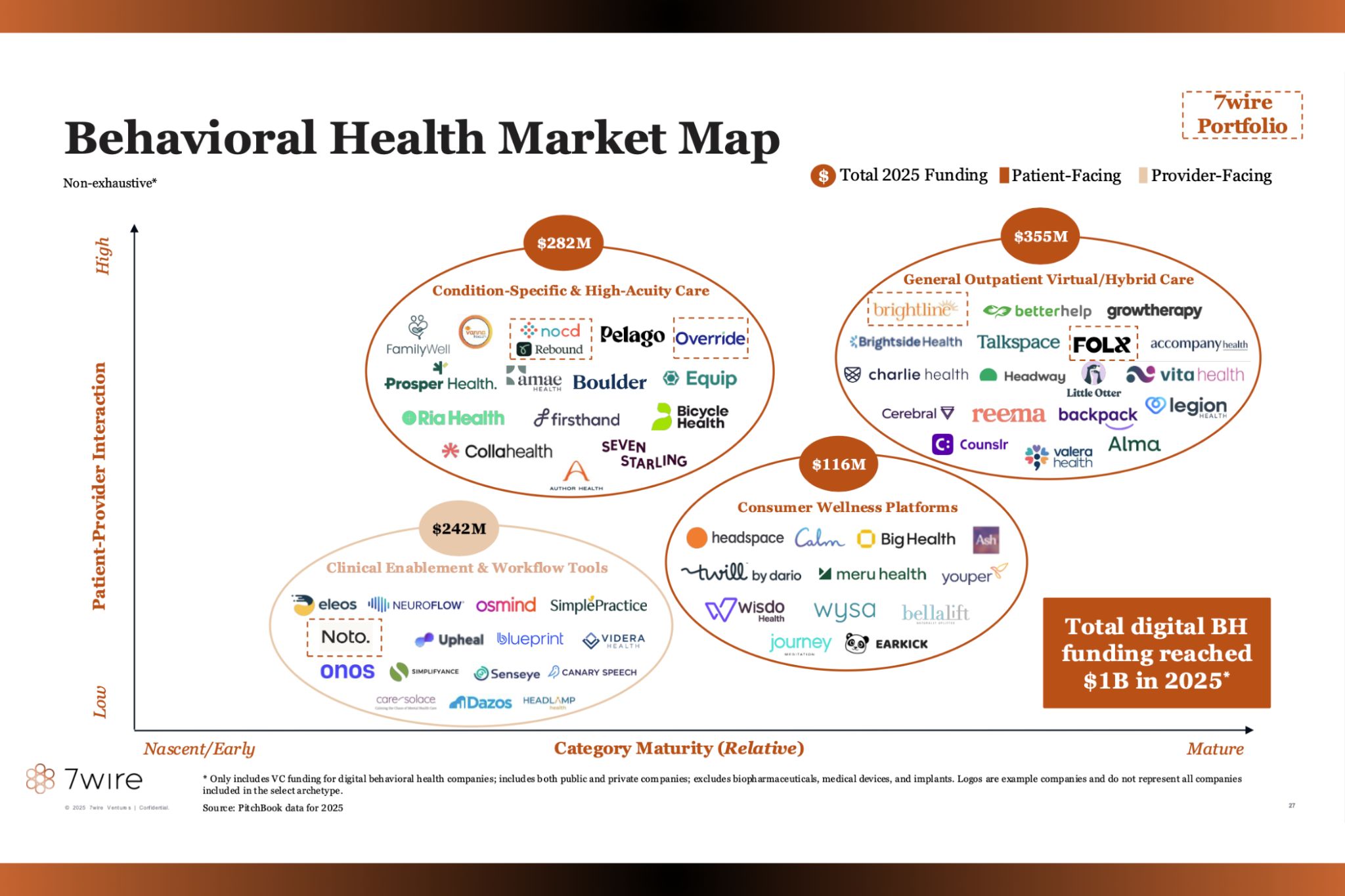
The pandemic-era land grab in digital behavioral health is behind us, and a beautiful report from 7wire Ventures makes the case that the next chapter will be written by the platforms that can prove people actually get better.

Access was just the start of the story. Hundreds of behavioral health companies launched on the premise that technology could improve access at scale, and the capital followed. Digital mental health raised $4.9B in 2021 alone.

  • Despite the investment surge, the access problem is still very real. Nearly 1 in 4 U.S. adults experienced a mental health condition in 2024, yet almost half received no treatment.
  • The problem is that utilization growth outpaced meaningful clinical outcomes, and population-level ROI remained tough to verify.

The market is adjusting accordingly. Payors and self-insured employers are now conditioning contracts on measurement-based care – PHQ-9s, functional improvement data, and documented reductions in downstream medical costs – while commercial models shift from PMPM setups toward case rates and performance guarantees.

  • First-generation platforms that scaled enrollment without outcomes infrastructure are struggling to keep pace, and behavioral health M&A jumped 42% in 2025 as a result.
  • Recent tie-ups like Spring Health and Alma plus UHS’ $835M acquisition of Talkspace suggest the fragmented point-solution era is winding down in favor of integrated platforms.

AI is the primary lever. The provider shortage isn’t budging (HRSA projects a 43k psychiatrist shortfall by 2038), so the most scalable near-term play is technology that extends existing clinicians rather than trying to bypass them.

  • The report draws a sharp line between supervised AI (where a licensed clinician stays accountable for diagnosis and escalation) and autonomous agents, with the supervised camp winning payor confidence and reimbursement traction.

One prediction worth flagging: 7wire expects outcomes data to become the primary basis for payor and employer contract decisions, turning measurement-based care from a differentiator into table stakes that determines who even makes the RFP shortlist.

The Takeaway

Behavioral health went from digital health’s most funded clinical indication to a market where enrollment numbers no longer impress anyone. Access got the industry to the starting line, but the platforms that survive the accountability era will be the ones that can show their work – to payors, to employers, and ideally to patients.

New Model Predicts 900 Diseases From Real Records

Last week brought a potentially significant step forward for early diagnosis in the form of a new AI model that can predict a patient’s next diagnosis across nearly 900 diseases using just real-world medical records.

Meet DT-Transformer. Researchers at Harvard, Brigham and Women’s, and the Broad Institute unveiled the GPT-style foundation model in a new arXiv preprint.

  • DT-Transformer reads a patient’s medical history as a sequence and predicts which disease will show up next, and when it might come knocking.

The real headline is the training set. DT-Transformer was trained on 57.1M structured EHR entries from 1.7M patients across MGB’s 11 hospitals and 200 clinics (2000 to 2024) – the messy reality of U.S. clinical care rather than a polished research data set.

The numbers were impressive. A few standouts:

  • DT-Transformer achieved a median AUC of 0.871 across 896 disease categories, with AUC over 0.5 for every condition.
  • The model crushed an age- and sex-based baseline by +0.214 AUC (0.871 vs. 0.657), beating it on 96% of diseases.
  • All of that was accomplished with a featherweight 2.2M parameter model that’s small enough to run just about anywhere (by comparison, Claude Fable 5 has about 6 trillion parameters).

The real test told a humbler story. When the team ran a true prospective test forecasting new diagnoses DT-Transformer had never seen, median AUC slipped to 0.713.

  • That still beats the baseline on 80% of diseases, but that gap between the retrospective flex and the prospective reality is fairly significant.  
  • A 0.871 headline number and a 0.713 crystal ball aren’t the same product, and the second one is the one that patients would actually have to deal with.

One other highlight worth mentioning: including every repeated diagnosis worsened model performance, “drowning out the signal” rather than improving predictions – another reminder that more data isn’t always better. Better data is.

The Takeaway

Population-scale risk forecasting that runs on a model smaller than most phone apps is a real milestone, and training on routine records instead of a spotless biobank is exactly the kind of thing that could get models like DT-Transformer in front of actual patients – assuming the data holds up to peer-review.

UpDoc Lands First FDA Clearance for Patient-Facing AI 

UpDoc just landed the first FDA clearance for a patient-facing AI model, which acts as a “concierge doctor” to support patients between visits. Good news for the human docs reading this – it isn’t going after your job just yet.

What’s UpDoc? It’s a clinical AI platform that unifies clinical guidelines, longitudinal patient context, and physician governance to safely execute real-world care workflows.

What isn’t UpDoc? An AI doctor.

  • The 510(k) clearance had a narrow scope. It allows the AI to call or message patients between visits and adjust their insulin doses within parameters set by human clinicians.
  • UpDoc says its AI will ease doctors’ workloads and help patients better manage illnesses like Type 2 diabetes. 

The data backs that up. A study in JAMA Network Open saw 32 patients with T2D randomized to receive support from UpDoc (daily voice AI check-ins to record blood glucose and adjust insulin) or standard care (AKA log their own data until they see their doctor in person).

  • The AI group hit their target blood glucose in 15 days, compared to the standard care group where less than half got there at all within the 8 week study period.
  • That trial provided the clinical foundation for the now-cleared solution, which is set to be piloted at Cleveland Clinic, UCSF Health, and Allegheny Health Network.

UpDoc is taking the road less traveled. It’s not the only AI startup in this wheelhouse, but so far it’s one of the only ones that doesn’t seem to be actively avoiding FDA regulation. 

  • The most notable example is Doctronic, which has been testing its AI prescription tech through a state-run program in Utah rather than seeking a full-fledged authorization.
  • That’s an easier path to market than vaulting over FDA hurdles, but it doesn’t get you the “world first” feather in your cap that now belongs to UpDoc.

So, now what? The FDA has long debated how to regulate AI, and UpDoc could be the first sign that they’re getting comfortable enough with the tech to give the green light to more models.

  • With the first clearance out of the way, other AI developers also have an established precedent and a blueprint to follow suit.

Don’t forget about the docs. Besides the regulatory shakeout, it’ll be equally interesting to see how this new breed of AI ends up in the hands of clinicians.

  • We saw OpenEvidence fold a new biomarker for heart disease into its platform just last week, and the most direct path to a wide distribution for many soon-to-be-cleared AI tools could be similar licensing partnerships.
  • Plenty of companies already have a massive user base and are actively expanding the clinical scope of their platforms – Abridge, OE, Doximity, the list goes on for a while. It feels like licensing models from the UpDocs of the world is a natural next step after all the journal partnerships we’ve been seeing now that FDA clearance is part of the picture.

The Takeaway

The FDA finally cleared its first patient-facing clinical AI model, and UpDoc might have been the first domino, but it definitely won’t be the last.

Get the top digital health stories right in your inbox