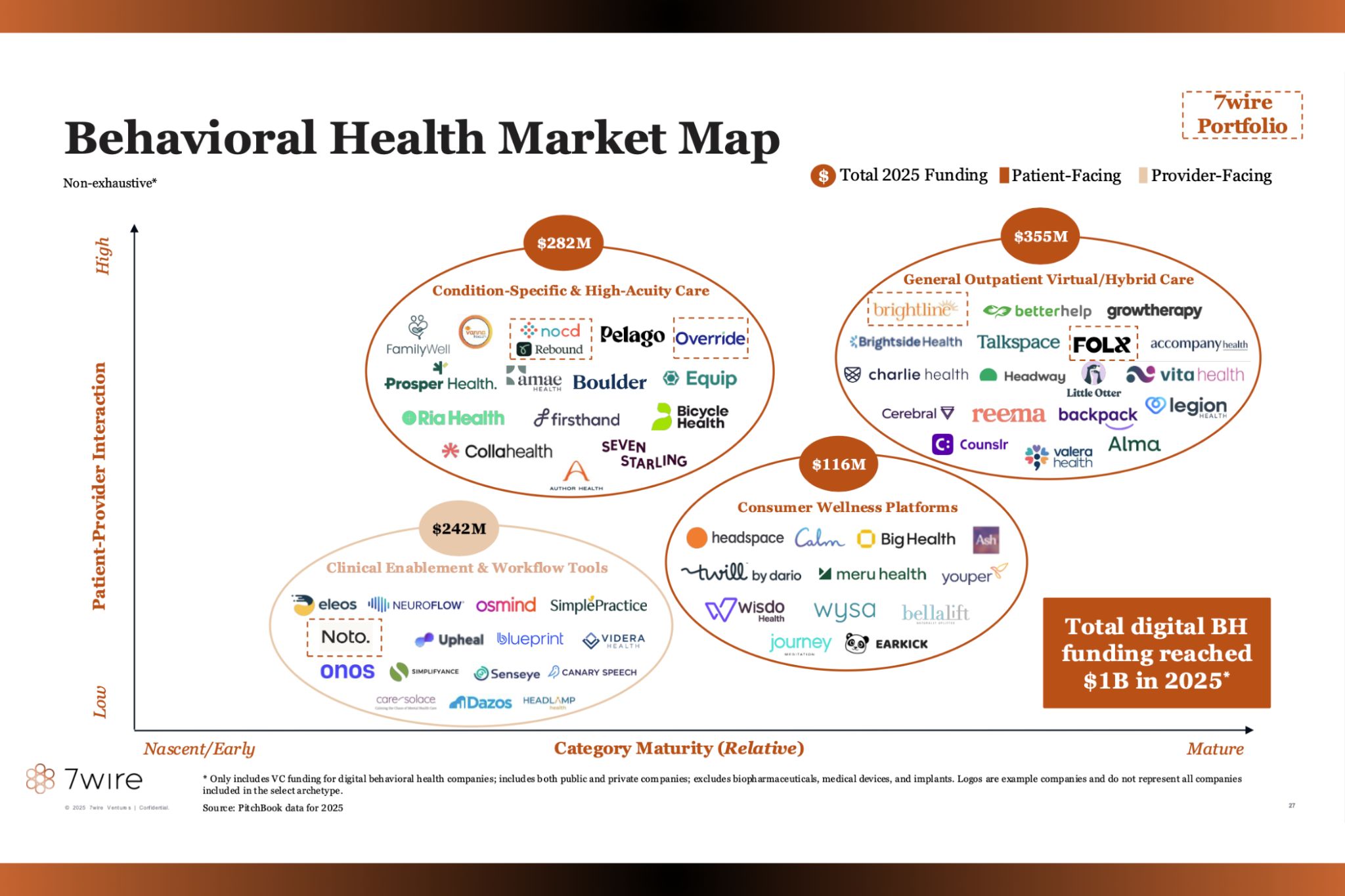
The pandemic-era land grab in digital behavioral health is behind us, and a beautiful report from 7wire Ventures makes the case that the next chapter will be written by the platforms that can prove people actually get better.
Access was just the start of the story. Hundreds of behavioral health companies launched on the premise that technology could improve access at scale, and the capital followed. Digital mental health raised $4.9B in 2021 alone.
- Despite the investment surge, the access problem is still very real. Nearly 1 in 4 U.S. adults experienced a mental health condition in 2024, yet almost half received no treatment.
- The problem is that utilization growth outpaced meaningful clinical outcomes, and population-level ROI remained tough to verify.
The market is adjusting accordingly. Payors and self-insured employers are now conditioning contracts on measurement-based care – PHQ-9s, functional improvement data, and documented reductions in downstream medical costs – while commercial models shift from PMPM setups toward case rates and performance guarantees.
- First-generation platforms that scaled enrollment without outcomes infrastructure are struggling to keep pace, and behavioral health M&A jumped 42% in 2025 as a result.
- Recent tie-ups like Spring Health and Alma plus UHS’ $835M acquisition of Talkspace suggest the fragmented point-solution era is winding down in favor of integrated platforms.
AI is the primary lever. The provider shortage isn’t budging (HRSA projects a 43k psychiatrist shortfall by 2038), so the most scalable near-term play is technology that extends existing clinicians rather than trying to bypass them.
- The report draws a sharp line between supervised AI (where a licensed clinician stays accountable for diagnosis and escalation) and autonomous agents, with the supervised camp winning payor confidence and reimbursement traction.
One prediction worth flagging: 7wire expects outcomes data to become the primary basis for payor and employer contract decisions, turning measurement-based care from a differentiator into table stakes that determines who even makes the RFP shortlist.
The Takeaway
Behavioral health went from digital health’s most funded clinical indication to a market where enrollment numbers no longer impress anyone. Access got the industry to the starting line, but the platforms that survive the accountability era will be the ones that can show their work – to payors, to employers, and ideally to patients.