Assort Closes $120M to Scale Voice AI Across Healthcare

If you needed any more proof that communication friction is one of the biggest pain points for patients and providers, look no further than Assort Health’s just-closed $120M Series C – its third funding round in 18 months.

Assort started with a simple thesis. Unlock the front door of healthcare, and the rest will follow. Assort originally aimed its voice AI agents at scheduling because it meant solving for two key ingredients needed to solve everything else downstream: 

  • The care protocols required to handle that first interaction.
  • The patient communication data that flows into the rest of the journey.

The first call is an important moment. Mistakes here mean the patient never comes back, and Assort’s edge in preventing that is its Synapse agentic model.

  • Synapse learns specialty workflows across every deployment, then simulates the edge cases to stress test them before any agents go live.
  • That allows even non-technical teams to safely implement Assort’s agents at scale, which fuels an AI development flywheel that’s already learning from 190M patient interactions, 62M care protocols, and 1.6M decision pathways.

Assort covers the entire patient journey. What began as the first voice AI agent to schedule a specialty appointment has grown into a full-fledged voice AI platform that includes:

  • Concierge – handles inbound calls, triage, lab requests, med refills, scheduling, eligibility checks, and intake.
  • Activate – reaches patients proactively to close referral loops and act on care gaps, recover no-shows, and resolve payments.
  • Orchestrate – runs the operational work behind each visit and writes every detail back to the EHR.
  • Empower – equips staff with an AI copilot to manage complex patient access needs in real time.

Patient Journey Memory ties it all together. The capability is built on three pillars.

  • Each patient gets a personal AI agent that knows their context and preferences so they don’t have to keep repeating the same story every time they interact with their provider.
  • The agents share the same data and talk to each other, so care gaps surface wherever the patient happens to engage.
  • Having a continuous journey across every interactions allows the platform to activate patients when they’re high intent.

Next stop: everywhere. Every new tech generation sees a flood of new solutions, then only a few survive. Voice AI is about to hit that same shakeout, and Assort plans on sticking around.

  • The funding was earmarked for bringing on veteran C-levels to make that happen, and expanding into health systems ranging from community-based organizations to the biggest academic medical centers in the country.
  • Major systems like John Muir Health are already signed on as demand grows for platforms that can support increasingly complex ambulatory operations – the exact kind Assort is uniquely tuned to solve.

The Takeaway

Assort is looking to become the voice AI transformation partner for every healthcare provider in the country, and if its funding tempo is any indication, it’s moving with enough urgency to actually pull it off.

Cadence Lands $100M to Scale Chronic Care

One of the hottest names in chronic care just got nine-figures hotter after Cadence hauled in $100M of Series C funding to scale up with AI agents.

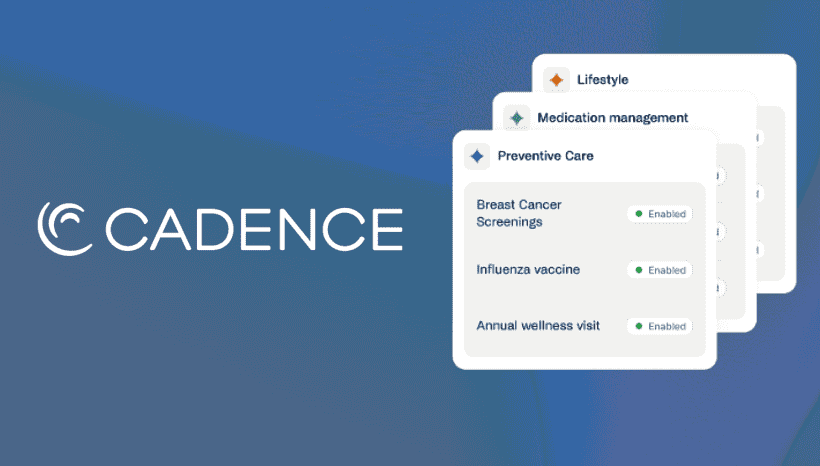
Welcome to the unicorn club. The round vaulted Cadence’s valuation to $1.2B as it looks to extend the reach of its Clinical Intelligence platform to more patients managing chronic conditions like hypertension, diabetes, and heart failure.

  • The platform is purpose-built to deliver continuous support between visits, with regular vital monitoring and AI agents that translate the data into timely medication adjustments and personalized lifestyle coaching. 
  • Cadence integrates directly with its partners’ EHRs and clinical workflows, then equips every patient with connected devices that allow its system – supervised by physicians – to flag high-risk patients and predict adverse events before they happen.

Cadence lets its numbers do the talking. It’s easy to see why.

  • 70% relative improvement in blood pressure control (JACC).
  • 27% fewer hospital admissions (Mayo Clinic Proceedings).
  • 230% increase in heart failure patients on GDMT (JCF).
  • $1,300 annual cost reduction per patient (Circulation).

Now it’s time to scale. Cadence is already treating 100k patients, and this investment will support the infrastructure “to treat millions.”

  • The current partner roster includes over 20 major health systems, including new additions like Texas Health Resources and Duke Health, which liked working with Cadence so much that it participated in the round.
  • The word on the street is annualized revenue is pacing $140M for FY 2026, more than double the $62M it brought in last year.

Last but not least. Scaling from thousands of patients to millions of patients is no small task, and Cadence is working on deploying new AI agents to help carry the load.

  • A new prescription hypertension management agent is reportedly en route, which “pre-authorizes” medication recommendations to steer patients toward their blood pressure goals, with new prescriptions and dose changes made autonomously by the AI.
  • That falls squarely in medical device territory, and Cadence is actively working with regulators to bring it to patients – including an application to the FDA’s TEMPO pilot that will let certain devices for chronic care on the market before they’re officially approved.

The Takeaway

Chronic disease is the single largest driver of healthcare spending in America, and a significant amount of that cost is avoidable. Cadence is building the tools to avoid it, and another $100M should only help the cause.

New Studies Show AI Outperforms Physicians, Just Not at Medicine

In case last week’s AI drama wasn’t hot enough, a pair of new studies in Nature cranked up the heat by finding that AI agents beat physicians on ER and care management tasks – just not real ones.

“Towards autonomous medical artificial intelligence agents.” The first study took a look at MIRA, an AI agent developed in Germany that operates inside a sandboxed EHR environment.

  • Using 574 real emergency department cases, researchers had MIRA chat with another patient agent and execute entire care workflows, such as investigating diagnoses, ordering labs, and triaging for hospital admission. 

The headline: MIRA significantly outperformed four board-certified physicians. The agent had higher overall diagnostic accuracy (87.8% vs. 78.1%), was better at ordering correct procedures like laparoscopic appendectomy (53.5% vs 38.3%), and had 35% better guideline alignment.

The reality: ER doc Graham Walker, MD, put it perfectly on LinkedIn: “There is no way in hell that humans mismanaged almost 30% of appendicitis cases, the most common ‘surgical emergency’ that we’ve all seen hundreds of in our career.”

  • It turns out the EHR sandbox needed 21 keystrokes to get this right, and the physicians failed unless they explicitly searched and entered a “laparoscopic appendectomy.” AI is built for that, humans not so much.

“Towards conversational AI for disease management.” The second study explored whether Google’s AMIE agent could expand from pure diagnostics to longitudinal care management.

  • The blinded study pitted AMIE against 21 primary care physicians on 100 multi-visit cases, with the agent pulling live guidelines and drug references to produce structured management plans.

The headline: AMIE’s care plans were better than PCPs across the board. The agent notched higher marks on management reasoning, precision of investigations, and guideline alignment.

The reality: AMIE operated in a world without prior auths, without formulary restrictions, and without social needs that patients didn’t want to bring up. The authors didn’t pretend otherwise.

The Takeaway

This might sound familiar, but these studies show that MIRA and AMIE performed well in ideal scenarios, not in the messy trenches of real-world medicine. That said, the results aren’t important because AI beat a benchmark, they’re important because AI took another big step toward “delivering actions” instead of just “delivering answers.”

Easing the Data Burden in Diabetes Care

By Mark Clements, M.D., Ph.D. and Trisha Martinez , RN, BSN, MBA, Glooko

Health systems are not short on diabetes data. They are short on the time, workflows, and signal clarity needed to act on it.

That distinction matters. Continuous glucose monitoring (CGM), connected devices, remote uploads, insulin delivery data, and inpatient glucose trends are generating more information than ever before.

In Glooko’s latest Annual Diabetes Report, more than 60 billion CGM readings flowed through the platform in 2025, supported by more than 1 million active patients, 30,500 clinicians, 9,000 clinics, and a global footprint across 1,082 geographic locations.

  • The scale is no longer the story, but what health systems do with that scale is.

For leaders focused on digital transformation, the opportunity is to shift diabetes management from retrospective review to prioritized action.

  • Traditional measures such as Time in Range (TIR), Glucose Management Indicator (GMI), Time Below Range (TBR), and Time Above Range (TAR) remain essential, but they can obscure when risk occurs, how severe it is, and which patients need attention first.
  • Two patients may look similar by familiar metrics, yet one may face recurring overnight lows while another carries persistent daytime hyperglycemia.

The report’s overnight hypoglycemia analysis illustrates why this matters. Glooko’s model surfaced patients who appeared near target by common measures but had substantially higher overnight hypoglycemia exposure.

  • In validation across 586,549 patient weeks, the highest-risk group showed a 2.79x lift in identifying observed overnight hypoglycemia compared with baseline selection.
  • This is where digital transformation becomes clinical transformation: turning connected data into prioritized lists, cohort-level visibility, and workflows that help teams intervene between visits.

The same safety lens extends into the hospital. EndoTool provides an inpatient view of glycemic management, supporting individualized insulin dosing during complex episodes such as Diabetic Ketoacidosis (DKA) and Hyperosmolar Hyperglycemic State (HHS), renal impairment, steroid exposure, and changing nutrition status.

The Takeaway

The next chapter of diabetes care will not be defined by more dashboards. It will be defined by connected intelligence that helps health systems identify risk earlier, focus clinical attention, reduce cognitive burden, and support safer decisions across the hospital, clinic, and home.

Learn how Glooko is partnering with organizations like yours to transform diabetes care.

General-Purpose LLMs Outperform Healthcare-Specific Models

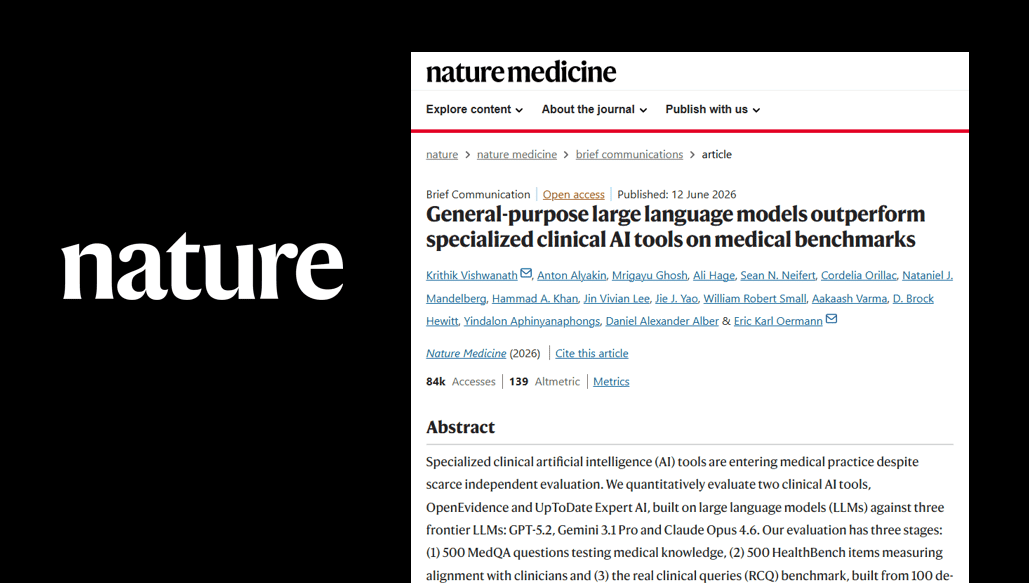
We might have just gotten our spiciest study of the year after new findings in Nature Medicine showed that general-purpose LLMs outperform specialized healthcare models straight out of the box.

It was a battle of the bots. Researchers pitted OpenEvidence and UpToDate Expert AI against three frontier models that anyone with a web browser can pull up in two seconds: GPT-5.2, Gemini 3.1 Pro, and Claude Opus 4.6.

The models were tested across three domains:

  • medical knowledge (MedQA)
  • expert clinician alignment (HealthBench)
  • 100 real physician queries (RCQ) scored by 12 blinded clinicians  

It was a clean sweep. The general-purpose LLMs outperformed the specialized models on all three evals, and by a healthy margin. This chart gets the point across.

  • On MedQA, Gemini led the pack with 97.4% accuracy (vs. 89.6% for OE and 88.4% for UTD). Fun fact, the frontier models had a huge advantage here since their training data included these exact questions (and answers).
  • On HealthBench, GPT-5.2 dominated with an 88%. It’s almost like OpenAI invented the benchmark.
  • The RCQs were probably the most clinically meaningful component, and all three frontier models took the podium here as well. It was a bit odd that the researchers didn’t share the specific questions, and OE definitely thought so too.

OpenEvidence hit back hard and fast. It went straight to its socials to let the world know that the study was not only poorly designed and biased, but that the authors had reached out for API access to help build a competing product. Request denied.

  • OE also pointing out the training data contamination issue with MedQA, and critiqued HealthBench for scoring responses based on subjective stylistic choices (in one example OE scored 20% “worse” because it didn’t use a specific email header).
  • The cherry on top was OE revealing that the real-world clinician queries were only added after peer reviewers flagged the study for having weak evidence. Big if true.

Obligatory disclaimer: the models were evaluated back in February, and the performance gap could easily be even wider today. 

The Takeaway

OpenEvidence and UpToDate didn’t become successful by being better AI developers than OpenAI and Anthropic. They did it by doing the things that don’t show up in benchmarks – curating sources of verifiable evidence, wrapping them in an interface that docs actually enjoy using, and earning their trust one question at a time. If anything, this study confirmed that those matter now more than ever.

Abridge Unveils New Platform, Teams Up With Lilly and Nvidia

Patients, platforms, Lilly, and Nvidia. Abridge’s first keynote had it all.

There were enough major announcements to fill an entire issue of DHW, so here’s the abridged version of the top stories to come out of NYC.

The new platform stole the show. Abridge unveiled “the first AI-native clinician intelligence platform” organized around patients, built for clinicians, and designed to help health systems.

  • Before the visit: The platform surfaces care gaps and relevant clinical context so clinicians can address what matters during the visit instead of discovering it in retrospective chart reviews.
  • During the visit: Abridge suggests discussion topics while delivering evidence-based answers to clinical questions from a growing content library that includes new specialty-focused partners like AAFP, AAN, ADA, and ASCO.
  • After the visit: Abridge generates documentation, flowsheets, patient summaries, orders, and billing codes (soon to be fine-tuned through a new partnership with AHIMA).

“The base unit of healthcare is a clinician caring for a patient.” As Abridge pushes into new models of care delivery, its platform will provide the connective tissue between the clinical workflows where care actually gets delivered and outside orgs like payers or life sciences firms.

  • The keynote highlighted some key examples: Cigna was on stage discussing how embedding AI in clinical workflows has the potential to unlock real-time claims adjudication, and Aetna shared how it could help realize the promise of VBC.
  • More than 300 health systems are already live, including a just-announced rollout at Northwestern Medicine.

Eli Lilly is buying into the vision. The pharma giant made a strategic investment in Abridge’s next chapter, and even though the keynote was light on details, the move started to add up after seeing one of the new capabilities coming to the platform: clinical trial screening.

  • By comparing clinical guidance with patient-provider conversations in real-time, Abridge can surface relevant trials directly in the encounter – the moment it matters most. 
  • They didn’t mention a check size, but big opportunities attract big investments, and identifying candidates while initiating screening at the point of care sounds huge.

Last, but certainly not least, Nvidia. Abridge is teaming up with Nvidia to develop a first-of-its-kind foundation model for clinical conversations that’s trained, shaped, and evaluated against real-world conditions.

  • We’ll have to wait until later this year to see it in action, but a little pre-, mid-, and post-training magic with Abridge’s de-identified clinical data will apparently help make it the first model that can “reason clinically from its foundation.”

The Takeaway

If the keynote made one thing crystal clear, it’s that Abridge’s platform doesn’t revolve around AI documentation. It revolves around patients, and every new feature is purpose-built to prove it.

Patients Want AI, So Long As There’s No Copay 

New research in npj Digital Medicine suggests that patients might be warming up to medical AI, at least if it’s less expensive than seeing an actual doctor.  

Here’s the setup. Johns Hopkins researchers recruited 248 U.S. adults with type 1 diabetes, then presented them with scenarios where they were due for an annual diabetic eye screening.

  • Diabetic retinopathy is the leading cause of blindness among working-age adults, and autonomous AI tools that can diagnose the disease from retinal images are already cleared by the FDA and in clinical use.
  • In each scenario, one of these autonomous AI tools was made available as an alternative to a specialist referral.

The catch was the copay. Participants were randomized to have the AI offered with either a $50 copay, or with the copay waived by their insurer or the AI developer.

Fifty bucks is fifty bucks. More than 80% of participants opted for the AI tool when the copay was waived, compared to 43% who chose AI when the copay wasn’t waived.

  • Not only did more participants opt for the AI screening when there was no copay, but participants also perceived the AI as more effective.
  • It didn’t matter whether the copay was waived by the AI developer or their insurer.

There was one major caveat. Patients who chose AI over a traditional screening with a human specialist were far more likely to seek reconfirmation from their doctor after getting the results.

  • The AI group was nearly 3x more likely to seek reconfirmation after abnormal results, and still nearly 50% more likely to ask for a second look after getting normal results.

The trust isn’t there yet. AI might be able to give patients results, but they still want to hear from a medical professional to verify those results.

  • The authors point out that human oversight is still clearly a top priority for patients, and that “it’s crucial to address the persistent preferences for provider follow-up and verification, even when AI results are normal.”

The Takeaway

Financial incentives remain undefeated, but this study confirmed that you can’t put a price on trust with AI in medicine.

Optura Closes Series A for ROAI Platform

The only thing healthcare orgs love more than AI is ROI, and Optura just raised $17.5M of Series A funding to give them the best of both worlds with its ROAI platform.

It’s time for a Return on AI Investment. Leadership teams across the industry are facing tighter margins, more compliance exposure, and heightened board scrutiny around their AI investments.

  • As payers and providers shift AI gears from proof-of-concept to performance, the big question becomes which initiatives – if any – are driving measurable value.

That’s where Optura comes in. The ROAI platform is designed to answer three key questions. 

  • How healthy is our AI program?
  • Which of our AI initiatives are generating a return?
  • Does our roadmap support further innovation?

Optura takes a three-pronged approach to finding the answers. First, it works directly with C-suites to get organized around AI and evaluate ideas against their business priorities.

  • That looks like systematically mapping an organization’s existing data into a unified knowledge layer so every decision is grounded in how that org operates. 
  • It then scores and ranks use cases against organizational priorities, cost, and readiness before translating the top priorities into AI agents. Optura’s forward-deployed engineers help operationalize the agents while making sure they stay aligned with key priorities.
  • The third step (that many companies still miss) is closing the loop. Optura continuously measures how AI contributes back into the P&L, quality scores, and care delivery – creating a flywheel that strengthens future initiatives.

The traction metrics back up the strategy.  

  • Optura actively manages $2B of AI initiatives through the platform.
  • It’s tracked over $120M of new value – otherwise known as ROAI.
  • More than 250 healthcare AI use cases have been identified as value-drivers.

The Takeaway

Optura could probably crush it just by sitting on the trademark for ROAI. Instead, it raised $17.5M to build real relationships with healthcare orgs and prove why “its love language is showing value.”

Wearables Are Here, the Outcomes Aren’t

Wearables have come a long way since the first Apple Watch launched back in 2015, so Rock Health crunched the numbers from its latest Consumer Adoption Survey to see just how far they’ve actually come – and how far they have left to go.

Everybody’s health-maxxing. Rock Health’s survey data showed that 57% of U.S. adults now own at least one wearable or connected device [Chart: Wearable Ownership].

  • Smart watches still dominate the form factor mix, but consumers have been building out their personal health tech ecosystems, with average ownership now up to 1.5 devices. 

The engagement numbers are off the charts. Most wearable owners wear their devices 5+ days per week (83%) to track physical activity (35%), sleep (26%), and heart rate (21%).

  • Nearly half of wearable owners (47%) have used a wearable for 3+ years, and only 23% have ever switched brands [Chart: Usage Snapshot].

So people are getting healthier, right? The general consensus is a resounding “maybe.”

  • While certain populations – like those managing chronic conditions – would get a ton of value from continuously monitoring their health data, those that could benefit the most remain the least likely to own wearables.
  • Part of that is because positioning reinforces reach. Oura’s marketing around finding a healthy balance resonates with yogis, and Whoop’s marketing around high-level performance resonates with marathon runners.  

Either way, the data is coming to the visit. As consumers generate more health data, Rock Health highlighted a few key trends that are worth keeping an eye on.

  • Vendors are crossing categories. Consumer-focused brands are piling into healthcare (Ex. Oura and Whoop launching telehealth services), and clinical-focused brands are heading in the opposite direction (Ex. Dexcom pushing the Stelo on metabolically curious consumers).
  • Health systems need to choose wisely. New access points are disrupting typical patient flows and referrals. A consumer whose device flags irregular sleep patterns and routes them to a specialist may never loop in their traditional PCP. Systems will need to determine where partnerships can create real bridges.
  • For public health, the next chapter will come down to whether wearables can evolve into infrastructure that improves outcomes for everyone. That will depend less on generating more data, and more on expanding adoption across underrepresented populations and earning trust on how data is collected and used.

The Takeaway

The technology has finally converged to the point where AI can distill practical insights from a soup of data from wearables, EHRs, and countless other sources. The question now is whether the health outcomes will follow.

The Case for Primary Care as a Public Utility

What happens if primary care gets treated like a public utility – something that everyone can access as easily as running water?

A new article in JAMA paints a beautiful picture of what that might look like, and even colors it in with a roadmap for how to get there.

Primary care is a critical component of healthcare. It’s also far from universal.

  • More than a third of U.S. adults lack access to primary care, an eye-popping number that unfortunately makes more sense knowing primary care only sees 5 cents of every federal dollar spent on healthcare.

The authors frame up the issue perfectly. 

  • “Primary care has long fit awkwardly as an insurable risk in the marketplace. Insurance is designed to protect against large, unpredictable expenses. Yet primary care is largely predictable, similar to food, housing, and other common necessities.”

The proposed solution? A primary care common fund, which pools primary care spending from public and private purchasers and pays practices directly. Here’s the basic outline:

  • The common fund would comprise current primary care spending from payors, and include the additional spending that states invest into primary care in the future.
  • A state authority – much like a public utility – would administer the funds and pay practices directly.
  • The “pluralistic financing” of primary care would remain intact. Employers and individuals would continue to pay premiums for commercial plans, and Medicaid would continue to be financed by federal and state funds. On the back end, the state would redirect the primary care portion of payor premiums (their contribution) to the common fund.
  • A key point is that the common fund starts with no “new money.” Baseline contributions equal what purchasers are already spending on primary care (ex. Oregon has a primary care spending target of 12%, and would assess 12% of plan premiums). 
  • Payors would no longer need to compete on prices and benefits for primary care, but they’d still compete on their specialty and other lines of business.
  • People remain enrolled in coverage for non-primary care services, but the common fund “assumes responsibility for coverage and payment of primary care and accountability for its spending.”

The Takeaway

If the U.S. wants everyone to have access to the benefits of primary care, a good start might be making sure everyone has access to primary care. This paper charts a path to get there straight down the middle of single-payor and free-market approaches, and a “Medicare Advantage for Primary Care” feels more doable than ripping and replacing the entire system.

Get the top digital health stories right in your inbox