Qualified Raises $125M to Build AI Infrastructure

In an era of isolated AI pilots, Qualified Health is building the infrastructure to connect the dots.

AI is the star of enterprise transformation. Health systems are looking to deploy and scale AI across their entire organization, and Qualified just raised $125M of Series B funding to make sure every new agent fits into a cohesive constellation.

The core platform has four distinct layers:

  • A data foundation that turns the EHR and external sources into an AI-ready bedrock.
  • A layer that lets hospitals build and deploy AI tools without always starting from scratch.
  • A layer that turns those tools into AI apps and agents deployed directly into workflows.
  • A layer that keeps governance, monitoring, and evaluation at the center of everything.

Qualified doesn’t leave AI to chance. It embeds forward-deployed product leaders alongside health system teams to identify high-priority needs, deploy solutions quickly, and iterate based on actual feedback in the trenches.

That has a couple of major benefits:

  • AI solutions are purpose-built for specific operational problems rather than mass market appeal.  
  • The tight feedback loop allows Qualified to iterate faster than it would be able to with a traditional implementation cycle, which shortens the timescale needed to improve its deployments and demonstrate a measurable impact.

The proof is in the pudding. At the University of Texas Medical Branch, Qualified reportedly generated a $15M measurable run-rate impact within the first six months.

  • That’s an eye-popping number to get on record, and it apparently stemmed from “a real willingness to dive deep” alongside UTMB clinical teams to deploy multiple assistants and automated workflows.
  • Qualified already supports systems representing about 7% of U.S. hospital revenue, and the next chapter is about deepening those partnerships and scaling responsibly.
  • Big ambition also means big competition, and Qualified will be up against everyone from Innovaccer to Epic if it wants to become healthcare’s AI platform of choice.

The Takeaway

Hospitals aren’t looking to AI for incremental improvement. They’re looking to AI to transform how they deliver care, and Qualified just landed another $125M to be the infrastructure that makes that possible.

Google AMIE Shines in First Real-World Study

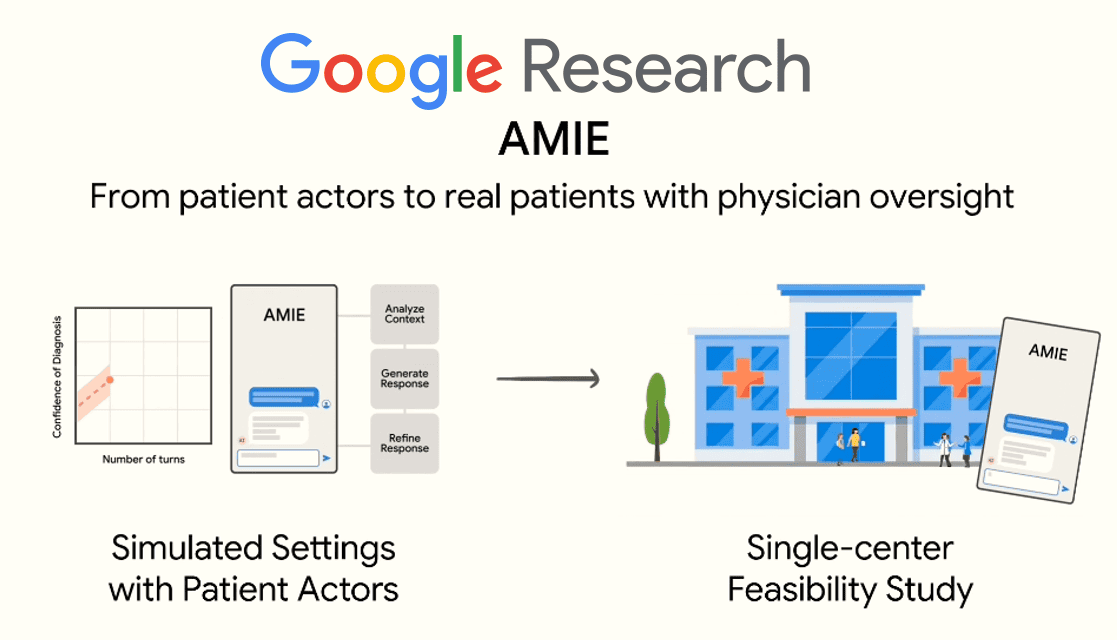
The gap between benchmark scores and real-world performance has been the theme of the year in AI research, so Google was right on cue with its first prospective clinical trial for AMIE using actual patients. 

Meet the Articulate Medical Intelligence Explorer. AMIE is Google’s flagship “medical AI researcher,” and it teamed up with Beth Israel Deaconess Medical Center to gauge performance in real clinical workflows.

  • 100 patients completed an AMIE interaction before their primary care visit, with AMIE taking medical histories and equipping patients with potential diagnoses to discuss with their PCP.
  • PCPs received the transcript, summary, and AMIE’s management plan prior to the visit. All interactions were monitored live by physicians trained to intervene if safety criteria weren’t met.

AMIE got a gold star. Not only were there zero safety stops across all 100 interactions, patients reported that their attitudes toward AI significantly improved after chatting with AMIE.

  • AMIE’s differential included the correct final diagnosis in 90% of cases (per chart review 8 weeks post-encounter), with 75% top-3 accuracy.
  • PCPs using AMIE reported increased visit preparedness in 75% of cases, as well as potential behavior change in nearly 60%.
  • The quality of AMIE’s differential diagnosis and management plan appropriateness was similar to PCPs, although PCPs won on management plan practicality and cost-effectiveness.

Other findings were less obvious. PCPs had the chart, the physical exam, and the pre-visit transcript, yet AMIE still matched them on differential quality and management safety without taking a single peak at the EHR.

  • That speaks to the ceiling (or lack there-of) for structured AI history-taking, and shows that AI is gearing up to improve patient care in more ways than just making predictions.
  • The fact that PCPs reported better visit preparedness and potential behavior change in over half of cases also highlights how AI can augment – not just replace – clinical reasoning.

The Takeaway

The distance between the bench and bedside is getting shorter, and Google’s AMIE results suggest that conversational AI in primary care is closer to reality than most people might think.

How to Build Patient Trust in Medical AI

AI might move at the speed of trust, but new research in JAMA Network Open shows that trust only moves at the speed of accuracy.

The study had a solid setup. To determine the factors currently driving patient trust in AI, researchers presented 3,000 U.S. adults with a pair of hypothetical AI-assisted visits for a moderate-risk rash. 

  • Each visit had six randomized attributes, such as whether or not a doctor was present, how well the AI performs relative to human clinicians, and various AI governance mechanisms.

AI performance came out on top by a wide margin. Respondents cared more about how well the AI performs than FDA approval, governance, and even having a doctor in the room.

  • The biggest difference came from AI performing better than a specialist, which increased the likelihood of choosing that visit by 32.5%.
  • AI performing at the same level as a specialist boosted visit preference by 24.8%, slightly more than having AI that performs as well as a general practitioner (19.1%).
  • Having an actual doctor present surprisingly only swayed visit preference by 18.4%.

Governance factors also moved the needle. They just didn’t move it much.

  • FDA approval for the AI increased visit preference by a modest 11.1%.
  • Mayo Clinic AI certifications apparently carry just as much weight – also coming in at 11.1%.
  • Local hospital certifications for the AI only gave visits a 7.8% lift.

AI data quality was important. It just wasn’t as convincing as AI performance. 

  • AI that had nationally representative training data boosted visit preference by 11.9%, but it was interesting to see that disclosing bias in the training data had no effect versus not providing any data details.

The written explanations told the same story. Respondents cited AI performance and clinician involvement as the primary reasons for their choices, with many of them expressing comfort with AI as a tool – but not as a standalone decision-maker.

The Takeaway

Widespread AI adoption requires patient trust, and this study did a great job highlighting the specific areas that should be prioritized for building it.

Microsoft Dragon Copilot Gets AI Upgrades

Microsoft might have had the biggest presence at the biggest health IT conference, and it made sure all the lights in Las Vegas were on Dragon Copilot

Unify. Simplify. Scale. Microsoft’s theme at HIMSS was all about making Dragon Copilot a one-stop-shop for information within clinical workflows. It debuted several new capabilities at the show:

  • Integrated medical content from trusted sources
  • Partner-powered AI apps and agents
  • Proactive ICD‑10 specificity suggestions
  • Expanded role-based experiences for physicians, nurses, and radiologists

Partnering is quicker than building. Rather than developing every Dragon Copilot capability in-house, Microsoft has been leaning on outside partners to round out the platform.

  • Dragon Copilot’s clinical evidence feature is a prime example. It brings medical content and other relevant contextual information in-workflow, all curated through new partnerships with Wolters Kluwer, Elsevier, and other vetted sources.

Microsoft Marketplace fills the gaps. It allows users to add AI partner apps directly into their Dragon Copilot workflows. Picture a modular side panel with insights from folks like: 

  • Regard – surfaces comorbidities and relevant diagnoses 
  • Canary Speech – analyzes voice biomarkers for mental health conditions
  • Humata Health – automates prior authorization processes for clinicians 
  • Atropos – generates personalized real-world evidence 
  • Optum – identifies potential coverage issues and supports claims processing 

All roads lead to scribes. When Microsoft first acquired Nuance for $20M back in 2022, it was its second largest acquisition ever behind LinkedIn, and the core offerings were radiology report automation, dictation, and transcription (with humans still pulling a ton of weight).

  • The product formerly known as Dragon Ambient eXperience is now the backbone of Dragon Copilot, and it’s been adding features at a breakneck pace.
  • Microsoft is looking to make Dragon Copilot everything, everywhere, all at once, and so far new partnerships have been the key to making that happen.

The Takeaway

As every digital health company rushes to add scribing to their platform, the OG scribe is rushing to add everything else. Now it just needs to maintain a unified user eXperience.

Infinite Healthcare, What’s It Worth?

Healthcare is one of the few industries where rising usage is treated as a failure, and a16z just published some solid arguments for why that framing might be completely backwards.

Everybody wants to be healthy. The demand for services that help people get and stay healthy is almost limitless, but the supply has always been limited by clinician time and cost.

  • AI balances the equation. It expands our capacity to provide care and drives down its marginal cost, and a16z makes the case that AI opens the door for us to consume an effectively unlimited amount of proactive care – consistent coaching, continuous monitoring, and earlier interventions.

Health is invaluable. As it stands today, when a payor sets reimbursement for a medical service, the rate assumes a certain volume to assess the overall budget for that service.

  • Price x Quantity = Total Medical Expense
  • If AI sends the quantity of the service through the roof while holding the price constant, the total medical expense would skyrocket.

The question isn’t how to avoid this. It’s “what do we get for it?” 

  • Half of all U.S. health expenditures go to 5% of the population, and AI that helps avoid hospitalizations or acute events can generate huge savings from a few patients.
  • Healthier people are also more productive. If AI can help just 1% of the 160M workers in the U.S. work an additional year because they’re healthy, that’s worth $260B in GDP.

How do you price AI for abundant consumption? In a world with truly proactive AI-driven care, delivering more care earlier is what actually bends the cost curve. Pricing shouldn’t punish usage.

a16z looks to other industries as good examples for healthcare:

  • Telecom used to charge for voice and data by the minute because network capacity was scarce, but pricing shifted to unlimited plans as infrastructure improved. Usage went up significantly, but the total market value grew alongside consumption.
  • Music followed the same arc. iTunes sold songs one at a time. Spotify sold access instead. People started listening to more songs, and consumer surplus expanded.

The Takeaway

As AI expands care capacity and access, consumption naturally increases. Affordable access leads to explosions in usage, and business models shift to subscriptions over per-unit pricing. Other industries have made the transition before, and a16z thinks it might be healthcare’s turn.

HIMSS 2026 Recap and Major Announcements

Viva Las HIMSS. The world’s largest healthcare IT conference officially has its swagger back.

The themes at HIMSS might have rhymed with the themes at ViVE, but the conversations were definitely louder – mainly because the exhibit hall was packed with attendees.  

Agentic AI has moved from promises to receipts, and measurable ROI is now mandatory for the pitch decks that want to make it to the top of the pile.

It’s also becoming increasingly clear that health systems aren’t looking for quick fixes to old problems. They’re looking for long-term partners to lean on as they navigate a technology landscape that’s shifting faster than ever.

Without further ado, here’s our roundup of the biggest announcements from HIMSS26:

  • Abridge rolled out its enterprise-grade AI platform for clinical conversations across WVU Medicine, the largest health system (and private employer) in West Virginia. It turns out that balancing decision support with clinician control resonates just as much at rural systems as it does at the most complex academic medical centers in the country.
  • Amazon brought Health AI to the biggest patient acquisition channel in the world: Amazon.com. The new Health AI agent can answer questions, manage prescription renewals, and even book appointments. Better yet, over 200M Prime members can use it to get five direct message care visits with a One Medical provider on the house. Not a bad way to follow up last week’s big news and one of the best interviews at the show.
  • athenahealth introduced athenaConnect to deliver a single access point for external health systems, pharmacies, and labs looking to connect with the 170k+ providers using athenaOne. The intelligent interoperability layer brings together integration solutions that bridge the EHR to outside partners as it looks to improve care coordination across local markets.
  • Artera showcased its latest AI Agents for patient access workflows, which recently got the nod as Best in KLAS for Patient Communications. The agentic AI wave has helped grow Artera into the trusted access partner at over a thousand provider orgs, and it now supports over 2B patient communications annually.
  • Cognosos upgraded its RTLS portfolio with encounter-sensing tags designed to improve compliance and automate data capture during patient interactions. The disposable patient wristbands generate time-stamped data that feeds directly into the EHR without the need for fixed infrastructure.
  • Epic previewed its no-code Agent Factory, a visual builder that lets health systems create and deploy custom AI agents directly within their EHR. This could end up tightening Epic’s golden handcuffs on health systems if it catches on, and it also probably means that selling workflow automation agents just got even harder at 40% of U.S. hospitals.
  • Google Cloud kicked off a string of industry partnerships with CVS Health, Highmark, Humana, Quest Diagnostics, and Waystar. The collaborations embed Gemini-powered agentic AI into a wide range of operations, with Waystar announcing that it’s already helped prevent 15B denials and CVS launching an entirely new Health100 subsidiary built from the ground up on the foundation.
  • Innovaccer unveiled a new AI-powered solution within Flow by Innovaccer that codes 80% of encounters autonomously in seconds, tackling coder shortages, revenue leakage, and rising cost per encounter. We got the full scoop on Flow Capture straight from the top.
  • Meditech released its own native AI scribe for physicians and nurses. Welcome to the party, it’s still pretty fun even though everyone else got here last year.
  • Microsoft made its presence felt with new Dragon Copilot capabilities that were front-and-center on the showfloor. The biggest enhancements included a huge suite of new AI partner apps spanning from RCM to CDS, and expanded role-based experiences for docs, nurses, and radiologists. More on this one next week.
  • PointClickCare launched Discharge Intel, an AI-powered solution designed to give health plans timely clinical intelligence within 24 hours of hospital discharge. Discharge Intel is PCC doing what PCC does best, eliminating manual processes and manilla envelopes from transitions of care.
  • RevSpring expanded its agentic AI capabilities for patient billing support, natural language payments, and real-time staff guidance for financial conversations. Not one to rest on its agents’ laurels, RevSpring also unveiled RevSpring Prime to help scale membership-based care models for direct-to-employer and direct-to-member programs.
  • Salesforce expanded Agentforce Health with six new AI agents built to act as a 24/7 administrative layer to automate high-stakes tasks that previously stalled treatment. The lineup includes agents for Referrals & Assessments, EHR Writeback, Claims & Coverage, Rural Health, Epidemiology Analysis, and Hospital Operations.
  • Snowflake released research revealing that 77% of healthcare orgs are already investing in agentic AI. Two-thirds have adopted, are piloting, or plan to implement new AI agents within the next 12 months, and the vast majority of leadership teams (85%) report that improving data interoperability is a higher priority than it was two years ago.
  • Stryker made waves with its new SmartHospital Platform through a newly formed business unit called Smart Care, serving as the connective tissue between all the hardware, software, and people inside of hospitals. It combines ambient sensors, the Engage alarm-filtering engine, Sync Badge devices, and virtual nursing workflows – the culmination of its recent M&A streak that included AI-enabled virtual care company Care.ai and communication platform Vocera.
  • Surescripts released its always-excellent Annual Impact Report to unpack the latest trends in e-prescribing and prescription benefits. Key takeaways from this year’s report were that interoperability looks like it finally reached a tipping point, with the Surescripts network clocking 30.5B health data transactions in 2025 – up 12.3% YoY – as well as nearly a billion real-time prescription benefit responses across 973K prescribers.
  • Talkdesk debuted a Complex Scheduling tool to help patients access specialty appointments. The specialized capability within Talkdesk’s CXA platform uses agentic AI to reduce delays and optimize physician capacity in contact centers and clinics.
  • Verily is bringing Samsung’s Galaxy Watch 8 onto its Pre precision health platform to provide an integrated solution for generating evidence and monitoring real-world populations. The joint offering is geared toward accelerating research for life sciences and government agencies by combining advanced health analytics with consumer-grade wearable data.
  • Vital debuted Vital Guard, an AI-driven solution that combs through clinical documentation and radiology reports to flag incidental findings that were uncommunicated, then closes the loop with auditable, asynchronous patient outreach. That means less malpractice exposure, and more downstream revenue.
  • VSee introduced “the world’s first autonomous telehealth AI robot” that’s purpose-built for hospitals. It leverages LiDAR to navigate hospital hallways independently for use cases like virtual rounding, supply/medication deliveries, or specialist coverage in the ED.
  • Zoom announced a string of healthcare updates to create a more unified “AI-first ecosystem.” Zoom Contact Center is now available in Epic Toolbox to eliminate app switching, Clinical Note added deeper Epic integrations, and Zoom Workplace for Frontline is getting new capabilities for  urgent messages and faster handoffs.

Even notoriously slow industries can cover a ton of ground in 12 months, so stay tuned for deeper dives into some of these announcements next week. 

Shoutout to all the old friends, new readers, and great sushi hosts that made our trip to Vegas so amazing.

Amazon Health Connect Sends AI to the Back Office

If the competition for the back office was already hot, it’s a certified wildfire after last week’s debut of Amazon Health Connect

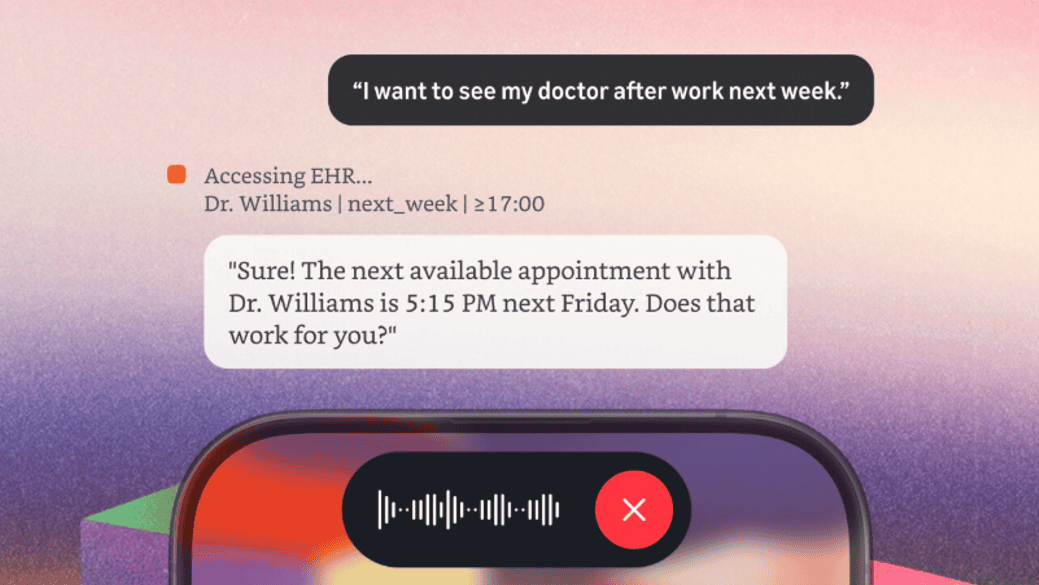
Amazon is pitching Amazon Connect Health as a purpose-built agentic AI solution for the administrative work that gets in the way of care. That’s definitely not fun to read for all the companies that had the same tagline on their booth at ViVE.

It comes with five capabilities straight out of the box: 

  • Patient verification
  • Appointment scheduling 
  • Pre-visit summaries
  • Ambient documentation
  • Medical coding 

What’s the core use case? AWS Director of Healthcare AI Naji Shafi says it’s the entire patient journey.

  • When a patient calls to book an appointment, Amazon Connect Health answers immediately, confirms their identity, checks their coverage, and lines up the visit while they’re still on the line.
  • Before the visit, it reviews their complete medical history across care settings, then surfaces previsit insights like active conditions or trends that might be relevant to closing care gaps.
  • During the visit, it drafts clinical notes for provider review in real-time, with every detail linked back to the moment in the conversation where it was discussed.
  • After the visit, it generates patient-friendly summaries and the medical codes needed for billing, allowing the visit to be payor-ready and submitted within minutes.

But wait, there’s more. Amazon Connect Health integrates natively with Epic, and connects to 100+ EHRs and 35+ HIEs through data integration partners like Redox.

  • It’s also built entirely on AWS HealthLake, the cloud giant’s FHIR data repository that’s now getting new agentic capabilities to help convert records into standard formats.

Early users love it. Amazon One Medical was the perfect sandbox for polishing Amazon Connect Health in clinical settings before opening it to outside partners. It shows in the results.

  • UC San Diego Health is saving a minute per call, diverting 630 hours a week from patient verification to direct support, and slashed call abandonment by 30%.
  • Netsmart’s EHR supports more than 1,300 community provider orgs, and it saw ambient documentation adoption skyrocket 275% – and better staff retention as a result.

The Takeaway

There were already tons of agentic AI solutions competing to automate healthcare’s administrative waste, and now there’s one that’s bankrolled by the biggest bookstore in human history. It’s a crowded space, but $1 trillion per year is also enough bloat to go around.

Anterior Closes $40M to Take AI to the Largest Plans in the Country

The AI race between payors and providers is healthcare’s Kentucky Derby, and Anterior just closed $40M to help turn the dark horses into the frontrunners.

Anterior uses AI to ease the back-office burden on health plans. It started with a laser focus on prior authorizations, translating huge amounts of unstructured data into the information that’s actually needed to make quicker decisions.

  • When Anterior helps payors deploy AI in their clinical and operational workflows, it doesn’t just dump a bunch of models on them and disappear into the sunset.
  • It embeds its own clinicians and engineers alongside the platform to support its partners, optimize accuracy, and drive a measurable impact.

Trust is a differentiator. Payors are a cautious crowd, and they aren’t exactly known for trusting new friends with their critical workflows. 

  • Anterior’s clinicians are its secret sauce. They make up about 40% of the company, and many of them have even started contributing directly to the platform’s code base.
  • This hands-on support why partners build trust, and that hard-earned resource is what allowed Anterior to take the same tech underpinning its prior auth tools and expand it to other workflows.

New partners lead to new proof points. New proof points lead to new use cases. 

  • Anterior’s early successes – from both its people and technology – have allowed it to quickly land and expand into areas like payment integrity and risk adjustment. 
  • Since closing its $20M Series A in June 2024, Anterior has deployed its AI across major payors like Geisinger Health Plan, and worked alongside enterprise technology partners like HealthEdge to build out key strategic integrations.
  • The platform now supports orgs representing over 50M covered lives, and the fresh funds will help it use those case studies to pry open the door to the biggest national plans in the business.  

The Takeaway

Anterior’s earliest partners had to gamble on an unproven platform without any real-world evidence to back it up. Now, the proof is in the success stories, and Anterior just landed another $40M to go after the largest and most risk-averse payors in the country.

PHTI Breaks Down Barriers to Clinical AI

PHTI’s new Clinical AI report delivered exactly what we’ve come to expect from their research: top tier industry analysis through the lens of actual stakeholders.

They assembled the A Team for this one. The report was built from an in-person workshop that PHTI convened with senior industry leaders – from health systems and health plans to tech firms and federal agencies – to explore what’s needed to safely scale clinical AI.

  • The workshop underscored the policy, reimbursement, and evidence gaps holding back adoption, with several key themes emerging from the discussion around their example use cases (hypertension management and mental health chatbots).

Theme 1: Evidence standards should compare AI to current standards of care and scale with risk.

  • That means comparing AI to the care that patients actually receive today rather than idealized care, then having different standards that align with the clinical risk of using the tool.
  • Highlight: Evidence should assess whether the full workflow (including multiple models, devices, and human oversight) improves outcomes, not merely model performance.

Theme 2: Performance benchmarks should be based on clinical outcomes, and safety standards should adapt as the evidence grows.

  • Ambiguity around what constitutes “good” performance is a persistent barrier. Metrics need to be anchored to specific clinical outcomes instead of vague process measures.
  • Highlight: Across both use cases, participants emphasized the need not only to set benchmarks but to set minimum safety floors, which could adjust dynamically over time on the basis of observed outcomes, changing patient risk profiles, & emerging evidence.

Theme 3: New technologies may be initially tested in lower-risk populations, but should scale quickly to high-risk populations to maximize impact.

  • Low-risk patients are tempting on-ramps, but AI’s greatest benefits come from reaching the high-need patients, and reaching them carries higher evidence expectations and more clinical risk.
  • Highlight: For mental health, engagement and retention are huge barriers to treatment. Participants cautioned that overly restrictive AI deployments risk limiting access and instead emphasized the need for appropriate care routing following LLM engagement.

The Takeaway

Even the most effective clinical AI tools still have plenty of questions to address before adoption can scale, and PHTI just crowdsourced some promising answers straight from the boots-on-the-ground in the healthcare trenches.

Get the top digital health stories right in your inbox