The peer-reviewed version of Google’s study on AMIE’s real-world performance was just printed in The Lancet, and the headline safety result made it through intact. Some of the preprint’s bolder claims did not.
ICYMI. The setup is identical to the March preprint on the Articulate Medical Intelligence Explorer, Google’s “medical AI researcher” that’s better known as AMIE
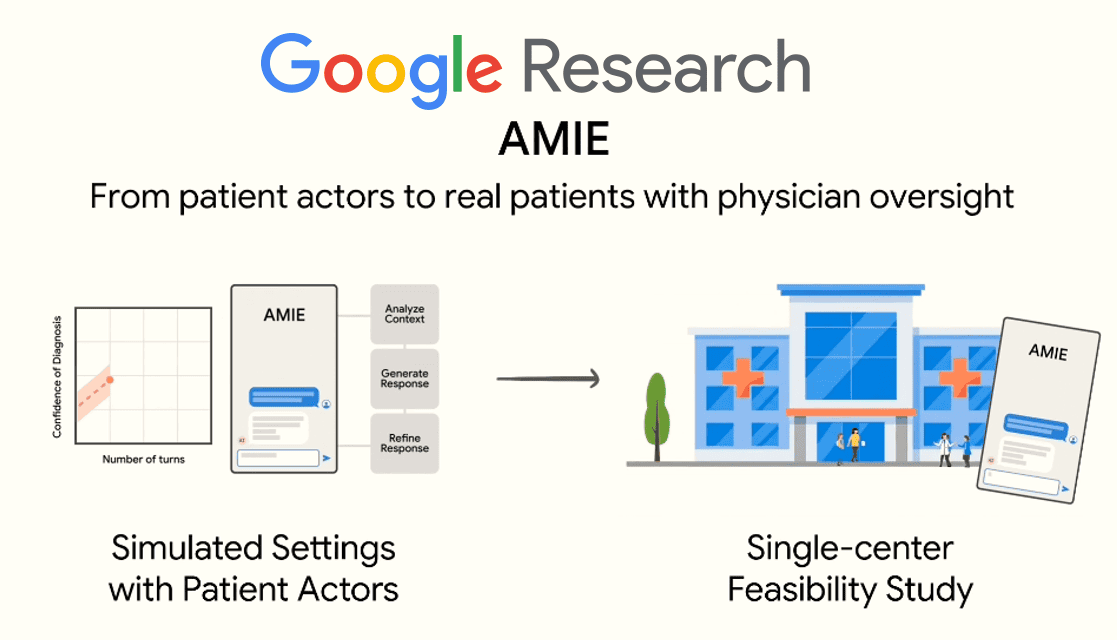
- 114 urgent care patients at Beth Israel Deaconess Medical Center chatted with AMIE, which then created a list of potential diagnoses and management plans for PCPs to review prior to the appointments.
- AMIE’s conversations were supervised live in case anyone needed to step in, and blinded evaluators graded the outputs afterward.
AMIE passed with flying colors. Key highlights:
- Zero conversations needed a safety stop. Supervisors logged just one hallucination, where AMIE described a past surgery as upcoming.
- AMIE’s differential included the final diagnosis in its top seven candidates for 90% of cases, and its top three for 75%.
- Of the 44 PCPs who had AMIE’s outputs before their visits, 33 found it helpful for prep and 25 said it may have changed their approach.
- Evaluators rated the conversations favorably in 87-100% of cases, and patient attitudes toward AI improved after chatting with AMIE.
Here’s what got cut. In March, Google claimed that AMIE’s differentials and management plans were the same quality as those produced by the PCPs – “without significant differences.”
- The Lancet version drops that comparison entirely because of confounding: the clinicians had read AMIE’s transcript before writing their own assessments, which could have biased their diagnoses.
- The management plan comparison survived, with no significant gap on appropriateness or safety, but PCPs taking the lead on practicality and cost-effectiveness.
That wasn’t the only change. Supervisor interventions grew from three in the preprint to five in the final paper, primarily because AMIE included a “malignancy” in three of its potential diagnoses.
- One of those listed lymphoma, and the treating clinician believed “the patient might have had anxiety related to the output and assessed the interaction as somewhat harmful in hindsight.” The supervisor saw no visible distress and let it run.
The Takeaway
Zero safety stops in a real clinical setting is a nice victory for AMIE, and it will be even nicer if it can scale to more patients. Luckily, Google already has a nationwide study underway with Included Health to show it can.