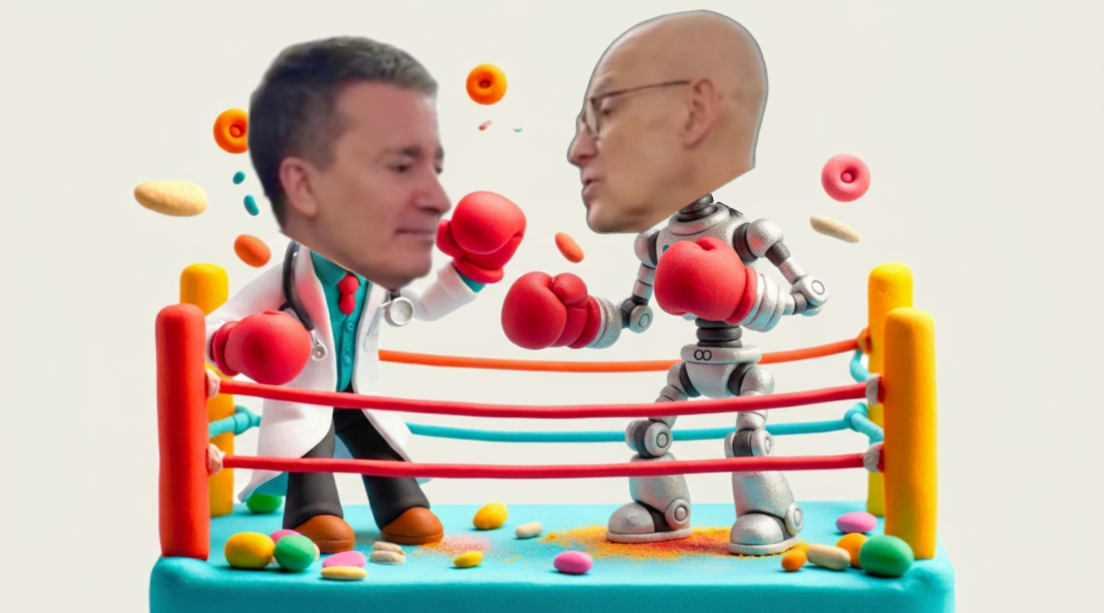
The Physicians vs AI Debate Goes Another Round

Zeke Emanuel isn’t letting the AMA have the last word in the physicians vs AI debate. A month after his JAMA article with Vinod Khosla predicted autonomous AI will outperform physicians (even physicians using AI) by 2030, he took to STAT to answer AMA CEO John Whyte’s rebuttal point by point.

Whyte’s pushback boiled down to three objections: we lack licensure and liability structures for autonomous AI, doctors are still needed for the “art of medicine,” and most of the supporting evidence comes from simulations rather than real patients.

Emanuel’s counter opens with a history lesson. The piece sets the stage with the surgeons who ignored Joseph Lister’s latest antiseptic data and gave President Garfield a lethal infection by operating on his bullet wound with unwashed hands – “good intentions but ignoring science.” He then works through Whyte’s objections one at a time to help avoid past mistakes:

  • On licensure and liability: it’s true we lack what’s necessary, so build the structures instead of rejecting the technology. Emanuel already published a licensing framework in JAMA, and a liability paper is under review.
  • On the art of medicine: 13 of 15 studies comparing empathy rated AI higher than clinicians, and patient actors felt more at ease with Google’s AMIE than with PCPs (97% vs. 65%).
  • On simulations: the shortage of real-world testing is the fault of doctors, regulators, and laws that block it. The one real-world study of 461 patient visits found physicians produced worse treatment plans than AI even after seeing its recommendations.

Emanuel and Whyte also squared off face-to-screen-to-face. In a spirited debate on the Lifers podcast, Emanuel shared a story about his brother’s two weeks of night sweats that stumped 48 diagnostic tests before Claude nailed a trout-protein reaction from a single query. His brother’s physician reportedly replied, “Does Dr. Claude have malpractice insurance?”

  • The answer to that question sums up the debate perfectly. If autonomous AI is ready for the final say, why hasn’t a single AI company volunteered to own the malpractice liability? State medical boards still hold physicians fully responsible, and no AI vendor has stepped up to shoulder the risk.

The Takeaway

Regardless of where we’re heading, we’ll be in a better spot if we embrace debate. Dr. Zeke and Dr. John just delivered a great one.

Khosla Says AI Should Replace Human Physicians

Will autonomous AI deliver better medical care than physicians by 2030? 

Who knows, but that didn’t stop Vinod Khosla from saying it in JAMA (and starting an angry mob of doctors in the process).

When Khosla talks, people listen. The VC heavyweight has a long track record of nice picks in healthcare – Abridge, Headspace, Sword, and most recently Bunkerhill. 

  • His predictions carry a lot of weight, especially when he makes them in a respected journal with co-authors like former White House health policy adviser Zeke Emanuel and Curai Health CEO Neal Khosla (maybe genius runs in the family).

The latest forecast ruffled some feathers. It’s easy to see why: “AI alone will provide better medical care than physicians, or even physicians working with AI.” 

The article argues that AI already rivals or outperforms doctors at five cognitive medical tasks:

  • gathering patient information
  • choosing tests 
  • making diagnoses
  • prescribing treatments
  • managing chronic diseases

Those are some big ones. The authors cite plenty of evidence to back that up (some might say low-quality evidence), then go on to predict that the gap will only widen from here.

  • The argument is that AI is rapidly improving, whereas physicians are increasingly threatened by AI-induced deskilling.
  • They also make the case that once AI beats physicians at a task, including a human in the loop will only degrade performance. In other words, AI-only care will outperform human-AI hybrid care.

Fair points for the techno-optimists. Not fair enough for the doctors.

  • Everyone agrees that getting the diagnosis right matters. Choosing the right test matters. Recommending the right treatment matters.
  • But so does understanding what a patient values, knowing when something doesn’t feel right, and having the instinct to act on it.

Performing medical tasks isn’t the same as practicing medicine. AI might be better at one, but you’ll get an angry mob if you say it’s better at both.

  • If serendipity is on your side, you might also get a beautiful new framework for physicians’ role in the age of AI, straight from DiMe and the same AMA that runs a certain journal that isn’t afraid to print hot takes.

The Takeaway

Average views produce average returns, and Khosla didn’t make his fortune by following the herd. That said, this might be the most contrarian view we’ve ever seen, so luckily we only have to wait until 2030 to find out if doctors are all out of the job.

Get the top digital health stories right in your inbox