Mispricing the RCM Bundle

Recovering consultant Andrew Tsang is back with another top tier analysis exploring why healthcare’s revenue cycle management bundle is currently mispriced. 

Great bundles lead to great unbundling. The term “unbundling” was first coined in a 2010 Tumblr post that applied the concept to Craigslist, a patchwork homepage of loosely related categories waiting to be peeled off as specialized startups.

  • AirBnB eventually took housing, Indeed took jobs, and dating apps took personals. Investors were standing by with checkbooks in hand every time. 

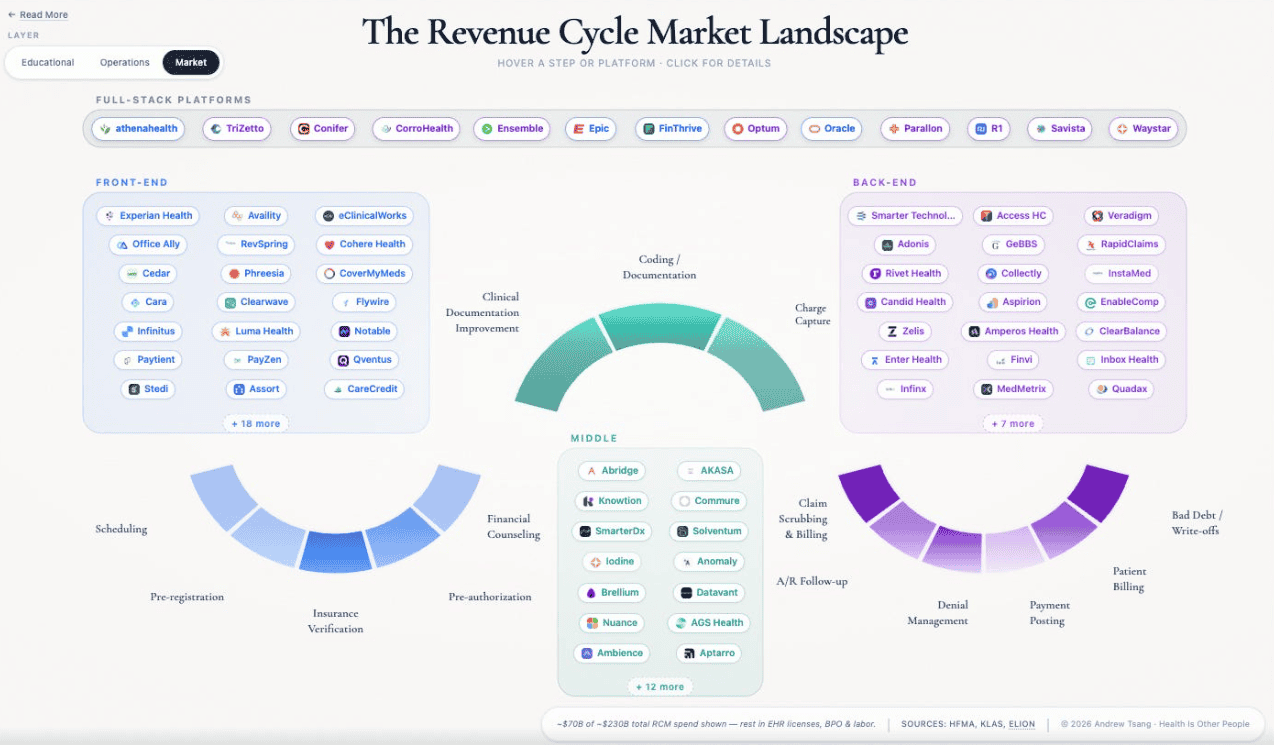
RCM is healthcare’s Craigslist. It’s a $300B monster of about a dozen different steps that exist to process the disagreement when payors and providers can’t agree on what care is worth.

  • RCM is practically begging to be broken into its component parts (prior auth, clinical documentation, denials), but the same investors funding the unbundling thesis are also the ones writing huge checks to fuse the wedges back together.

That’s because Craigslist isn’t linked like RCM. You don’t need a new love interest to get a new couch, and you don’t need a new couch to get a new love interest. Although it couldn’t hurt.

  • With RCM, optimize coding and the patient’s bill goes up. Optimize collections and patients defer future care. Every optimization at one step ripples through the others.

Hospital execs know this. They’re not buying best-of-breed point solutions, they’re consolidating onto platforms that cover the full lifecycle, and vendors are behaving accordingly.

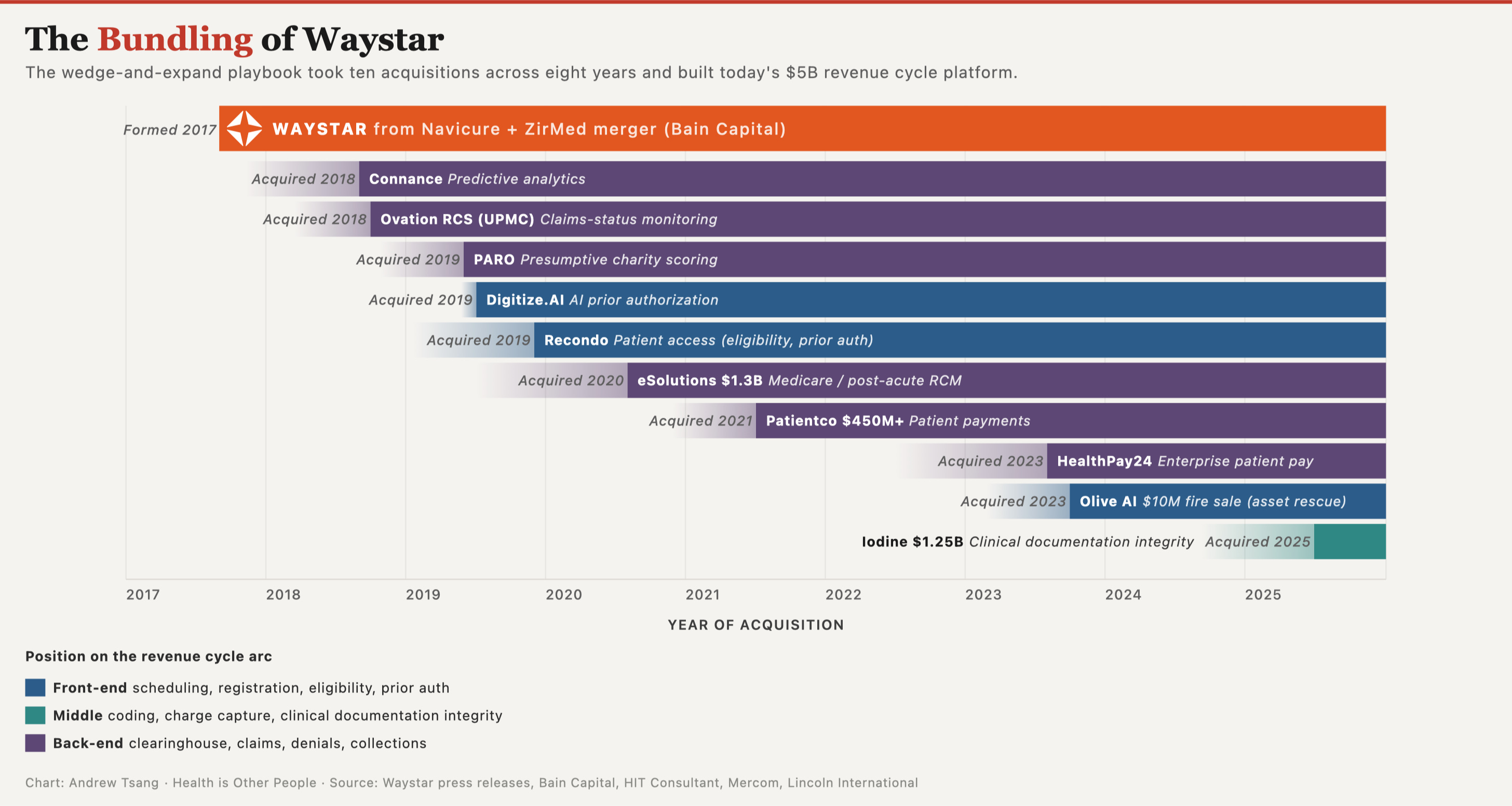
  • Tsang argues that RCM vendors are rational actors that are being pushed to acquire nearby wedges rather than build them, and you don’t have to look much further than Waystar or Smarter Technologies to find evidence to support that.
  • “The payor-provider fight is structurally dysfunctional, and that dysfunction rewards positioning over performance.”

RCM isn’t getting unbundled, it’s getting rolled up. When IT budgets get cut, CFOs pick the partner who covers enough of the arc to be worth keeping.

  • The worse the market gets, the more valuable broad coverage becomes, and the RCM platform moat continues compounding. That’s the state of the RCM market.

The Takeaway

Tsang makes a compelling case that the RCM vendors that survive the next decade won’t be the ones that reduce the claims disagreement. They’ll be the ones that own the channel for it.

Abridge Moves Upstream With $300M Series E

The ambient AI segment is turning into a bigger spectacle than the NBA Finals, and Abridge just dunked on it with $300M of Series E funding.

Big-time startups have big-time valuations. The latest round doubled Abridge’s valuation to $5.3B, up from a paltry $2.5B when it closed its last nine-figure round four short months ago.

  • We’ll leave it to the VCs to decide whether Abridge is worth twice as much as it was in February, but it’s now deployed at 50% more health systems – over 150 in total.
  • Abridge also reportedly hit $117M in contracted annual recurring revenue as of Q1, and is on pace to support upwards of 50M medical conversations this year alone.

Abridge is aiming upstream. The new capital was earmarked for “automating more of what happens behind the scenes and enabling revenue cycle management teams to operate with unparalleled efficiency.” 

  • That means embedding revenue cycle intelligence earlier in the clinical conversation, and eliminating unnecessary back-and-forth between clinicians and billing teams.
  • In Abridge’s own words, the ultimate aim is to “help achieve faster reimbursement cycles and minimize the risk of denials.”

The ambient AI race needs a rebrand. As Abridge and its competitors start lunging toward every workflow within arms reach of the clinical conversation, their platforms are quickly pushing past documentation. Within just the last week:

  • Ambience Healthcare announced that its coding-aware ambient AI platform saves St. Luke’s Health System $13k+ per clinician annually, then followed that up by launching Patient Recap for pre-visit chart summaries.
  • Commure raised $200M and rounded out its RCM and documentation capabilities with AI agents that handle scheduling, referrals, and prior auths. 
  • Nabla closed $70M to build out an Adaptic Agentic Platform that enables real-time coding assistance, direct EHR commands, and new capabilities for nurses.
  • There’s also the 1,000 pound gorilla formerly known as Nuance, but the incumbent scribing champ hasn’t been too vocal since rolling out Microsoft Dragon Copilot earlier this year.

The Takeaway

The hottest segment in digital health is boiling over into revenue cycle management, and Abridge is cranking up the heat with its Series E funding. Topping off the warchest comes with golden strings attached, so expect the pace to only accelerate from here as Abridge looks to live up to its valuation by coming out on top in the RCM landgrab.

Get the top digital health stories right in your inbox