8VC’s Vision for Healthcare AI in America

8VC just dropped its Vision for Healthcare AI in America, and it’s the best roadmap we’ve seen for removing the barriers between AI and its potential to transform medicine.

Great cakes have three layers, maybe four. Before 8VC shared its recipe for how AI can help fix things, it laid out the four main ingredients that it’ll be working with.

  • Level 0: Administrative – AI that supports providers in the back office. Example: AI scheduling agents, scribes.
  • Level 1: Assistive – AI that assists clinicians but doesn’t diagnose, treat, or triage, or prescribe medications to patients. Example: AI coaches, navigators.
  • Level 2: Supervised Autonomous – AI that does all the things that Level 1 doesn’t, with decisions supervised by a clinician. Example: AI medication management.
  • Level 3: Autonomous – AI that diagnoses, treats, triages, or prescribes medications completely on its own. Example: fully-autonomous triage lines.

Now for the vision. Most healthcare AI solutions currently live on Level 0. They’re creating real value for providers, but they aren’t going to steer the Titanic away from the iceberg.

  • 8VC thinks the other levels might, but not unless we remove the legal barriers that are preventing our innovators from innovating.

Level 1. These solutions exist today, but assistive AI care models are being held back by a lack of broadly billable CPT codes for the services they render.

  • Solution: Implement value-based reimbursement for assistive AI care models. 8VC describes a CMMI model with durable codes and case rates, which sounds like something most payors would be lining up to lobby for.

Level 2. All autonomous AI is considered Software as a Medical Device by the FDA, but the current performance bars are set too high. Driving tests don’t need to be F1 races.

  • Solution: Align FDA approval benchmarks with real-world standards, not hypothetical ideals. LumineticsCore is a good example – the FDA required the tool to catch at least 85% of diabetic retinopathy cases, but most ophthalmologists land between 33-77%. 

Level 3. Only a few policy changes are needed to open the door to Level 3 once we get to Level 2, the biggest of which is defining AI as a type of practitioner that’s eligible for reimbursement.

  • Solution: Amend the Social Security Act to allow Medicare reimbursement for licensed AI. As it stands today, even if CMS created a code for a Level 3 service, it would still be illegal for Medicare to pay an AI company instead of the supervising physician.

The Takeaway

AI is going to have to level up if we want to transform healthcare experiences, costs, and ultimately outcomes. 8VC thinks we can get there if we let our builders build, and it even gave us a blueprint for getting out of our own way.

AI Scribes Aren’t Productivity Tools, Yet

The first randomized controlled trials for ambient AI have finally arrived, and NEJM AI just gave us the strongest evidence yet that scribes deliver… minimal time savings.

The first study was a mixed bag. UCLA researchers assigned 238 physicians across 14 specialties to one of two scribes – Microsoft DAX and Nabla – or usual care for two months.

  • Nabla ended up saving about 23 seconds per visit, while DAX shaved off a whopping 5 seconds (which wasn’t even statistically significant).
  • Both scribe groups did however report less burnout and reduced cognitive burden than the usual care controls.

The second study told a similar tale. Physicians at the University of Wisconsin that used Abridge’s AI scribe for 6 weeks trimmed their daily documentation time by 22 minutes.

  • Still not a world-changing difference, but the UW physicians also saw significant positive improvements in work exhaustion and well-being.

But wait, there’s more. While those studies didn’t go as far as to suggest a cause for the lackluster time savings, a separate well-timed study from Navina offered a possible mechanism.

  • Scribes capture clinical conversations. Those conversations only inform a piece of the note, and those notes are only a piece of the workflow.
  • Navina found that incorporating patient medical histories into ambient documentation dramatically improves both note completeness and quality, which also seems like a great way to help physicians avoid lengthy manual chart reviews to fill any remaining gaps.

Then why do scribes get rave reviews? That’s a mystery that’s still up for debate.

  • It’s worth noting that “average time savings” include plenty of physicians who barely used the scribe. UCLA only had about a third of physicians pick up the tools, while UW was close to a best-case scenario at 71%.
  • It’s also possible that physicians enjoy not having to hold the visit in their head until they can finish their note, and getting rid of that burden is as magical as actual time savings.

The Takeaway

Not everything that can be measured matters, and not everything that matters can be measured. AI scribes might not be productivity tools quite yet, but physicians are clearly finding plenty of reasons to love them until they get there – even if more time isn’t one of them.

Bain & Company: Top Healthcare IT Priorities

Payors and providers are fighting different operational battles, but they’re using the same two-letter weapon to come out on top: AI, you guessed it. 

A joint report from Bain & Company and KLAS found that 80% of payors and 70% of providers now have an AI strategy in place, up from just 60% last year.

  • Providers are up against structural workforce shortages and rising patient volumes, while payors are contending with higher medical loss ratios and more regulatory scrutiny.
  • Bain and KLAS’ survey of 228 U.S. healthcare execs suggests that all signs point to one solution, and that’s deploying tech to improve margins.

Where are payors investing? Care coordination (57%) and utilization management (55%) were the top IT investment priorities for the second straight year.

  • Payors place total cost of ownership, functionality, and scalability ahead of suite convenience, so best‑of‑breed is still the default buying motion.
  • Plans are leveraging AI for everything from member engagement (35%) and enrollment (26%) to risk adjustment (26%) and prior auth automation (20%).

Where are providers investing? Revenue. Cycle. Management.

  • Half of providers ranked RCM among their top IT priorities, placing it above clinical workflows (34%) and EHRs (32%).
  • RCM = ROI. Accurate documentation and coding results in cleaner claims and fewer denials, which directly translates to higher revenue and lower expenses.
  • It’s also a match made in heaven for AI automation, and RCM currently represents the four most common AI use cases: ambient documentation (62%), clinical documentation improvement (43%), coding (30%), and prior authorization (27%).

Here’s the kicker. Providers cite EHR integration and interoperability as their biggest pain points, so most of them prioritize their EHR vendors for new solutions.

  • Only 20% of providers are primarily best-of-breed buyers, and two-thirds of Epic customers would choose an Epic option that’s “good enough” over a better competing product.

The Takeaway

It’s getting pretty hard to not be bullish on AI. There’s still plenty of uncertainty, but both payors and providers now seem to agree that inaction is the riskiest action.

AI Learns the Natural History of Human Disease

Clinical decision-making relies on understanding patients’ past health to improve their future health, an impossible task without first understanding how diseases progress over time.

That’s where a new study in Nature suggests AI is ready to help.

It starts with generative pretrained transformers. Researchers built a GPT, dubbed Delphi-2M, to predict the “progression and competing nature of human diseases.” 

  • Delphi-2M was trained on 400k UK Biobank participants (which lean healthier than the average person), and then externally validated on 1.9M Danish patients.
  • The training was designed to predict a patient’s next diagnosis and the time to it, using only data readily available within the EHR: past medical history, age, sex, BMI, and alcohol/smoking status.

How’d it do? The results speak for themselves:

  • Delphi-2M was able to forecast the incidence of over 1,000 diseases with comparable accuracy to existing models that are fine-tuned to predict single diseases.
  • Death could be predicted with eerily impressive accuracy (AUC: 0.97), and the survival curves that it simulated lined up almost perfectly with national mortality statistics.
  • Comorbidities emerged naturally from the training, and Delphi-2M was able to understand the progression from type 2 diabetes to eye disease to nerve damage.
  • Delphi-2M’s ability to predict heart attack and stroke matched established scores like QRisk, and it even outperformed leading biomarker-based AI models.

Better forecasts inform better policies. If policymakers can consult the Oracle of Delphi to see how many people will develop a disease over the next decade, the authors conclude that they’ll also be able to implement better regulations to prepare. 

  • Not a bad theory, assuming models trained on historical data can make forecasts that hold up to evolving treatments and populations (and that politicians act in the best interest of the people:).

The Takeaway

AI is reaching the point where it can predict thousands of diseases as well as the best narrowly focused models, and that could have big implications for everything from early screening to policymaking.

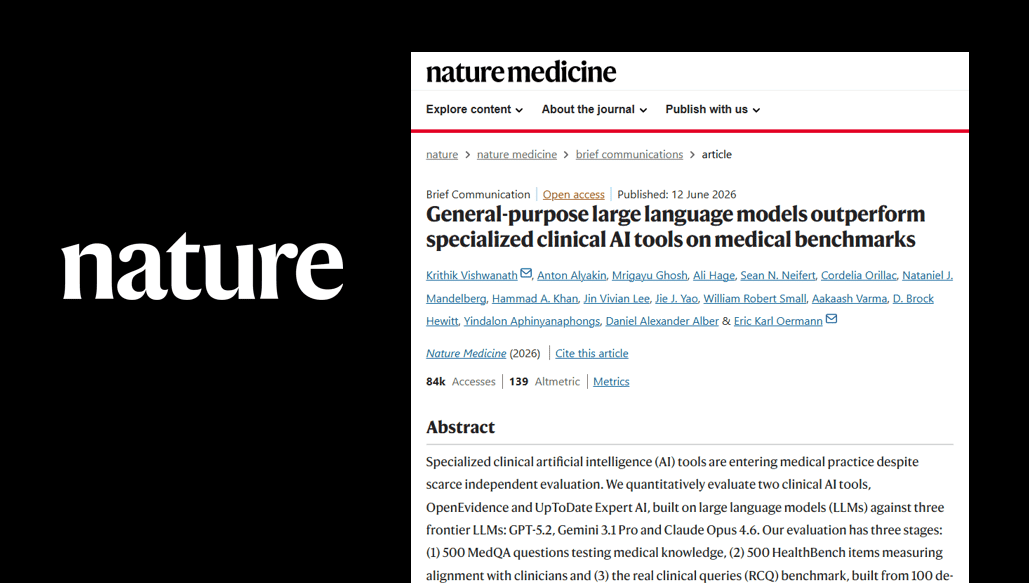
Wolters Kluwer Jumps in the GenAI Ring With UpToDate Expert AI

Right when you think Wolters Kluwer might just let everyone else have all the AI fun, it debuted UpToDate Expert AI to give the world’s most widely used clinical decision support tool a much-needed AI overhaul.

Wolters Kluwer took its time with the launch. The incumbent CDS juggernaut is used by 3M doctors worldwide, so it had plenty of users to disappoint with a hasty roll out.

  • That said, nimble competition has been gaining ground pretty much as fast as it takes to download OpenEvidence from the App Store.
  • The good news is that WK made the most of the extra development time.

Here’s what sets UpToDate Expert AI apart. Unlike general-purpose chatbots, the AI-enhanced version of UpToDate is built exclusively on WK’s peer-reviewed content library.

  • It draws on 30+ years of evidence-based research authored by 7,600 experts, rather than the open web or selective journals.
  • That allows it to quickly answer complex clinical questions, while surfacing all of its sources, assumptions, and step-by-step reasoning directly in the response. Probably safe to assume that also helps with hallucinations.
  • Those answers still manage to be easy to scan at the bedside and will look extremely familiar to any doctor that’s ever read an UpToDate article (or one that’s been reading them for a decade).

The extra time in the oven means that more features are baked in. Wolters Kluwer knows its audience, and UpToDate Expert AI’s biggest leg up on the competition is its fine-tuning for health systems.

  • Enterprise-grade governance, compliance, and workflow integration are all standard out-of-the-box, giving UpToDate Expert AI an advantage for a system-wide implementation over OpenEvidence or Doximity.

The Takeaway

It turns out that the 800-pound clinical support gorilla wasn’t going to let the newcomers eat its lunch forever, and UpToDate Expert AI gives health systems plenty of reasons to keep rolling with Wolters Kluwer.

Penguin Ai Raises $30M to Arm the AI Agent War

Payors and providers are in an AI arms race, and Penguin Ai just raised $30M to supply both sides with agents to outcompete each other.

Penguin goes far beyond point solutions. The enterprise AI platform combines proprietary LLMs with AI tooling that both payors and providers can use to configure custom agents for their own back-office processes. 

  • The platform enables customers to prep their data for AI, use pre-built LLMs via APIs, or start with a ready-made agent for medical coding, prior auths, claims adjudication, appeals management, risk adjustment, medical chart summarization, or payment integrity.
  • The ultimate goal is streamline high-volume workflows and cut down on the billions of dollars of administrative waste that the healthcare industry generates every year.

The agent wars have begun. Payors and providers across the country are racing to enlist AI agents to fight for an advantage in a system that’s historically been plagued by inefficiencies and headbutting.

  • Providers vs. Payors: Doctors and hospitals are leveraging agents to fight back against billing denials – filing floods of appeals and automating responses faster than any human could manage alone.
  • Payors vs. Providers: Health plans are rolling out agents to instantly review claims, prior auths, and appeals requests – enabling mass, automatic care decisions that overwhelm providers.

Penguin CEO Fawad Butt has been in the buyer seat. He spent his career serving as the chief data officer at some of the biggest names in the industry: UnitedHealthcare, Kaiser Permanente, and Optum.

  • He founded Penguin to build the platform he saw was missing, and that adds a lot of credibility as Penguin takes on incumbent admin agent dealers like Innovaccer and Autonomize AI.

The Takeaway

The agent wars are in full swing, and Penguin is bringing a comprehensive platform to a battlefield full of point solutions. 

Doctors Who Use AI Are Viewed Worse by Peers

The research headline of the week belongs to a study out of Johns Hopkins University that found “doctors who use AI are viewed negatively by their peers.”

Clickbait from afar, but far from clickbait. The investigation in npj Digital Medicine surfaced interesting takeaways after randomizing 276 practicing clinicians to evaluate one of three vignettes depicting a physician: using no GenAI (the control), using GenAI as a primary decision-making tool, or using GenAI as a verification tool.

  • Participants rated the clinical skill of the physician using GenAI as a primary decision-making tool as significantly lower than the physician who didn’t use it (3.79 vs. 5.93 control on a 7-point scale). 
  • Framing GenAI as a “second opinion” or verification tool improved the negative perception of clinical skill, but didn’t fully eliminate it (4.99 vs. 5.93 control). 
  • Ironically, while an overreliance on GenAI was viewed as a weakness, the clinicians also recognized AI as beneficial for enhancing medical decision-making. Riddle us that.

Patients seem to agree. A separate study in JAMA Network Open took a look at the patient perspective by randomizing 1.3k adults into four groups that were shown fake ads for family doctors, with one key difference: no mention of AI use (the control), or a reference to the doctors using AI for administrative, diagnostic, or therapeutic purposes (Supplement 1 has all the ads).  

For every AI use case, the doctors were perceived significantly worse on a 5-point scale:

  • less competent – control: 3.85, admin AI: 3.71; diagnostic AI: 3.66; therapeutic AI: 3.58
  • less trustworthy – control: 3.88; admin AI: 3.66; diagnostic AI: 3.62; therapeutic AI: 3.61
  • less empathic – control: 4.00 ; admin AI: 3.80; diagnostic AI: 3.82; therapeutic AI: 3.72

Where’s that leave us? Despite pressure on clinicians to be early AI adopters, using it clearly comes with skepticism from both peers and patients. In other words, AI adoption is getting throttled by not only technological barriers, but also some less-discussed social barriers.

The Takeaway

Medical AI moves at the speed of trust, and these studies highlight the social stigmas that still need to be overcome for patient care to improve as fast as the underlying tech.

Healthcare’s Sci-Fi Future at Epic UGM

Where there’s smoke, there’s fire, and Epic just lit up its sci-fi themed User Group Meeting with enough futuristic new solutions to prove last week’s rumors true – and then some.

The future is now. This year’s event gave us a look at over 160 AI projects currently under development at Epic, including a three-product family set to immediately shake up the industry.

ART is a provider copilot for charting, pre-visit summaries, queuing up orders, and yes – ambient scribing.

  • ART will reportedly be able to provide real-time suggestions during visits, and its highly-anticipated scribe still came as a surprise after Epic revealed that it will be powered by Microsoft when it arrives in early 2026. More on that later.

Emmie is a patient-facing advocate within MyChart that can help with everything from scheduling and reminders to education and navigation.

  • Epic is positioning Emmie as the best place for patients to ask health questions and get answers that are actually grounded in their personal medical history.

Penny is an administrative assistant targeted at revenue cycle management, generating appeal letters, and supporting back-office tasks.

  • There isn’t as much information out there on this one, but Epic doesn’t appear to be shying away from claims and payor workflows.

The EHR is dead, long live the CHR. Judy grabbed even more headlines by announcing that she’s retiring the term “EHR” in favor of “Comprehensive Health Record,” which seems fitting considering the other major announcements that joined the Big Three.

  • Cosmos AI will provide diagnosis and treatment support, as well as discharge planning.
  • MyChart Central will give patients a single login across all sites of care.
  • Flower Pot will expand access to lightweight Epic implementations for smaller practices.

The scribe is real. Now what? Epic’s decision to team up with Microsoft on documentation was pretty unexpected given its 46-year track record of building everything in-house, confirming that the CHR giant would rather bend its core rules than lose market share.

  • Scribes proved how fast health systems would layer on their own AI if Epic couldn’t keep up, and we’ll now have to wait and see if the cost and experience of Epic’s scribe is enough to compete with the flock of ambient AI innovators dedicated to this problem.
  • Epic might own the “operating system,” almost as much as Microsoft owns Windows, but just because MS Paint exists doesn’t mean the world doesn’t need Adobe Photoshop.

The Takeaway

Some call it consolidation. Others call it innovation. Either way, this year’s UGM will probably go down as a key step along Epic’s march toward intergalactic domination. 

Is AI Robbing Physicians of Their Skill? 

A study in The Lancet threw some refreshingly cold water on the AI hype train after finding that healthcare’s shiny new models might be de-skilling physicians.

Here’s the setup. Researchers tracked four Polish health centers that gave their gastroenterologists AI to help spot polyps during colonoscopies before yanking it away after three months.

  • Long story short, the doctors’ ability to detect polyps plummeted 6% below baseline following the AI rugpull.
  • Unassisted polyp detection rates fell from 28.4% before the AI teaser to 22.4% after, raising concerns that relying on AI might rob physicians of hard-won skills. 

Sounds familiar. The findings echo a recent MIT preprint that showed that people who used AI to write essays used less of their brains and had worse recall of their writing than those who mustered up the words on their own.

  • That’s probably not a shocker to anyone that’s used ChatGPT for more than five minutes, but it’s easy to see that it might spell trouble when applied to medicine.
  • If gastroenterologists start leaning on AI to detect polyps, what happens if they lose their ability to detect them without it?

Right idea, wrong question. People were better at mental math before they had calculators, but that doesn’t mean society would be better off without them. The question we have to ask ourselves is, which skills are we willing to lose?

  • Gastroenterologist Dr. Spencer Dorn nails it: AI doesn’t just risk de-skilling doctors in polyp detection, it risks diminishing their overall critical thinking skills.
  • “My real concern is not the technical skills we can afford to lose, but the foundational ones we can’t: critical thinking, sound judgment, and compassionate care. These aren’t just important to preserve – they’re irreplaceable.”

The Takeaway

If doctors keep outsourcing their thinking to AI, it could be a one-way ticket to a world where Dr. GPT is the only one patients can turn to. Seems dystopian, but is it really that bad if it also means better outcomes for those patients?

AI Spotlight on Epic, Abridge, and Oracle 

Epic, Abridge, and Oracle just gave us a year’s worth of blockbuster AI announcements in three days, and at least one of them was more than speculation and old news.

‘Twas the week before UGM, and the rumor-mill has been overheating with reports that Epic might finally launch its own EHR-native scribe at its upcoming User Group Meeting.

  • Over 40% of U.S. hospitals are already on Epic, which means its scribe would have access to one of the biggest distribution channels in healthcare even if its UX and performance aren’t best-in-breed (which they won’t be).
  • That means about 100 ambient AI startups could be about to find out why scribing is a feature – not a product – and the race will be on to differentiate through other capabilities like RCM and specialty-specific tuning.

Abridge doesn’t plan on being commoditized. Less than 24 hours after Epic’s scribe leaked, Abridge unveiled the exact type of solution that’ll define who survives the incumbent squeeze: real-time prior authorization at the point of conversation.

  • Abridge is co-developing the new solution alongside Highmark Health, a Pittsburgh-based payvidor that operates both a multistate payor division and the 14-hospital system Allegheny Health Network.
  • Integrating Abridge’s ambient AI platform across Highmark’s entire organization will allow patients to get approval for necessary treatments before they even leave the office, a perfect example of how “scribes” can be truly transformative beyond just transcripts.

Oracle couldn’t let Epic and Abridge have all the fun. It decided to “usher in a new era of AI-driven health records”… by reintroducing us to the same AI EHR it unveiled last October.

  • Although mostly a PR stunt to grab headlines ahead of UGM, the new EHR includes several features that underscore where the AI puck is heading, including a native scribe, voice-first navigation, and agents to support clinical workflows.
  • These features are also a good list of use cases where startups might not have a lot of juice left to squeeze after EHRs start bringing them in-house (and prior auths just so happen to be the last thing Oracle wants to get its hands dirty with).

The Takeaway

Native scribing is (very likely) on its way to Epic, Abridge is giving patients the gift of time with instant prior auths, and Oracle is banking on voice for the future of EHR navigation. What a week for digital health.

Get the top digital health stories right in your inbox