Function Lands $298M for Medical Intelligence

The face of the health membership movement is now worth $2.5B after Function landed $298M of Series B funding to prove that subscription care is here to stay.

Function is building an “operating system for human health.” The OS “fuses AI with medical expertise to empower 8 billion people to take control of their health and get ahead of disease.”

  • Translation: Function offers personalized nutrition and lifestyle recommendations based on a massive menu of lab tests that members can access for $365 per year.
  • Unlike most annual physicals that measure ~26 biomarkers, Function offers 160+ tests spanning from the heart and hormones to heavy metals and cancer signals.
  • It also doubled down with the acquisition of Ezra earlier this year, adding AI-guided full-body MRIs (for detecting cancers, endometriosis, strokes) and CT scans (for lung tumors, heart plaque, soft tissue damage).

The Medical Intelligence Lab takes the vision even further. Function just launched its Medical Intelligence Lab to unify all of its data – labs, imaging, wearables, and medical records – into a continuously learning model designed to reveal patterns and surface actionable insights.

The lab gives members immediate access to three new AI capabilities:

  • Private AI Chat – answers health questions with responses informed by member data.
  • Protocols – translate complex data into health plans with easy-to-follow steps.
  • Health Records – members can securely upload lab results, visit notes, and medical records to feed into Private AI Chat and Protocols.

The testing gold rush is here… but that might not be great for everyone. Research has shown that direct-to-consumer testing companies have a history of wading into murky waters, particularly misleading marketing and a lack of care continuity.

  • Function will have to prove that its benefits outweigh those risks, but hundreds of thousands of members are already voting with their wallets that the math checks out.

The Takeaway

Function will tell you that it isn’t just leading a new category, it’s setting the standard for how we understand, manage, and extend human health. If that turns out to be true, then $298M should go a long way toward proving it.

TrumpRx and the GLP-1 Land Grab

It’s a bad day to be a pharma middleman. The White House announced the launch of TrumpRx in 2026, kicking off a wave of cost reductions on some of the most popular drugs in the world. 

TrumpRx looks exactly like it sounds. Here’s the website.

  • The site will serve as a portal for patients to find the best rates on prescription medications, AKA “Most-Favored-Nation Pricing.” 
  • Unlike other billionaire-run pharma projects like Mark Cuban Cost Plus Drug Company, TrumpRx won’t actually fulfill anything. 
  • Instead, it will send people to pharmaceutical companies’ direct-to-consumer sites to process orders, a strategy that Cuban applauded as having “no downside for anyone.” 

It gets better. TrumpRx was part of a broader initiative to lower drug costs for Americans, and included major partnerships with Novo Nordisk and Eli Lilly to expand access to GLP-1s.

  • Novo’s Ozempic and Wegovy will be listed at $350 per month on TrumpRx, significantly lower than the $1k per month that many patients are used to.
  • The same goes for Lilly’s Zepbound, and both manufacturers agreed to list their upcoming oral GLP-1s at $150 “in the event that the FDA later approves them.” That seems pretty likely at this point.

What does pharma get out of it? Medicare coverage.

  • The “historic reductions” will enable Medicare and Medicaid to cover GLP-1s for adults with obesity, as opposed to confining coverage to those with diabetes or heart disease.  

Things snowballed from there. Novo revealed this week that it will immediately slash its GLP-1s to $349 on its DTC platform, with doses available at $199 for new patients.

  • GoodRx was quick to match them at $199 for the first two months, and Ro hopped on the same introductory bandwagon.
  • Omada also completely changed its tune within hours of the TrumpRx announcement and said that it will begin prescribing GLP-1s for the first time in 2026.

The Takeaway

The GLP-1 landscape just got tossed on its head, and the oral versions haven’t even come out yet. Drug manufacturers are already throwing down the direct-to-consumer gauntlet, but so far it looks like patients might actually come out on top.

U.S. Healthcare is an “Abominable Creature”

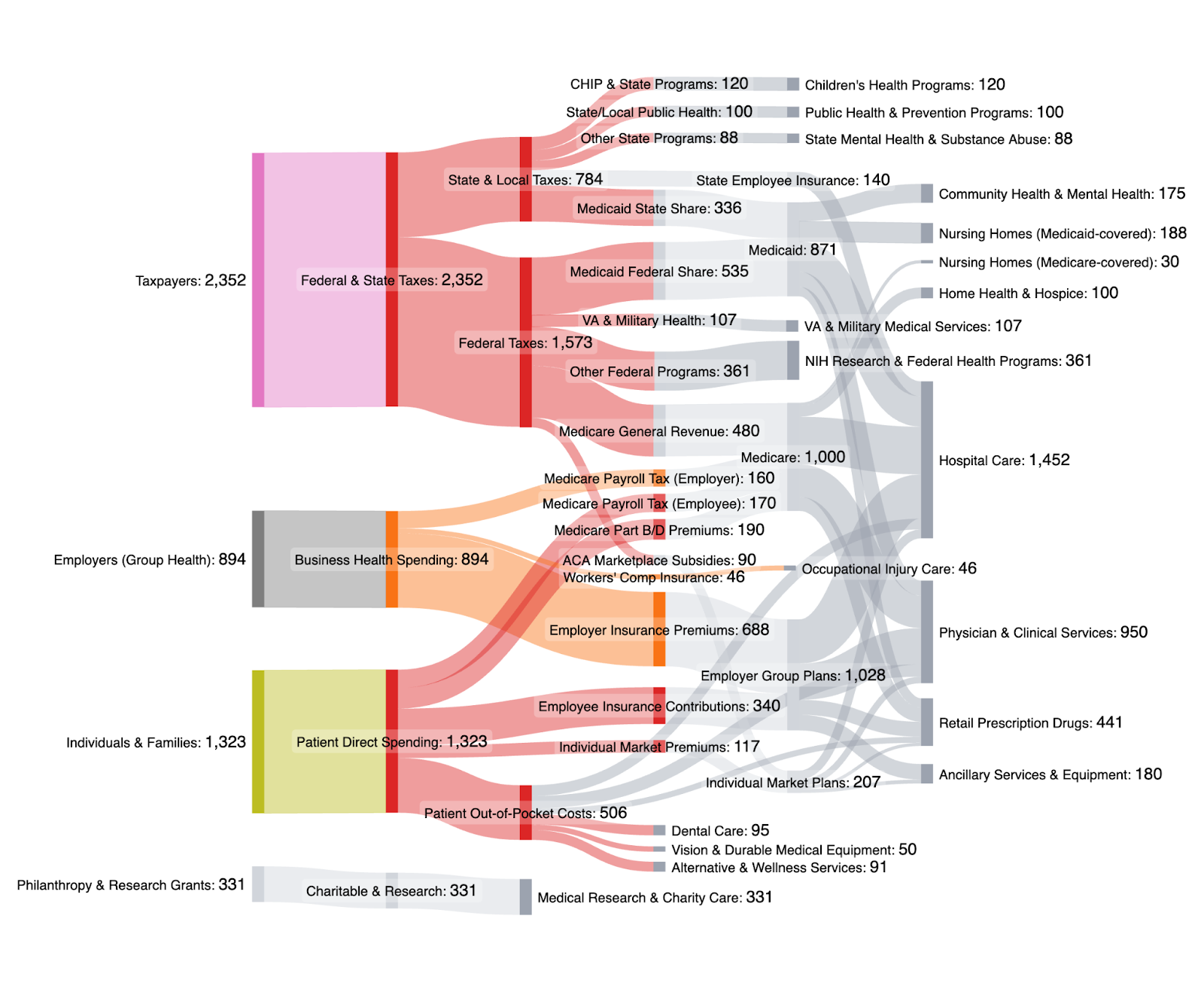
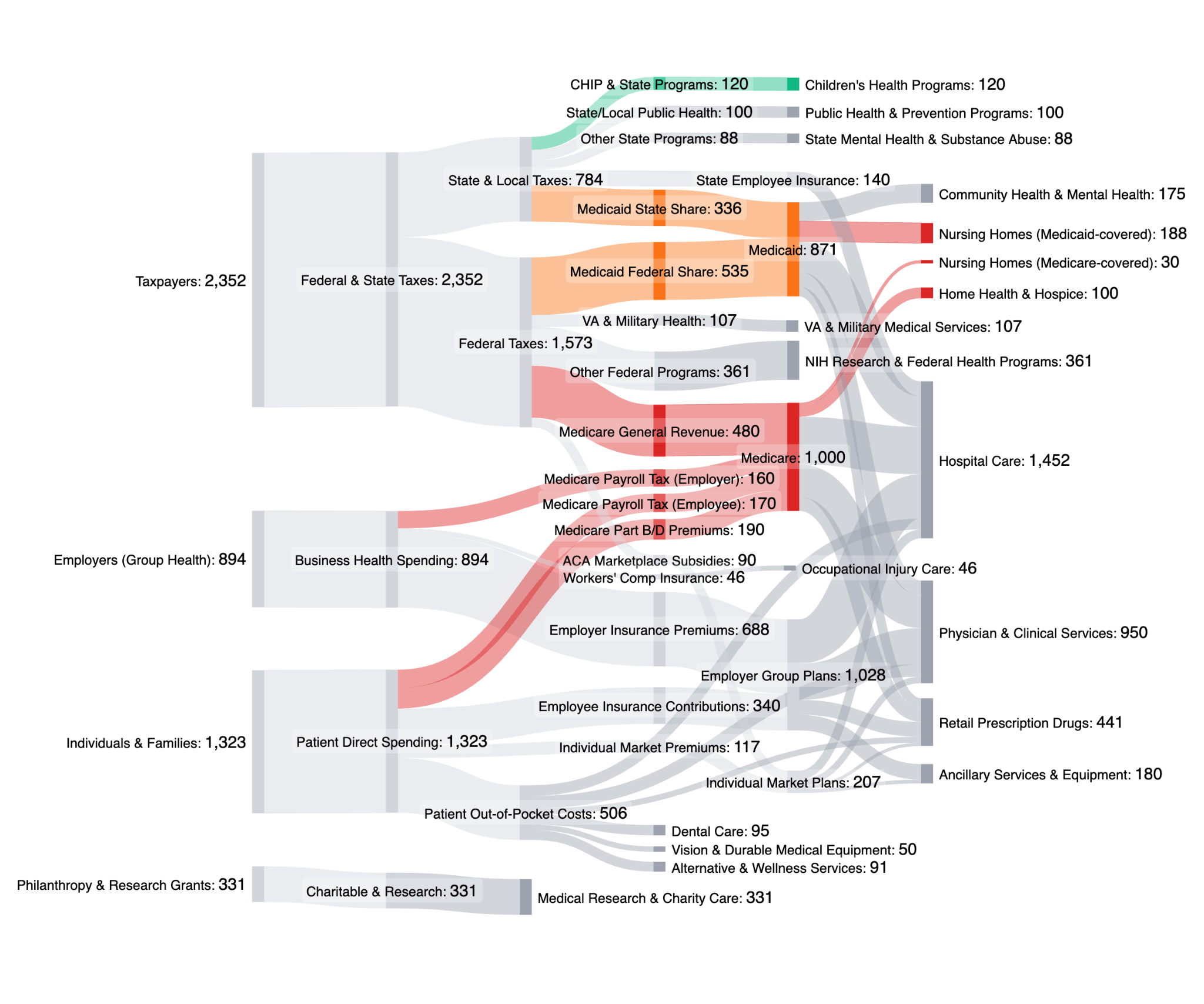
If a picture is worth a thousand words, then this chart from industry consultant Andrew Tsang might be worth a million.

America’s healthcare system is “An Abominable Creature.” That’s also the title of Tsang’s stellar blog post that meticulously maps out every dollar that flows through it.

  • The flows in the diagram represent $4.9T, but they’re also a glimpse at every medical decision that was made in the U.S. last year. Every diagnosis. Every birth. Every death.

The charts don’t just map spending, they map our decisions. We built the healthcare system brick by brick with the choices we made, and although they might have all made sense individually, the end result is a monster of our own design.

Decision 1 – Workers fund healthcare twice… or more [Chart 1]. 

  • Federal, State, and Local Taxes – $2.4T for Medicare, Medicaid, and public health.
  • Payroll Taxes – employers fund Medicare even though most employees aren’t 65.
  • Premiums – $688B gets deducted from paychecks for employer plans.
  • Out-of-Pocket Costs – Americans shell out another $506B when they actually get care.

Decision 2 – We look after our seniors [Chart 2]. 

  • Medicare accounts for $1T every year.
  • Nursing homes account for $218B every year.
  • Home health & hospice account for $100B (and 22% of all Medicaid spending).

Other Decisions – The full U.S. diagram can tell whatever story you want it to [Chart 3].

  • Treatment is more important than prevention – $100B goes to public health while $1.5T goes to hospital care annually.
  • Innovation is a bigger priority than price controls – $441B is spent on prescription drugs.
  • Repairing old age is better than investing in children – $120B goes to children’s health compared to $1T for Medicare.

The Takeaway

The U.S. healthcare system was pieced together through a long chain of isolated decisions, each one solving a specific problem at the time. Tsang just gave us a beautiful illustration of the end result: a kraken with countless tentacles that all seem to have a mind of their own.

Remote Monitoring Boosts Revenue, Access

Remote patient monitoring was in the crosshairs last week after UnitedHealthcare axed its coverage, but a well-timed study in Health Affairs suggests that the cuts are bad news for practices – and their patients.

Practice makes perfect. Although many studies have looked into how RPM affects patients, this might be the first study to quantify its impact on practices themselves.

  • Researchers at Columbia analyzed Medicare data from 754 primary care practices that adopted RPM between 2019 and 2021, then tracked outcomes through 2023.

20%. That’s how much the practices that adopted RPM increased Medicare revenue compared to similar practices that didn’t adopt it.

  • Most of that growth came directly from RPM billing, but a quarter of it stemmed from more outpatient visits and care management services. 
  • It’s worth noting that the RPM practices also saw a 2.7% uptick in provider headcount, but the authors pointed out that most of the revenue gains came from higher activity per clinician rather than the additional hiring.

Patients also came out on top. Despite concerns that RPM can take provider time and attention away from patients that don’t need it, the RPM practices also ended up seeing more patients overall.

  • Many of these patients had higher disease burdens or were dual-eligibles, which seems to indicate that RPM didn’t shift resources away from in-person visits.

Where does that get us? The authors concluded with a “cautious optimism” for RPM’s role in primary care, but warned that unchecked expansion could drive up costs.

  • They called for thoughtful reimbursement policies with evidence-based limits on monitoring duration and patient eligibility, pretty much echoing PHTI’s recent recommendations on the same topic.
  • PHTI agreed that RPM for use cases like hypertension can be very effective, but found that 40% of beneficiaries receiving RPM for blood pressure control are monitored longer than six months – well beyond what’s clinically effective.
  • That might be good for the bad actors seeking revenue above-all-else, but it’s horrible for Medicare, taxpayers, and the public perception of RPM.

The Takeaway

One bad apple doesn’t spoil the whole bunch, and just because there are bad actors in RPM, doesn’t mean we should throw it all away.

Fabric Continues Acquisition Spree With UCM

Fabric is back at it again with its fifth acquisition in less than three years, picking up telehealth provider UCM Digital Health to round out its virtual care portfolio.

Here’s a look at Fabric’s M&A journey since launching in 2023 to tackle capacity constraints:

  • May 2023 – Fabric nabs Zipnosis from Bright Health to expand into asynchronous care.
  • Jan 2024 – Fabric scoops up GYANT to provide an AI-entry point to its services.
  • June 2024 – Fabric acquires MeMD and its 30k payor/employer partners from Walmart.
  • Sept 2024 – Fabric broadened its provider network by acquiring TeamHealth VirtualCare.
  • Nov 2025 – Fabric leans in on payors and employers with UCM Digital Health.

End-to-end platforms are built brick-by-brick. Fabric got its start by bringing consumer mobile app experiences to the ER, but it’s quickly expanded into new verticals and use cases.

  • The acquisition spree has grown Fabric into a comprehensive access and experience platform backed by its own medical group, which allows it to streamline virtual-first care for patients across the country.

Fabric’s Hybrid AI is the connective tissue. It automates routine processes to make all the M&A pieces fit together, while also streamlining care coordination and clinical decision support to make its providers more efficient. 

  • By reducing provider work time to just 89 seconds for asynchronous visits, Fabric enables faster treatments for patients and saves payors up to $17 per member per month – all while maintaining outcomes on par with in-person care.

What’s the end result? Salvaging MeMD from the rubble of Walmart’s telehealth business already gave Fabric a strong foothold in the payor/employer market, and UCM will deepen its impact.

  • UCM adds another 400 payor and employer customers to the mix. They’ll transition to the Fabric platform and reap the benefits of its national provider network and polished patient experiences.
  • That brings Fabric’s total client roster to over 75 health systems, 30k employers, and more than 100M lives across all 50 states. Not too shabby for a startup still looking forward to its third birthday.

The Takeaway

Fabric’s been acquiring and integrating new platform capabilities as fast as any digital health company out there, and the “buy-and-build” approach definitely seems to be working. They might be spinning a lot of plates, but they haven’t dropped one yet.

Hippocratic Closes Series C to Fuel Patient-Facing Agents

Rising tides lift all boats, and the venture-backed surge in AI startups just helped boost Hippocratic AI’s valuation to $3.5B on the back of $126M in Series C funding.

Do no harm. Hippocratic’s “safety-focused” AI agents perform almost any low-risk, patient-facing task under the sun. 

  • That includes appointment scheduling, patient intake history, SDOH surveys, health risk assessments, post-discharge outreach, and even chronic condition management.
  • They don’t diagnose patients or prescribe medications… at least not yet.

The Polaris Safety Constellation Architecture makes it all possible. Hippocratic’s healthcare LLM constellation leverages multiple specialized models that “double-check the primary model to ensure accuracy and safety.”

  • The company then performs output testing, human evaluations, and cross-validations to make sure its models’ real-world performance lives up to their simulated testing.

Hippocratic is moving quickly. In just 15 months since commercialization, it’s established partnerships with over 50 major health systems, payors, and pharma clients in six countries.

  • Many of those health system partners have also become investors after being “very impressed” on the safety front, including Universal Health Services, Cincinnati Children’s, and WellSpan Health.
  • The AI agents have already expanded to more than 1,000 use cases and completed upwards of 115M patient interactions – with no reported safety issues.

The nine-figure round sets the tone for the next chapter. Hippocratic earmarked the funding to usher in an “era of abundance” that healthcare has never seen before.

  • At the tactical level, that will involve fueling expansion through mergers and acquisitions, accelerating product development, and leaning in on international growth.

The Takeaway

Whether business makes bubbles or bubbles make business, raising another $143M from industry insiders makes it seem like business is booming at Hippocratic AI.

Incorporating Human Factors Into AI Research

The majority of AI research centers on model performance, but a new paper in JAMIA poses five questions to guide the discussion around how physicians actually interact with AI during diagnosis.

A little reframing goes a long way. As the clinical scope of AI expands alongside its capabilities, the interface between the models and doctors is becoming increasingly important. 

  • Researchers from UCLA and Tufts University point out that this “human-computer interface” is essential to make sure AI is properly integrated into care delivery, serving as the first line of defense against common AI pitfalls like distracting doctors or giving them too much confidence in its answers.

Here’s the questions they came up with, and why they’re each important:

Question 1: What type of information and format should AI present?

  • Why it’s important: Deciding how information gets presented is just as important as deciding what information to present. Format affects doctors’ attention, diagnostic accuracy, and possible interpretive biases.

Question 2: Should AI provide that information immediately, after initial review, or be toggled on and off by the physician?

  • Why it’s important: Immediate information can lead to a biased interpretation, while delayed cues can help physicians maintain their hard-earned diagnostic skills by allowing them to fully engage in each diagnosis.

Question 3: How does AI show its reasoning?

  • Why it’s important: Clear explanations of how AI arrives at a decision can highlight features that were ruled in or out, provide “what if” explanations, and more effectively align with doctors’ clinical reasoning.

Question 4: How does AI affect bias and complacency?

  • Why it’s important: When physicians lean too heavily on AI, they might rely less on their own critical thinking, widening the space for an accurate diagnosis to slip past them.

Question 5: What are the risks of long-term reliance on AI?

  • Why it’s important: Long-term AI reliance could end up eroding learned diagnostic abilities. We recently covered a great study in The Lancet that investigated the topic.

The Takeaway

AI holds enormous potential to improve clinical decision-making, but poor integration could end up doing more harm than good. This paper provides a solid framework to push the field from “Can AI detect disease?” to “How should AI help doctors detect disease without introducing new risks?”

Get the top digital health stories right in your inbox