|
AI Ghost Stories, Suki, and the Funding Hype Cycle
By Jason Barry and Virginia Hunt
October 15, 2026
|
|
|

|
|
Together with
|

|
|
|
“My advice to founders is: make sure you’re really clear on the why. Building anything worth building is extremely difficult, and so much of success comes down to grit and not giving up. To pull it off, you need to have a deep sense for the why.”
|
|
Omada Health CEO Sean Duffy
|
|
|
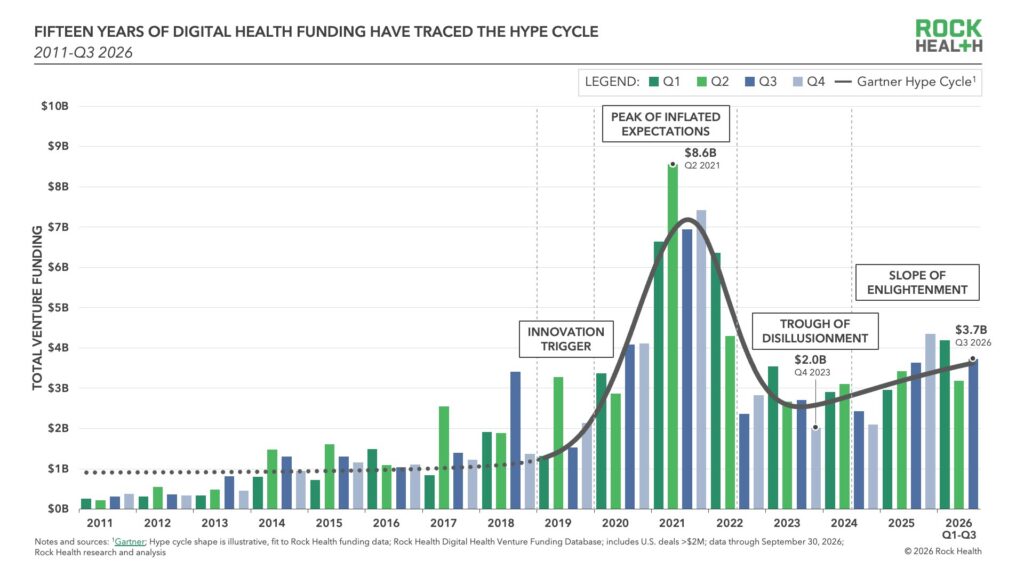
Does Gartner’s hype cycle map perfectly onto digital health funding, or was digital health funding mapped perfectly onto Gartner’s hype cycle. You tell me.
– Jason Barry, Managing Editor
|
|
|
|
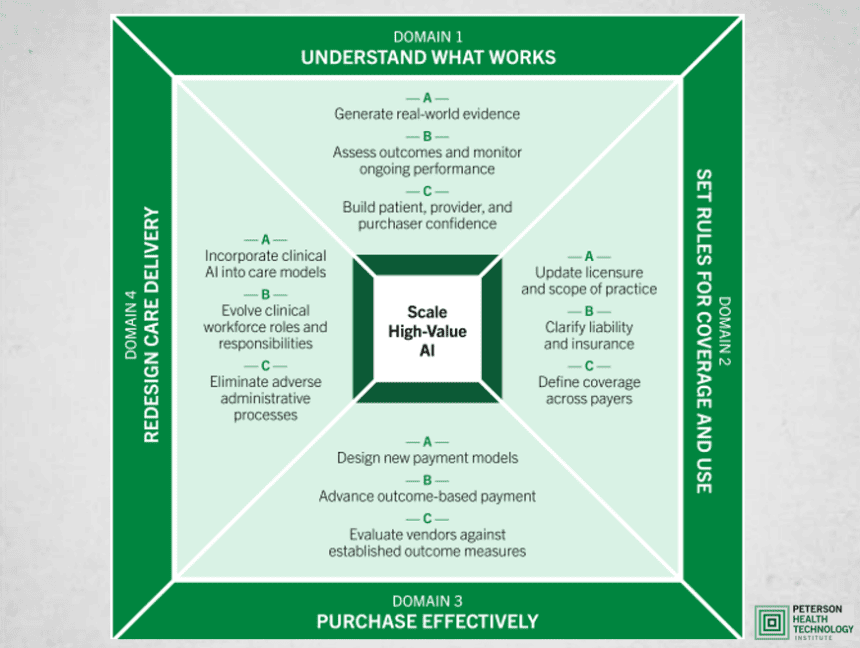
The Peterson Health Technology Institute’s new roadmap for scaling high-value AI in healthcare shows that AI does exactly what the system pays it to do – which is the problem.
Start with the diagnosis. PHTI’s four findings boil down to one: AI maximizes whatever incentives it’s handed, and today’s incentives reward transactions, documentation, and billing.
- Admin AI is spreading fastest with limited evidence of system-wide benefit, while the clinical AI most likely to expand access is stuck behind licensure, liability, and payment rules written for humans.
Exhibit A is prior auth. 60% of transactions run on phone or fax, each cycle costs plans $40-50 and providers $20-30, and across four major insurers 5,000+ codes require PA with only 3% overlap.
- Both sides are automating their half, yet nobody has shown AI lowers the cost per claim once the AI is paid for. It mostly speeds up the submit-deny-appeal loop, or as one workshop participant put it, “Bots don’t get tired of asking questions, so my review queue keeps growing.”
- PHTI’s fixes are machine-readable medical policies, standardized PA APIs in the EHR, and decision rationales instead of binary denials.
Exhibit B is the scribe. Every large health system surveyed has adopted AI documentation, and one multihospital system saw Level 5 visits rise 5% and Level 4 visits 7% after deploying a scribe, worth $1,004/month per provider.
- Payors report an immediate jump in coding intensity when the tools switch on and are deploying their own algorithms to downcode, a trajectory PHTI says payors and patients can’t keep absorbing.
Meanwhile, the good stuff is stalled. PHTI wants clinical AI aimed at access-constrained conditions with measurable outcomes: hypertension (nearly half of adults, one in four controlled) and depression and anxiety (almost half the country lives in a mental health shortage area).
- Fee-for-service fit goes from good to partial to poor as AI autonomy rises, since an AI that titrates blood pressure between visits replaces encounters instead of generating them, leaving nothing to bill.
The fix starts with payment.
- Outcome-based models are the entry point, with CMS’s ACCESS model (160+ participants since July, expanding to heart failure, COPD, and SUD next spring) as the most concrete step, alongside FDA’s TEMPO pilot, Utah’s sandbox for AI prescription renewals, and ARPA-H’s $62.7M cardiovascular agent program.
- PHTI’s three payment principles: pay only for system-level value, tie payment to results with guardrails against overuse, and start rates high to reward early adopters before ratcheting down as the software scales.
The Takeaway
PHTI just delivered a cautionary tale why AI returns have concentrated in the back office: healthcare built AI to pay for itself, and that’s easier done by denying care than delivering it.
|
|
How Clinicians Are Using AI to Find Relief
Clinicians are facing a documentation burden that’s outpaced every attempt to contain it, and they’re adopting AI to tackle the crisis faster than health systems can keep pace. Download Heidi’s new report to see how over 1,800 clinicians around the world are already using AI to find relief, and what that means for the institutions still catching up.
|
|
The Distance Between an Idea and Reality
Almost every good idea in healthcare already exists. The hard part is building it. Bunkerhill Health CEO Nishith Khandwala believes shortening the distance between ideas and solutions will be the defining feature of healthcare’s next chapter, and his new essay lays out how agentic AI is making it happen – not by being the hero, but by giving heroes the tools they need.
|
|
- Suki Series E: Suki secured $90M of Series E funding as it looks to scale its AI agents for health systems and digital health companies beyond the 450 it already works with. The ambient scribe company is now officially an ACI company – ambient clinical intelligence – after expanding beyond documentation into revenue cycle, operational workflows, and just recently clinical reasoning with the launch of Ask, which integrates Wolters Kluwer’s UpToDate Expert AI directly into the Suki experience. Fundraising isn’t a competition, but if it were this would be up on the 2026 category podium with some familiar faces.
- Rock Health’s Q3 Numbers Are In: Digital health startups raised $3.7B across 114 rounds in the third quarter, bringing our 2026 total to $11.1B. The biggest trend has stayed the same all year: investors are cutting fewer, bigger checks. Rock Health included a fresh addition in its Q3 report that we haven’t seen before: this beautiful chart of digital health’s hype cycle. It looks a lot like we’re finally in the Slope of Enlightenment, and Rock Health expects AI for proactive care, personalized medicine, and physical AI systems to help write the next chapter.
- AI ROI: A new analysis from Bain & Company confirmed the findings from Bessemer’s recent AI scorecard: ROI arrived faster and higher than expected. About 60% of payers said that AI ROIs have met or exceeded expectations, especially when it comes to handling calls. Providers are also pleased as ROI is growing for AI systems that can accurately perform ambient documentation, but adoption appears urgent. The analysis showed providers are trying to keep up with payers AI investments to keep up with forecasted increases in claims denials.
- Implementing AI in Operations: Kontakt.io just published “The Ultimate Guide to Implementing AI in Healthcare Operations,” and it lives up to the name by distilling lessons from over 100 deployments at systems like HCA and Trinity. The guide touches on model and vendor selection as you might expect, but also maps out less explored areas like optimizing staff onboarding and measuring operational impact. Worth the skim especially if you’re just getting started and need some real-world examples or comparables.
- Emergence Collects Clinect: Private equity firm Emergence is piling on to its growing healthtech heap with a new acquisition of outcomes intelligence company Clinect Healthcare. The company’s program schedules outreach and records responses for >600 patient-reported outcomes like GAD-7 and PROMIS, then incorporates them directly across more than 20 EHR integrations. Clinect also reported that its system performs well in the increasingly popular job of healthcare’s “air-traffic controller.” For Emergence, the move is a big one for covering its bases in value-based care.
- Peace Out Independent Physicians: The rate of non-independent physicians climbed from 62% in 2019 to 82% 2026. Those aren’t hopeful numbers, but RevelAI CEO Dr. Christian Pean took to LinkedIn to talk about righting the ship. Things are looking up when it comes to site-neutral payments and deconsolidation, with giant physician employers like Optum considering selling their practices. Still, Pean called out the threat of CMS’s proposed 2027 fee schedule rule which would cut down the conversion factor (again) and halve payments for lower-value services.
- Teladoc Adds AI Duo to Solo: Teladoc is bringing vital measurements to virtual appointments and expanding ambient notetaking with two newly announced AI capabilities. The contactless SoloVitals system can reportedly capture heart and breathing rates through almost-imperceptible skin color changes via a patient’s camera. The capability is expected to fully release in December, but launch should be smooth since, as the name implies, the capability is built into the preexisting Solo suite. So is SoloScribe, which is built to streamline documentation, though the ambient notetaker is available now.
- Virtual Nursing at Owensboro: Optum and KY-based Owensboro Health shared results from a virtual nursing program that pairs bedside nurses with on-site virtual nurses for admissions, discharges, and care coordination. Since 2024 the virtual team has logged 30k+ patient interactions (3,600 admissions, 2,000 discharges, ~5,800 medication verifications) – returning 1,700 hours to the bedside. July alone returned 337 hours, or about 11 extra hours of direct care per day while also creating a “landing spot” for nurses who can’t manage the physical demands of the floor.
- Price Transparency Tune-Up: CMS finalized changes to the Transparency in Coverage rule so payer machine-readable files are actually usable. Plans must strip out implausible provider-rate combos (Ex. podiatrists’ rates for heart surgery), post one in-network file per network, not per plan, lower the out-of-network reporting threshold from 20 claims to 11, and have an exec attest to accuracy (if you need this one is it even worth adding?). Cost-sharing info will also be required to be available by phone starting with 2027 plan years, and the long-delayed drug pricing files now have a timeline starting in November.
- Vocca’s $20M Voucher: AI voice agent developer Vocca just brought in a solid $20M Series A round, increasing total funding fivefold. The two-year-old startup’s AI phone assistant can reportedly handle 70% of calls without an assist from humans (with longer-held customers reporting even higher numbers). That’s led its user base to balloon from 2k to 15k in the past year. The company said the funding boost will be used to expand its scheduling capabilities beyond voice channels in a wider number of specialty arenas.
|
|
Privia Accelerates VBC Success With Navina
How do you give physicians new AI tools to accelerate VBC without slowing them down? Privia Health found its answer with Navina. They co-designed an under-one-hour training program that onboarded 800+ clinicians in the first year, driving 87% weekly active usage while providing clearer visibility into their patient panels. Read the full case study to see what it takes to make adoption stick and outcomes follow.
|
|
Telehealth Has a Ceiling. Here’s How MetroHealth Broke It
For too many patients, traditional telehealth visits often lead to a dead end. To reach its full potential, virtual care needs a reboot. The MetroHealth System partnered with Ovatient to do just that with a new virtual-first care model built on the EHR and connected to patients’ ongoing care journeys. A study of 50k patient encounters shows the results: 100% of patients were able to have a new appointment within 3 days, 35% of virtual primary care patients were net new or re-engaged, and virtual urgent care achieved 17% lower 72-hour ED use than in-person visits. Read the report to learn more about MetroHealth’s approach.
|
|
A New Path for ACCESS Model Participants
Building your CMS ACCESS program? Withings was accepted into the inaugural cohort as both a participant and a device partner via the ACCESS Tools Directory. Bring the same FDA-cleared, cellular-enabled devices into your program, including BPM Pro 2, capturing clinical measurements and patient-reported outcomes at the point of reading, purpose-built for value-based cardio-kidney-metabolic care.
|
|
- Making Healthcare Feel More Human: Abridge has always believed that the best healthcare technology should make healthcare feel more human. That means focusing on the most human signal we have: the conversation. Head over to CEO Shiv Rao’s latest blog to see Abridge’s vision for bringing the broader healthcare ecosystem into the picture, so clinicians can focus more on the practice of medicine and less on the process of medicine.
- State of Payor Enrollment and Credentialing: Over half of provider orgs are losing revenue due to credentialing delays – with many missing out on over $1M annually. Medallion’s new report unpacks the forces quietly undermining operational and financial performance, and how leaders across the industry are addressing them. Head over to the full report to get insights tailored to your role and org type.
|
|
|
|
|