|
General Medicine, Arcadia Ascent, and Utah Get Me Two
By Jason Barry and Virginia Hunt
October 8, 2026
|
|
|

|
|
Together with
|

|
|
|
“AI is making healthcare advice ubiquitous. But once you know what you need, there’s still no good way to actually get it. The AI doctor is the easy part. Nobody’s built the store.”
|
|
General Medicine CEO TJ Parker
|
|
|
This is the 500th Digital Health Wire, and as much as the tech in here has changed, the best part of the newsletter has always stayed the same: the readers. This morning’s send went out to 41,310 of you so obviously I love some of you more than others (you know who you are;), but I’m truly grateful to every single one of you for choosing to share your mornings with us. Thanks for being here<3
– Jason Barry, Managing Editor
|
|
|
|
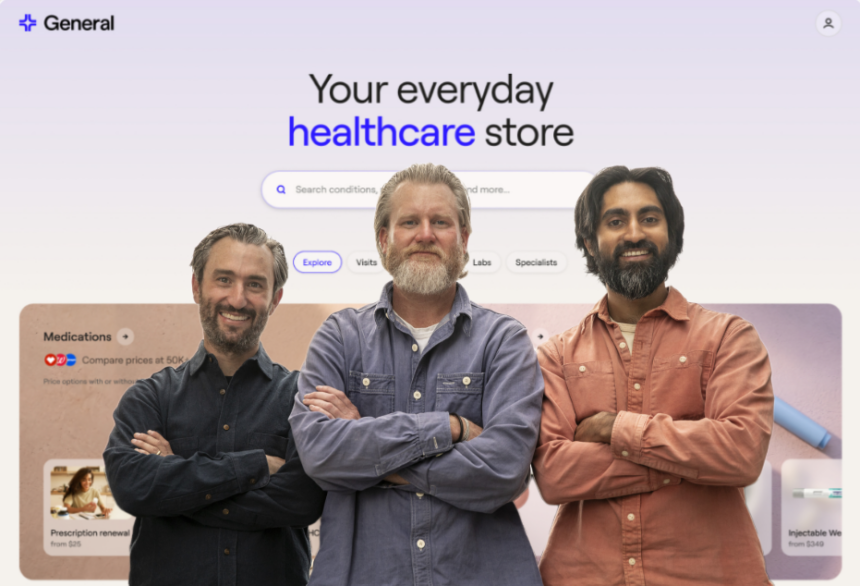
Everybody is using AI to see what they need to improve their health, but that doesn’t mean they have a store that’s magically stocked with that care. That is unless General Medicine builds it with the $120M Series B it just raised.
CEO TJ Parker has been here before. When he first noticed healthcare’s lack of great consumer experiences circa 2012, he decided to build his own – PillPack.
- PillPack didn’t grow to hundreds of millions in revenue through better contracts or technology, it got there by creating a pharmacy that consumers “actually loved using.”
- What do consumers love? Seeing actual prices, comparing their options, and choosing the one that works best for them.
General Medicine brings that same ethos to… general medicine. Who would’ve thought.
Say Dr. AI tells you to check your cholesterol. To turn that advice into care, you still have to identify the right test, determine if you need an order, and find somewhere you can go to get it.
- If the result comes back high, the same problem repeats with treatment.
- What you need is a store. Easier said than done in healthcare (per usual).
Take the cholesterol example:
- Clinicians, payers, and labs might all have different definitions for the same test.
- Two tests that look identical can be clinically different.
- Other times they’re identical in every way that matters except billing.
General Medicine is the missing product catalog. It put 2,900 distinct medications, labs, telehealth visits, and select in-person care in a single searchable store.
- GM doesn’t provide all that care itself. It lets you browse options from its own medical group, or connect with clinicians anywhere in the country through the same storefront.
- That works because GM defines the product first, then maps everything back to it. The store then combines benefits, contracted rates, and manufacturer discounts to show customers what their care will actually cost before they decide.
Product definitions are only half the problem. You also have to understand your customer. GM gathers an average of 11 years of health history for each of its customers.
- When you search for a cholesterol test, GM already has your history and coverage information, so you can easily compare labs and treatment options if needed.
- For $15, a GM clinician will review your history and results, determine which treatments are appropriate, and help make any changes if there’s side effects down the road.
Sound too good to be true? Maybe, but a16z believed in the vision enough to lead a nine-figure round, and the store won’t have any problem getting people through the door if it can recreate some of the consumer magic we’ve already seen with certain packaged pill companies.
The Takeaway
Healthcare has always been organized by who delivers care, not what someone is trying to accomplish. General Medicine is building its store the other way around, and $120M should be enough to tell which way consumers prefer.
|
|
Making Healthcare Feel More Human
Abridge has always believed that the best healthcare technology should make healthcare feel more human. That means focusing on the most human signal we have: the conversation. Head over to CEO Shiv Rao’s latest blog to see Abridge’s vision for bringing the broader healthcare ecosystem into the picture, so clinicians can focus more on the practice of medicine and less on the process of medicine.
|
|
Inside the GLP-1 Patient Journey
Withings just showed what 2,500+ patients reveal about the care gaps in weight-loss treatment. The survey of connected-scale users on GLP-1s – current, former, and prospective – mapping their treatment journey, where care breaks down, and where remote monitoring fits in. Get the full report.
|
|
- Utah, Get Me Two: Utah needs to take its shoes off before coming in the house after spending all week in its new “AI sandbox.” The program extends the pathway paved by Doctronic, which allowed AI to renew prescriptions originally written by clinicians, to companies looking to have their AI handle the initial script (without so much as a doctor’s signature). Three of these hopefuls have already jumped into the sandbox to start generating the safety data they need to earn full autonomy: Nolla Health (uses AI intake and patient photos to prescribe low-risk acne meds), August AI (currently testing AI renewals for 100+ scripts), and Expect Fitness (AI-guided pelvic floor physical therapy).
- Ascent, CareJourney, LifeScience: Arcadia took the lid off its new performance platform that helps healthcare orgs move from fragmented data to coordinated action across every population: Arcadia Ascent (for providers and payers), Arcadia CareJourney (market intelligence), and Arcadia LifeScience (RWE activation). The launch aims to settle the $1.5T tab that healthcare racks up on administrative waste every year, not by replacing the people doing that work, but by redeploying them into higher-value roles. The platform ties up a string of big moves from Arcadia, and the early metrics speak for themselves: a CIN closed 708k quality gaps in one year, a health system generated $7.5M in shared savings, and a health plan cut analyst time by 29%.
- Trends Shaping the Health Economy: Trilliant Health’s 2026 Trends Report delivered as much great data on the U.S. health economy as you could ask for, and then some. The 141 page analysis summed up the current state of affairs as “a textbook tragedy of the commons” that incentivizes individual actors for behavior the collective cannot sustain. Bookmark this one for whenever you have time to roll up your sleeves with – wraps tons of great numbers around how a declining commercial population, evolving care settings, and increasing price caps are challenging the long-held premise of more patients and more revenue.
- Artisight Acquires TMG: Deployment speed is turning into a competitive advantage as smart hospital rollouts scale up, and Artisight just acquired deployment firm TMG Global to sharpen its edge. TMG specializes in healthcare site surveys, network deployment, and large-scale implementation – all areas that are apparently important enough for Artisight to bring in-house. The AI-powered smart hospital platform has been quickly expanding across health systems like MetroHealth and WellSpan, and TMG will reportedly address the “recurring bottleneck” of coordinating third-party subcontractors during deployments.
- More Margin, More Mortality: A study out of UPenn showed that patients at for-profit hospitals fare significantly worse than those at nonprofits. Using 2024 data on over a million Medicare admissions at 143 FP and 798 NP hospitals across 10 states, for-profit hospitals had about 11 more deaths per 1k admissions (staffing differences were linked to nearly 45% of the gap), and 30-day readmission rates 2.04 percentage points higher for medical patients. Nurse burnout rates were also 9 pp higher, with staffing linked to about two-thirds of the difference over NP hospitals.
- Vitalize Series A: Vitalize hauled in $31M of Series A funding to bring “air traffic control” to healthcare. Moving past the fact that this is probably the fourth startup we’ve covered with that copy on their homepage, Vitalize’s workforce platform coordinates staffing and capacity across the enterprise, leveraging AI to automate manual scheduling tasks and forecast demand across thousands of beds. With every shift it manages, the platform learns a system’s specific rules and sharpens its recommendations, integrating natively with EHRs and payroll systems to replace “the 10-plus patchwork tools clinical teams juggle today” to accomplish the same thing.
- Aging in Place of Choice: DiMe added to its excellent library of public resources with Aging in Place of Choice, which includes playbooks to help digital health companies and providers build and implement technology for seniors. You can find a trio of new tools on the landing page: (1) AgeTech Developer Playbook for guidance on product design, business models, and reimbursement; (2) Care Provider Playbook for identifying where AgeTech can address a need and evaluating potential solutions; (3) Lived Experience Repository for insights on the unmet needs of older adults and tech adoption barriers.
- Elsevier’s AI Nursing Expert: More nurses are using AI, but many still don’t fully trust it, which is why Elsevier is looking to bridge the gap with ClinicalKey Nursing AI. The new solution allows nurses to ask questions in plain language and get answers based on the clinical content within Elsevier’s platform – citations included – and the results have proved promising. A pilot study showed nine in ten nurses felt more confident in their clinical decisions using the platform.
- Clinician-AI Scientists: Clinician-scientists are great, but a new viewpoint in The Lancet Digital Health makes the case that clinician-AI scientists are even better. As AI advances at a breakneck pace, the article calls for physicians trained in both medicine and AI to steer the technology into clinical practice. Although the authors skim over the fact that doctors don’t exactly have a ton of downtime to study AI when they’re done saving lives, they did note that focusing too much on AI runs the risk of stealing focus from clinical competence.
- Assorted Milestones: Assort Health shared new data on its patient-facing agents in the wake of its latest mega-round, citing its 95% resolution rate as proof we’ve reached the tipping point where AI can carry more of the communication burden for overworked practices. The agents now support 1,300+ providers across family medicine, internal medicine, and pediatrics, handling everything from scheduling and intake to refills and navigation. Since deploying Assort, Annapolis Internal Medicine has reportedly cut hold times by 75%, while Pediatric Associates of Southwest Missouri increased staff capacity by 68% and reclaimed 45 staff hours per week.
|
|
Turning Ideas Into Action
Healthcare has never been short on great ideas. What is new is the ability to turn them into reality at the pace patients need. Discover how Bunkerhill Health is closing the distance between knowing and doing, so providers can get back the two things they never have enough of: the time and the clarity to care for people.
|
|
State of Payer Enrollment and Credentialing
Over half of provider orgs are losing revenue due to credentialing delays – with many missing out on over $1M annually. Medallion’s new report unpacks the forces quietly undermining operational and financial performance, and how leaders across the industry are addressing them. Check out the full report to get insights tailored to your role and org type.
|
|
Unlock Better Care With LOLA
Whether you’re looking to augment your team’s capacity or capabilities, Tucuvi’s clinically validated LOLA voice agent is purpose-built to make it happen – and has the success stories to prove it. Hear first-hand from Tucuvi’s customers how LOLA is empowering clinical teams to care for patients while maximizing ROI.
|
|
- How Clinicians Are Using AI to Find Relief: Clinicians are facing a documentation burden that’s outpaced every attempt to contain it, and they’re adopting AI to tackle the crisis faster than health systems can keep pace. Download Heidi’s new report to see how over 1,800 clinicians around the world are already using AI to find relief, and what that means for the institutions still catching up.
- Virtual-First, Local Always: The humans of healthcare can get lost in the background at conferences full of robo-docs and AI assistants, but deep personal connections are just as key as new technologies for driving better outcomes. Find out how Ovatient is keeping care “virtual-first, local always” in Digital Health Wire’s rapid-fire interview from the ViVE exhibit hall.
- Making the Case for AI: Healthcare organizations have a lot to gain from implementing AI that can enhance coding accuracy and quality metrics, but securing buy-in from leadership is a crucial first step. Check out Navina’s new guide by Dr. Michael S. Barr to see exactly how to demonstrate clear financial benefits, ROI potential, and alignment with organizational priorities to help ensure AI projects are successful.
|
|
|
|
|


