|
AMIE’s an Expert, SmarterDx Merges, and the Crosshairs Shift to Epic
By Jason Barry and Virginia Hunt
August 17, 2026
|
|
|

|
|
Together with
|

|
|
|
“To some observers… AI would appear on the surface to be a new technology arms race, in which health plans invest first, health systems and hospitals catch up, there’s a certain level of disruption, and eventually a new equilibrium emerges. But it would be a mistake to assume that the AI-led disruption of today will play out similarly to the changes wrought by automation.”
|
|
Former Smarter Technologies CEO Jeremy Delinksy
|
|
|
The day has finally arrived. AI is now on par with human clinicians for video visits, the only catch is that patients still have to stick to a script. Getting there one step at a time!
Also, make sure you’re being nice to STAT (especially if you’re up to any funny business;) because the same reporters that aired Commure’s dirty laundry just kept their streak going with a hit piece on Epic.
We’ve got another juicy one lined up!
Jason
|
|
|
|
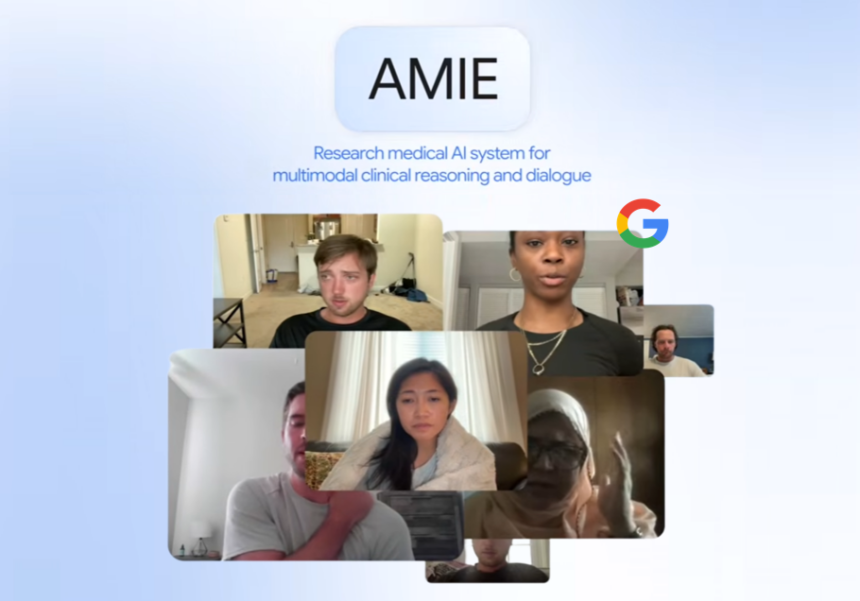
The moment has arrived. AI is now as good as physicians at conducting real-time video consultations – so long as patients stick to the script.
There’s a new expert in town. It’s Google’s flagship medical AI researcher named the Articulate Medical Intelligence Explorer, but its friends call it AMIE for short.
AMIE gets its eyes and ears from a three-agent architecture built on Gemini and Project Astra, which splits the job so no single model has to think and respond at the same time:
- A Talker agent keeps the conversation flowing with low-latency responses.
- A Planner agent continuously updates the differential diagnosis and clinical goals.
- A Perception agent watches the live audio-video stream for clinically relevant cues.
Google put AMIE through the wringer. A randomized study pitted AMIE against 10 board-certified PCPs across 100 telehealth scenarios enacted by 15 professional patient actors, with 20 independent physicians grading the encounters.
AMIE matched or beat the PCPs across the board:
- Overall clinical rubric score: 83% vs. 68%
- Top-1 diagnostic accuracy: 91% vs. 77%
- Perception and examination: 74% vs. 47%
The physical exam gap was the eye-opener. AMIE proactively coached patient actors through maneuvers like range-of-motion tests and self-palpation, while the human PCPs mostly fell back on verbal history-taking.
- Patient actors preferred AMIE for assessing and explaining their conditions, but still preferred humans for rapport, with interviews describing AMIE as having awkward pauses and odd conversational cadence.
Here’s the disclaimer. These were patient actors following scripts, not real patients. The physicians had to keep their cameras off, and AMIE still whiffed on subtle signals like tremors, nystagmus, and affect – the exact cues where perception matters most.
- That’s not exactly real-world validation, but that’s already underway through a feasibility study with Beth Israel Deaconess and a nationwide study with Included Health.
The Takeaway
When AMIE first prompted predictions that patients would soon see an “AI doctor” before a human one, the missing physical exam was the go-to rebuttal. That gap just got noticeably smaller, and it doesn’t feel like we’ll be able to write too many more of these before it disappears completely.
|
|
Full Context for Complex Patients
Clinicians want to walk into the exam room fully prepared, without the nights and weekends spent poring over charts. Abridge’s Care Signals makes this possible. Co-developed with Kaiser Permanente, the risk-adjustment technology flags risk gaps pre-visit, tracks discussion topics, and creates audit-ready documentation of confirmed conditions. Check out Abridge’s latest move beyond clinical notetaking.
|
|
The Agentic Platform for Your Environment
Your care plans. Your patients. Every health system is unique, which is why Tucuvi tailors its agentic platform to the day-to-day realities of care delivery at each of its partners. With configurable protocols and seamless EHR integration from day one, LOLA is the AI voice agent care teams trust to reach every patient. See LOLA handle real care workflows with your use cases today.
|
|
- Epic Investigation: Nobody’s safe from STAT reporters Casey Ross and Brittany Trang this summer. Less than a week after dragging Commure across the coals, the dynamic duo got the scoop on a federal investigation into Epic’s alleged anticompetitive practices. FTC officials have reached out to at least four people in recent months as part of a broad inquiry into the EHR behemoth’s business. The government is apparently especially interested in Epic’s non-compete clauses for employees and the extent that it wields its leverage over hospitals to block rival companies from accessing patient data. Still early innings, but a lot of eager eyes will be watching to see if Epic gets knocked down a peg.
- Epic Image Exchange: When it’s not busy fending off federal investigators, Epic is now tackling the image exchange dilemma with new functionality added to its Care Everywhere platform that enables users to retrieve and share diagnostic-quality medical images. Epic executives told Fierce Healthcare that the solution makes it easier to access prior imaging exams in real time without resorting to CDs. Up to now, Epic users have only been able to share radiology reports and reference-quality images through Care Everywhere. The functionality will be highlighted at Epic’s user group meeting later this month.
- Datavant + SmarterDx: Another big scoop arrived last week after Axios unveiled New Mountain Capital’s plan to merge SmarterDx with Datavant. The move is slated to follow Datavant’s debt recapitalization, which will require securing another $2.5B through a JPM-run recap process to restructure its existing facility. SmarterDx helps analyze procedures to ensure medical records support the correct reimbursement, and will be folded into Datavant’s data collaboration platform after the recap is complete. Not exactly clear what’s happening to the other two corners of the Smarter Technologies triangle after SmarterDx breaks off from Thoughtful and Access Healthcare.
- Ambient AI for the OR: Apella published two peer-reviewed studies from its Houston Methodist deployment that give ambient AI in the OR some real receipts. Using a difference-in-differences approach, researchers found a 7% case volume increase in a 15-room cardiothoracic suite – roughly 300 extra cases per year without needing new resources. The second study showed Apella’s Flagged Cases tool improved scheduling accuracy 40% and cut late-ending OR days by 46 percentage points. Houston Methodist was impressed with the results enough to join Apella’s Series B earlier this year.
- Unite Us and Vircho Unite: Unite Us acquired Vircho Health to bring more analytics into its closed-loop referral system. Unite Us explained the move using one of digital health’s catchphrases of the year: more measurement-based care. Vircho will allow hundreds of health systems already relying on Unite Us to connect social determinants of health to treatment – and keep track of their progress. Vircho also has plenty of data to back up its capabilities, with early results showing $250k savings and 33% faster response time.
- HealthEx Powers Up AskMD: HealthEx is partnering with Sharecare to bring patients’ full clinical context into AskMD, Sharecare’s AI-powered health navigation experience. When users opt in, HealthEx assembles their labs, meds, conditions, and clinical notes from across every place they’ve received care – made possible by TEFCA and direct provider connections – so AskMD’s guidance is grounded in their full history rather than a fragment of it.
- Could Reminders Boost Lung Screening Rates? The answer might depend on the method of outreach, and a JAMA Internal Medicine study tried to zero in on what’s most effective. Among 1.8k participants, more intense outreach geared toward reminding patients and their doctors to schedule scans improved screening rates by 28 percentage points. On the other hand, patient-focused reminders sent through portals or mail were not as successful and actually led to a 4.7-percentage-point decrease in screening.
- Oracle Opts for More Layoffs: All signs appear to be pointing toward Oracle making double-digit headcount cuts for the second time this year. Business Insider broke the news that Oracle is planning to level workforce spending again in September. The layoffs seem to be an attempt to balance out billions in debt that have snowballed during the company’s evolution into an AI datacenter slumlord. The upcoming round of layoffs would add to the 30k employees (18%) who were let go back in March.
- Gemini, the AI Booking Agent: For the 47% of people who have used AI to search for a provider, Gemini is now creating a more direct path to treatment through a new partnership with Zocdoc. The collaboration will create a platform-to-physician pipeline by allowing users to book an appointment with one of Zocdoc’s 200k providers all without leaving the chatbot. This move is another big one for Zocdoc, with Yelp and Healthgrades both adding scheduling icons for the service to their pages in the last year.
- Americans Most Concerned About Costs: Across the aisle, Americans agree that out-of-pocket costs and insurance premiums are their biggest healthcare stressors. The Commonwealth Fund interviewed 25k U.S. adults and found that over 80% of insured respondents ranked healthcare costs as the largest issue. What to do about it? Well, people were significantly more divided on that one. About 65% of Democrats put the responsibility on the government, compared to 36% of Republicans, while 40% of Republicans and 16% of Democrats said it’s payers’ problem to solve.
- Suvi Soothes the Stress of Care Coordination: Suvi Health just launched to turn bedside conversations with providers into actionable steps for family and caregivers. The ambient AI platform’s development was part of a year-long project by the University of Notre Dame’s 1842 Fund and Mayo Clinic to make care handoffs easier. Patients reportedly remember less than 20% of conversations they have in the hospital, so Suvi’s ability to sort to-dos into a prioritized task list could help reduce the stress of inpatient care.
|
|
How MetroHealth Reduced Barriers to Care
Modern consumers want easy access to healthcare. MetroHealth met the moment with a patient-centered model where there’s no wrong door to care. The system partnered with Ovatient to offer virtual urgent, primary, and behavioral health care, while leveraging Ovatient and Phox Health to provide same-day prescription delivery. Read the case study to learn more.
|
|
Start Practicing With a Partner
What began with notes now supports the work that surrounds them. From conversations to clinical questions and follow-ups, Heidi brings the full clinical day into one platform. See why clinicians across the country are making Heidi their trusted AI Care Partner.
|
|
The Distance Between an Idea and Reality
Almost every good idea in healthcare already exists. The hard part is building it. Bunkerhill Health CEO Nishith Khandwala believes shortening the distance between ideas and solutions will be the defining feature of healthcare’s next chapter, and his new essay lays out how agentic AI is making it happen – not by being the hero, but by giving heroes the tools they need.
|
|
- State of Payor Enrollment and Credentialing: Over half of provider orgs are losing revenue due to credentialing delays – with many missing out on over $1M annually. Medallion’s new report unpacks the forces quietly undermining operational and financial performance, and how leaders across the industry are addressing them. Head over to the full report to get insights tailored to your role and org type.
- Redefining Patient Monitoring for Obesity & Diabetes: Weight management programs live and die by adherence. Discover why partners like Calibrate, 9am Health, and Wondr Health trust Withings to keep members weighing in, with cellular-connected scales that deliver instant weight insights, full body composition data, and the lowest possible barrier to action throughout their weight loss journey.
- How Clinicians Are Using AI to Find Relief: Clinicians are facing a documentation burden that’s outpaced every attempt to contain it, and they’re adopting AI to tackle the crisis faster than health systems can keep pace. Download Heidi’s new report to see how over 1,800 clinicians around the world are already using AI to find relief, and what that means for the institutions still catching up.
|
|
|
|
|