|
App-titude Testing, Hinge Health, and Patient Portals
By Jack Troy
August 6, 2026
|
|
|

|
|
Together with
|

|
|
|
“I can’t envision my grandpa hopping on a Zoom meeting to talk about his mental health.”
|
|
U.S. House candidate Matt Little at Minnesota Farmfest. More on rural telehealth below…
|
|
|
It’s over already? I’ll be passing the reins back to Jason Barry after this issue, but thanks for trusting me as your Digital Health Wire editor these last couple of weeks. I had a blast. While you wait for Jason’s triumphant return, enjoy the latest on app-based interventions, digital health dealmaking, patient portal overload, and more.
One more thing! If life sciences are your jam, consider signing up for The Bio Wire. It goes live Sept. 3. I’ll be writing it, if that helps.
-Jack
|
|
|
|
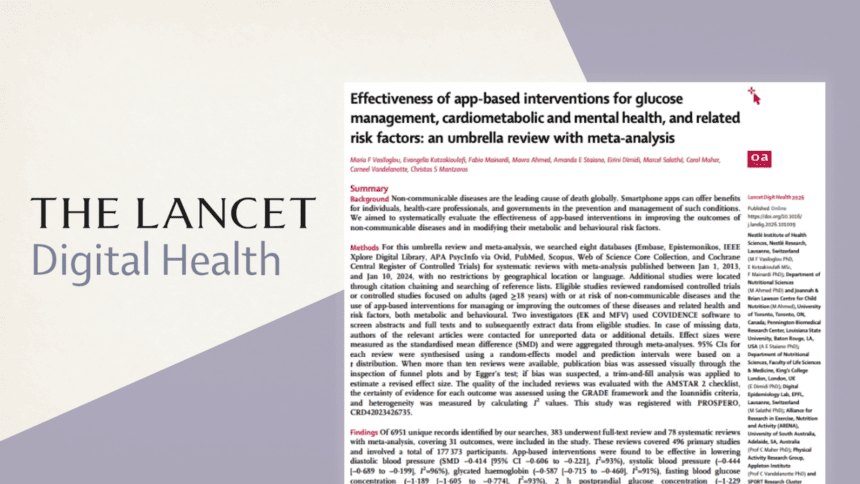
Anxiety, obesity, diabetes — there’s apps for all that and more. But which risk factors and outcomes actually respond to smartphone-based interventions? A new paper in The Lancet Digital Health separates helpful software from homescreen clutter.
Mountains of data went into this study. The umbrella review and meta-analysis covered 78 systematic reviews, 496 primary studies, and over 177k participants.
Apps came out looking pretty good. They made a dent in 21 of 31 outcomes.
- Users got moving, adding to their step counts and exercise time.
- BMI, weight, and waist size (but somehow not body fat percentage) fell.
- On the mental health front, anxiety, mindfulness, and stress saw the most positive movement, with depression and wellbeing just behind.
- Glucose levels improved — more than any other metric, at that.
But the study was a heartbreaker for cardiovascular disease apps (and a grab bag of other categories).
- Blood pressure was the only CV outcome that responded to apps.
- Cholesterol, triglycerides, and CV disease mortality didn’t budge.
- Fruit and veggie intake, smoking, and hospitalization were also unchanged.
Here’s where the lessons on better building and deploying apps come in. Researchers, clinicians, developers, and policymakers, take note.
- Tracking and monitoring were most useful when it came to physical activity, glucose management, nutrition, and medication adherence.
- Educational content went a long way for mental health.
- Support from healthcare professionals or a community was broadly helpful.
- Goal-setting and behavioral planning were generally underused.
Some outcomes might just be harder to achieve, though.
- The researchers theorize that apps are good at short-term behavioral changes, but struggle with conditions that require intensive, multifaceted care.
The Takeaway
App-based interventions are cheap, non-invasive, and low commitment, but this study shows they’re not useful for all conditions. Take that how you will, either as a sign to ditch smartphones for some types of care or double-down with better features.
|
|
Unlock Better Care With LOLA
Whether you’re looking to augment your team’s capacity or capabilities, Tucuvi’s clinically validated LOLA voice agent is purpose-built to make it happen – and has the success stories to prove it. Hear first-hand from Tucuvi’s customers how LOLA is empowering clinical teams to care for patients while maximizing ROI.
|
|
Full Context for Complex Patients
Clinicians want to walk into the exam room fully prepared, without the nights and weekends spent poring over charts. Abridge’s Care Signals makes this possible. Co-developed with Kaiser Permanente, the risk-adjustment technology flags risk gaps pre-visit, tracks discussion topics, and creates audit-ready documentation of confirmed conditions. Check out Abridge’s latest move beyond clinical notetaking.
|
|
- Dealmaking Declines: CB Insights says Q2 brought just 228 digital health deals, down 36% from Q1. That marks the slowest quarter in more than a decade. Funding also fell, going from $7.5B to $5.7B, even with the $2.1B megaround for DeepMind drug discovery spinoff Isomorphic Labs. Average deal size rose dramatically in H1 over 2025 ($31.7M vs. $19.9M), continuing a trend toward more established companies.
- Epic AI Cuts Hospital Deaths: A new NEJM AI staggered cohort study found the Epic Deterioration Index can slash inpatient mortality. Researchers tracked 23k high-risk patients at RWJBarnabas Health, observing an 18% drop in risk-adjusted death odds when using the AI-based deterioration predictor and rapid response alert system. It’s just one hospital network, but the results offer a clear example of clinical AI saving lives.
- Hinge + Cylinder: Hinge Health is acquiring digestive health startup Cylinder Health for $105M cash. The plan is to integrate a GI care program into the Hinge app (not that one) to complement existing musculoskeletal and migraine offerings. Hinge says it’s a matter of demand, since many of its users have chronic digestive issues, and adding Cylinder provides a running start. Pair the acquisition with a strong Q2, where Hinge grew YoY revenue by 53%, and the firm looks to be on a strong trajectory.
- Rural Telehealth Use: You could be forgiven for thinking telehealth is more popular in rural communities, which often lack nearby providers. But a recent Elevance analysis of 11.5M members with chronic conditions found the opposite: Rural telehealth uptake lags behind non-rural populations. The largest disparity comes from Medicaid patients (19.9% vs. 30.1%), followed by Medicare (18.7% vs. 27%), and commercial (18.2% vs. 26.4%). The causes aren’t clear, but internet access, cost, and digital literacy might play a role.
- Spotting Sleep Apnea: Samsung’s Galaxy Ring became the first wearable of its kind to receive FDA clearance for sleep apnea detection. Set to launch this fall, the feature uses blood oxygen and movement data to log sleep disruptions. Enough wake-ups, and users are advised to see a doctor. Samsung (and Apple) smartwatches got these capabilities in 2024, so it’s not the tech that’s noteworthy so much as its introduction to the fast-growing smartring market.
- DarioHealth Nabs $24M: Faced with dwindling cash on hand, chronic care platform DarioHealth used a registered direct offering to secure $24M. A mix of new and old investors, including a board member, purchased just under 3.5M shares. The money will go toward “working capital, investment, acquisitions, and general corporate purposes” — so just about anything. About a week after the raise, the firm launched a GLP-1 prescribing and monitoring program in collaboration with Beluga Health.
- Patient Portal Super Users: A new Health Affairs paper analyzed portal messages from 487k UCSF Health patients, and found a chatty few did most of the talking. Just 5% of patients sent 53% of messages. The same dynamic appeared on the receiving end, with the top quartile of 224k U.S. doctors getting 53 messages a week, compared to a median of 10. Higher message volume was tied to more after-hours EHR time for physicians. We see you, patient portal grinders.
- Abridge + Altrina: Abridge made its first-ever M&A move by acquiring Y Combinator-backed startup Altrina. Formerly known as Tessa AI, Altrina spent the last year-plus building AI agents, automating EHR workflows, and developing IT infrastructure. The acquisition comes during a time of rapid growth for Abridge, which recently moved into clinical decision support and is rolling out Care Signals, a tool that feeds doctors pre-visit notes and in-visit reminders about patients’ health histories.
- Don’t Sleep on Apollo: Apollo Neuro’s vibrating wearable bought users some extra Zs in a recent JMIR mHealth and uHealth study. The analysis looked at sleep time (tracked by Oura Rings) for 935 users. Those who typically caught less than six hours gained an average of 46 minutes, a bump that diminished but did not disappear for longer sleepers. REM rose, so it seems users got better rest, not just more of it.
- Blaze Banks $8.5M: No-code healthcare app builder Blaze.tech is up to $8.5M in pre-seed funding to fuel hiring, product development, and deeper data integration. With a bit of prompting, the platform’s AI quickly creates HIPAA-complaint software, like patient portals and billing tools. The app’s look and layout can be refined using drag-and-drop modules. Blaze isn’t the first easy app builder in healthcare, but it has landed a few notable clients, including Blue Cross Blue Shield and UCLA Health.
- Measuring Medical AI Superintelligence: The first lab to claim they’ve developed medical superintelligence has a lot to gain — money, acclaim, and the warm fuzzies from helping patients. But how will we know it’s actually that good? A new Nature Medicine article argues true superintelligence must beat top-tier doctors across meaningful tasks, account for real-world tradeoffs and properly handle long-term cases. From there, the piece introduces the Medical AI Superintelligence Test, an evaluation and benchmarking framework that goes beyond measuring minimum competence.
|
|
Privia Accelerates VBC Success With Navina
How do you give physicians new AI tools to accelerate VBC without slowing them down? Privia Health found its answer with Navina. They co-designed an under-one-hour training program that onboarded 800+ clinicians in the first year, driving 87% weekly active usage while providing clearer visibility into their patient panels. Read the full case study to see what it takes to make adoption stick and outcomes follow.
|
|
Turning Ideas Into Action
Healthcare has never been short on great ideas. What is new is the ability to turn them into reality at the pace patients need. Discover how Bunkerhill Health is closing the distance between knowing and doing, so providers can get back the two things they never have enough of: the time and the clarity to care for people.
|
|
How MetroHealth Reduced Barriers to Care
Modern consumers want easy access to healthcare. MetroHealth met the moment with a patient-centered model where there’s no wrong door to care. The system partnered with Ovatient to offer virtual urgent, primary, and behavioral health care, while leveraging Ovatient and Phox Health to provide same-day prescription delivery. Read the case study to learn more.
|
|
- State of Payer Enrollment and Credentialing: Over half of provider orgs are losing revenue due to credentialing delays – with many missing out on over $1M annually. Medallion’s new report unpacks the forces quietly undermining operational and financial performance, and how leaders across the industry are addressing them. Check out the full report to get insights tailored to your role and org type.
- How Clinicians Are Using AI to Find Relief: Clinicians are facing a documentation burden that’s outpaced every attempt to contain it, and they’re adopting AI to tackle the crisis faster than health systems can keep pace. Download Heidi’s new report to see how over 1,800 clinicians around the world are already using AI to find relief, and what that means for the institutions still catching up.
- A New Path for ACCESS Model Participants: Building your CMS ACCESS program? Withings was accepted into the inaugural cohort as both a participant and a device partner via the ACCESS Tools Directory. Bring the same FDA-cleared, cellular-enabled devices into your program, including BPM Pro 2, capturing clinical measurements and patient-reported outcomes at the point of reading, purpose-built for value-based cardio-kidney-metabolic care.
|
|
|
|
|