|
Mispricing the RCM Bundle, FDA Turmoil, and Nursing News
By Jason Barry
May 14, 2026
|
|
|

|
|
Together with
|

|
|
|
“Every few years, investors find a new market to draw lines through. Take something bundled – a platform, an industry vertical, a system that does too many things under one roof – and split it into specialized companies that each do one thing better… A useful mental model, or at least one that keeps the fundraising moving. Now it’s pointed at healthcare’s billing infrastructure.”
|
|
Healthcare Whisperer Andrew Tsang
|
|
|
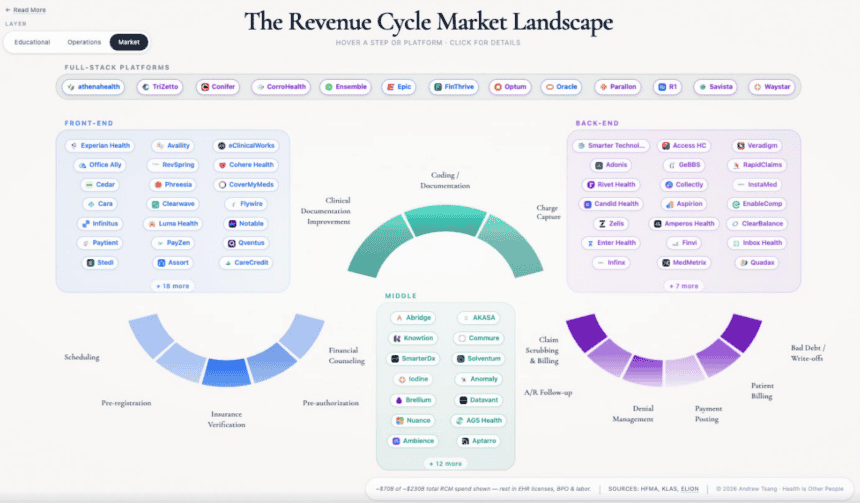
Everybody loves a good market map (DHW included), so today we’re highlighting what might be the best RCM category breakdown we’ve ever seen.
Also on deck – nurses getting left out, and nurses getting included.
Let’s get into it.
Jason
|
|
|
|
Recovering consultant Andrew Tsang is back with another top tier analysis exploring why healthcare’s revenue cycle management bundle is currently mispriced.
Great bundles lead to great unbundling. The term “unbundling” was first coined in a 2010 Tumblr post that applied the concept to Craigslist, a patchwork homepage of loosely related categories waiting to be peeled off as specialized startups.
- AirBnB eventually took housing, Indeed took jobs, and dating apps took personals. Investors were standing by with checkbooks in hand every time.
RCM is healthcare’s Craigslist. It’s a $300B monster of about a dozen different steps that exist to process the disagreement when payors and providers can’t agree on what care is worth.
- RCM is practically begging to be broken into its component parts (prior auth, clinical documentation, denials), but the same investors funding the unbundling thesis are also the ones writing huge checks to fuse the wedges back together.
That’s because Craigslist isn’t linked like RCM. You don’t need a new love interest to get a new couch, and you don’t need a new couch to get a new love interest. Although it couldn’t hurt.
- With RCM, optimize coding and the patient’s bill goes up. Optimize collections and patients defer future care. Every optimization at one step ripples through the others.
Hospital execs know this. They’re not buying best-of-breed point solutions, they’re consolidating onto platforms that cover the full lifecycle, and vendors are behaving accordingly.
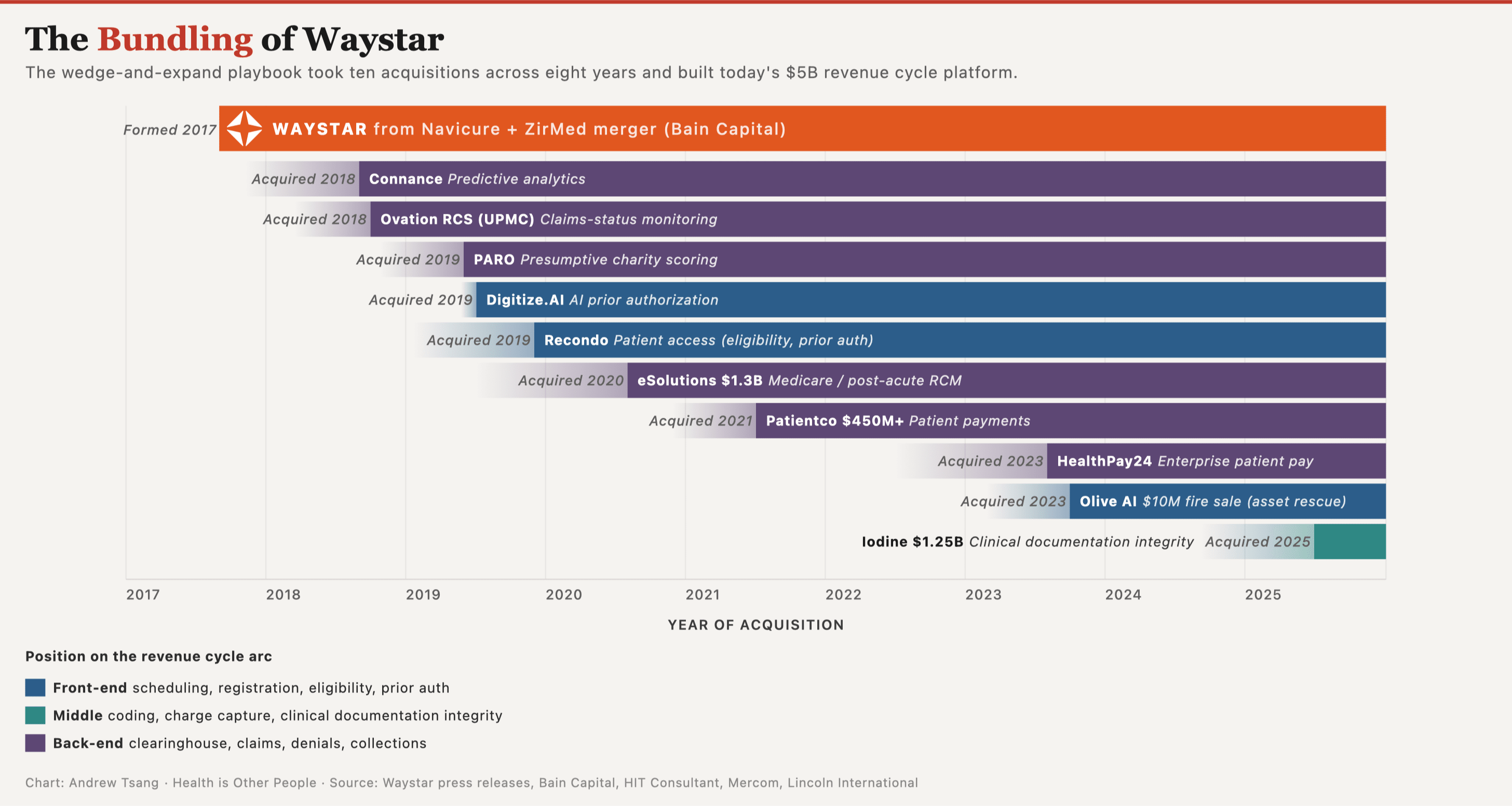
- Tsang argues that RCM vendors are rational actors that are being pushed to acquire nearby wedges rather than build them, and you don’t have to look much further than Waystar or Smarter Technologies to find evidence to support that.
- “The payor-provider fight is structurally dysfunctional, and that dysfunction rewards positioning over performance.”
RCM isn’t getting unbundled, it’s getting rolled up. When IT budgets get cut, CFOs pick the partner who covers enough of the arc to be worth keeping.
- The worse the market gets, the more valuable broad coverage becomes, and the RCM platform moat continues compounding. That’s the state of the RCM market.
The Takeaway
Tsang makes a compelling case that the RCM vendors that survive the next decade won’t be the ones that reduce the claims disagreement. They’ll be the ones that own the channel for it.
|
|
A Care Partner for the Full Clinical Day
Patient conversations are more than just a note. Heidi supports clinicians across the day from documentation to decisions and follow-ups, without adding any burden. See why clinicians around the globe are turning to Heidi for a true AI Care Partner.
|
|
State of Payor Enrollment and Credentialing
AI is changing the way that healthcare leaders tackle provider network management. Medallion’s latest report breaks down the biggest challenges, emerging trends, and how automation is transforming the landscape. Get the insights you need – read the full report today.
|
|
- WHOOP Gets Clinical: WHOOP is diving deeper into healthcare with the unveiling of on-demand video consultations and a HealthEx partnership for EHR syncing. The clinical push was paired with two AI updates, a “My Memory” persistent context layer for personalized coaching and “Proactive Check-Ins” for timely recommendations based on biometric trends. The moves come less than two months after WHOOP closed a $575M round at a $10.1B valuation, and a few weeks after it announced its participation in CMS’ new ACCESS chronic care program.
- Nurses Feel Overlooked: Elsevier’s just-published Clinician of the Future report shows that nurses feel left out of both the AI boom and decision-making at their org. The survey of 2,757 clinicians showed that just 41% of nurses frequently use AI tools (compared with 57% of physicians), and only 55% believe AI will save them time within the next two to three years (significantly less than the 70% of doctors who said the same). One key driver was that 41% of nurses said their views are rarely or never reflected in AI decision-making, a massive gap considering only 18% of physicians felt nurses’ views aren’t reflected.
- Abridge for Nurses: The nurses feeling left out of all the AI innovation didn’t have to wait long for Abridge to lend a helping hand. Co-developed alongside Mayo Clinic, Abridge for Nurses translates bedside conversations into discrete documentation that’s deeply connected to the realities of nursing workflows and the care delivered throughout a shift. Early numbers leveraging GPT-5.4 look impressive, with Abridge able to draft 30-40% more flowsheet fields from the bedside conversation versus the previous generation for nurse review.
- Telemedicine vs Utilization: New research in JAMA Network Open suggests telemedicine might reduce overall visits and spending, key word: “might.” The difference-in-differences analyses of over 3M U.S. adults during 2019 to 2023 suggested that high-telemedicine-adopting areas had 2.4% fewer visits and 0.5% lower spending, but the 95% confidence intervals crossed the null across all populations (Medicare, MA, Medicaid, dual eligible, commercial). Although that means telemedicine wasn’t significantly associated with any major changes, the authors point out that it should also ease concerns about virtual care driving large spending increases.
- Electronic Prior Auth Adopters: CMS announced the 29 healthcare organizations that have already signed on as early adopters in its new effort to advance electronic prior authorization. They include major players across providers (Cleveland Clinic and BSMH), EHRs (all the big names), and networks (b.well and CommonWell) – all of which will be joining the health plans that pledged to tackle the issue last June. Should the initiative work out as planned, we should have “API-enabled data exchange using FHIR-based standards, defined timeframes for PA decisions, and public transparency” ahead of the January 2027 deadline.
- Sanford + North Memorial: South Dakota-based Sanford Health is breaking into the Minneapolis market after announcing a merger with North Memorial Health. Sanford failed to break into the state by picking up Fairview three years ago and has since reached out to dozens of organizations as potential merger partners, none of which were very receptive to the idea. North Memorial wasn’t even included in that initial outreach, but after facing mounting financial pressures, it looks like it might finally give Sanford the foothold it’s been looking for with two hospitals and 22 clinics across the Twin Cities region.
- FDA Turmoil Continues: The turmoil at the FDA is dragging on this week with the departure of Commissioner Marty Makary, MD. The departure had been rumored for weeks as Makary was buffeted between the FDA’s traditional role in regulating the food and medical industries and demands for more rapid change by the Make America Healthy Again movement. Makary also presided over a year of personnel cuts that slashed the FDA’s workforce by about 21%, which wasn’t exactly great for the morale of remaining staffers.
- AI Catches Cancer: A new AI model from Mayo Clinic could change how one of the deadliest cancers is detected. The REDMOD system can identify signs of pancreatic cancer on routine CT scans up to three years before a typical diagnosis, way before tumors are visible to the human eye, by analyzing subtle tissue patterns, texture, and structural signals that clinicians cannot see. In a study of ~2,000 scans that were originally read as normal, REDMOD flagged 73% of cases that were later diagnosed with cancer. Two years ahead of diagnosis, it identified roughly 3x more early cancers than experienced radiologists.
- Availity Extend: Availity introduced Availity Extend, a new activation layer that lets payors, providers, and technology partners build agentic workflows on top of the Availity network without stitching together point-to-point integrations. The pitch is that the constraint on healthcare AI isn’t intelligence, but execution across siloed systems, and Availity’s existing direct connectivity (4,000+ payors and 3.5M providers powering half of all U.S. healthcare activity) makes it uniquely positioned to be that backbone. The initial rollout is underway with select customers, and broader availability is slated for later this year.
- Disparity Despite Progress: The Commonwealth Fund’s 2026 State Health Disparities Report found that racial and ethnic health gaps persist in all 50 states despite some post-pandemic gains in coverage and affordability. The annual scorecard tracks 24 measures across access, quality, and outcomes for different demographics, with Native, Hispanic, and Black communities continuing to bear the worst outcomes in the majority of states. The data only runs through 2024, but authors warned that Medicaid cuts and ACA subsidy expirations are likely to widen the gaps from here.
|
|
DoxGPT Nabs a New Name – and Big Upgrades
The tool formerly known as DoxGPT is now called Ask, and it’s packing more upgrades than just the name. Ask’s new agentic reasoning model delivers better, faster answers to physician’s most complex clinical and workflow questions – with the same verified outputs, journal access, and drug dosing they already know and trust. Discover the difference and Ask today.
|
|
Privia Accelerates VBC Success With Navina
How do you give physicians new AI tools to accelerate VBC without slowing them down? Privia Health found its answer with Navina. They co-designed an under-one-hour training program that onboarded 800+ clinicians in the first year, driving 87% weekly active usage while providing clearer visibility into their patient panels. Read the full case study to see what it takes to make adoption stick and outcomes follow.
|
|
Abridge & Availity Redefine Payer-Provider Synergy
Abridge is teaming up with Availity to redefine payer-provider synergy at the point of conversation. The collaboration aligns Abridge’s evidence-aware intelligence with Availity’s real-time health information network to create a first-of-its-kind prior authorization experience, with a shared understanding between patients, providers, and payers. Find out how Abridge and Availity are extending conversational intelligence across the revenue cycle.
|
|
- Unlock Better Care With LOLA: Whether you’re looking to augment your team’s capacity or capabilities, Tucuvi’s clinically validated LOLA voice agent is purpose-built to make it happen – and has the success stories to prove it. Hear first-hand from Tucuvi’s customers how LOLA is empowering clinical teams to care for patients while maximizing ROI.
- Virtual-First, Local Always: The humans of healthcare can get lost in the background at conferences full of robo-docs and AI assistants, but deep personal connections are just as key as new technologies for driving better outcomes. Find out how Ovatient is keeping care “virtual-first, local always” in Digital Health Wire’s rapid-fire interview from the ViVE exhibit hall.
- Any Use Case, Any Specialty: Bunkerhill’s Carebricks platform doesn’t stop at surfacing insights. It translates them into real-world action. From automating prior auths to closing care gaps, Carebricks lets health systems design and deploy AI agents for any clinical or operational need – without adding to anyone’s manual workload. Learn how Carebricks can automate actions for your patients today.
- BPM Pro 2 Delivers Data When It’s Needed Most: BPM Pro 2’s built-in questionnaires capture patient context alongside each blood pressure reading, reducing manual outreach and follow-ups. See how BPM Pro 2 is equipping care teams with actionable information upfront, and helping streamline workflows and prioritize interventions where it’s needed most.
|
|
|
|
|