|
Epic Scribe Launch, Best in KLAS, and Telehealth Flexibilities Return
February 5, 2026
|
|
|

|
|
Together with
|

|
|
|
“My favorite t-shirt says ‘Health IT is more complex than rocket science.’ Three people who work at Epic used to work in rocket science, and all three say that is true.”
|
|
Epic CEO Judy Faulkner
|
|
|
|
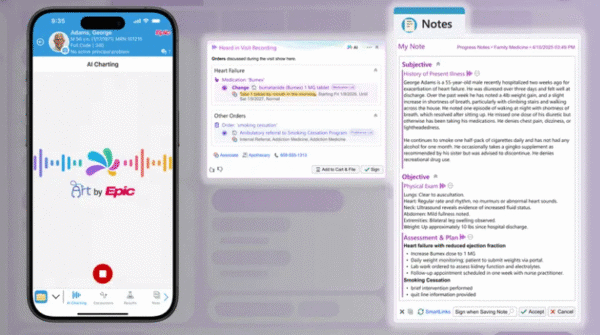
The wait is over. Epic’s scribe has arrived, and it’s packing a lot more than ambient notes.
“AI Charting” goes beyond transcriptions. The fully built-in feature not only listens during patient visits and drafts notes, it also queues up orders based on the conversation.
- The initial release allows clinicians to personalize the note structure using voice commands (Ex. asking to format the history of present illness as a bulleted list).
- Epic is positioning AI Charting as the killer app for its Art clinical copilot, which also has a pre-visit Insights tool that’s apparently already being used 16M times per month.
Distribution is king. Over 40% of U.S. hospitals are on Epic, and an AJMC study from just last week showed that two-thirds of those hospitals have already adopted ambient AI.
- AI Charting is breaking onto the scene through one of healthcare’s biggest distribution channels, and Epic has a ton of levers it can pull with pricing and bundling to start stealing share (DAX Copilot, Abridge, and ThinkAndor accounted for ~80% of Epic hospitals in the recent study).
- Rather than charging a per-user-per-month fee like most ambient AI platforms, STAT reports that Epic plans to have a separate license for AI Charting, with the price varying by org size and utilization to get the tool in as many hands as possible.
It’s time to differentiate. The race is on for established players to prove they can deliver value that Epic’s integrated approach can’t match.
- That means tackling problems that are too messy for Epic to touch (Abridge bringing real-time prior auths to the point of conversation), or too specialized for it to get right with so many other plates spinning (Nabla raising the bar for AI safety with world models).
- Epic is working closely with Microsoft to get new features online quickly, but nailing multiple specialties in countless languages could still prove to be a job that’s better suited for a company with a dedicated focus.
- Epic might own the “operating system” almost as much as Microsoft owns Windows, but just because MS Paint exists doesn’t mean the world doesn’t need Adobe Photoshop.
The Takeaway
Ambient scribes proved how fast health systems would layer on their own AI if Epic couldn’t keep up, and we’ll now have to wait and see if the cost and experience of Epic’s scribe is enough to compete with the flock of ambient AI innovators dedicated to this problem.
|
|
State of Payor Enrollment and Credentialing
AI is changing the way that healthcare leaders tackle provider network management. Medallion’s latest report breaks down the biggest challenges, emerging trends, and how automation is transforming the landscape. Get the insights you need – read the full report today.
|
|
Episode-Based Care: Making TEAM Work
The TEAM model represents one of the largest mandatory reforms in Medicare history, and forward-thinking perioperative leaders are leaning into it. Join C8 Health for a fireside chat exploring how episode-based care is reshaping quality improvement – and why the orgs succeeding under TEAM are treating it as a catalyst for transformation, not just a regulatory checkbox. Grab your spot here.
|
|
- Telehealth Flexibilities Return: This week’s partial government shutdown reached a quick conclusion after President Trump signed a funding package that included several long-awaited healthcare policies. Medicare telehealth flexibilities finally got their two-year extension, and the Acute Hospital Care at Home Program was approved all the way through September 2030. The package also brought notable reforms for PBMs, including new transparency requirements and a provision that prevents them from tying their revenue to drug prices in Medicare Part D.
- Duplicate Records Can Be Lethal: A study in BMJ Quality & Safety linked duplicative medical records to a massively heightened risk of inpatient death. Researchers analyzed outcomes for over 6k propensity matched patients (1.7k with duplicate charts, 4.4k without) across 12 hospitals from 2022 to 2023, finding that those with duplicate records were 5x more likely to die after being admitted (11% vs. 2.5%). The duplicate record group also had a 3.5x higher likelihood of needing intensive care (46% vs. 19%), and their average length of stay lasted 101 hours compared with 74 hours. Not great news for the ~10% of patients estimated to have multiple charts.
- Abridge Goes Back-to-Back: KLAS Research just took social media by storm with its annual vendor rankings, and we have our first returning champ in one of healthcare’s hottest categories after Abridge was named #1 Best in KLAS for Ambient AI. For the second year in a row, Abridge earned the highest overall score (94.7) based on independent feedback from its customers, which include over 250 of the largest and most complex health systems in the country. That score bakes in A+ ratings for culture, loyalty, relationship, and value, which is probably why the enterprise-grade AI platform is on track to power more than 80M clinical conversations before the end of the year.
- One Medical + Reperio: Preventative care is having its “Amazon moment” after One Medical announced that it’s teaming up with Reperio Health to offer at-home preventive screenings. The partnership gives patients access to ReperioKit, an FDA-cleared testing kit that analyzes everything from blood pressure and glucose to BMI and triglycerides. One Medical members can see the results in their app after taking the test, then immediately connect with a clinician to walk them through the information or line up any follow-up care that’s needed.
- Pre-Existing Conditions Are Expensive: FAIR Health’s latest claims analysis showed that 57.5% of patients with commercial health coverage had at least one chronic condition in 2024, and many had “clusters” of diseases like hypertension or diabetes. That unsurprisingly drove up spending, with health plans allowing an average of $3,039 to treat a patient with a single chronic condition, nearly double the amount for someone with none ($1,590). Of the 44 conditions studied, high cholesterol was the most common (21.2%), while lung cancer had the largest average allowed amount per year ($22,740).
- TrumpRx Delays: TrumpRx officially missed its January launch date, which means patients will have to wait a bit longer to find “Most-Favored-Nation Pricing” on their prescription medications.. HHS Secretary RFK Jr. said the launch “is going to be happening sometime, probably in the next 10 days” during a Cabinet meeting last Thursday, so the portal should be up and running late this week or early next. The delay coincides with new guidance clarifying how pharma companies can offer drugs directly to patients without violating the anti-kickback statute.
- Patients Aren’t Great at Home Monitoring: Patients can’t always be counted on to take at-home blood pressure readings for guiding medication therapy, according to a recent study in JAMA Cardiology. Out of 3.4k patients in Mass General Brigham’s remote hypertension program (home BP monitor, education, support), only 35% met “high engagement” (24-28 readings per week), 47% logged too few readings (less than 12 per week) to reliably guide med titration, and 33% never even used their home monitor.
- Primary Care Crossover: Employer-focused primary care companies Premise Health and Crossover Health are gearing up for a merger. If approved, the move would form an advanced primary care giant serving over 400 orgs and millions of members, with 900 clinics generating close to $2B annually. Both companies have already been focused on developing alternative payment models and primary care-centered health plans, so the merger will reportedly accelerate those efforts.
- Chamber Cardio Lands $60M: Chamber Cardio hauled in $60M to scale its value-based cardiology platform. The startup partners with both payors and providers to support long-term management of heart disease while keeping costs under control. Its platform integrates “workflow-native AI” to prioritize high-risk patients, identify gaps in guideline-directed therapy, and reduce manual chart review. Early trial data seems to suggest the model works, with Chamber reducing CHF-related hospitalizations by 39% and total inpatient admissions by 21%.
- TEMPO Tutorial: The FDA released a public learning module for anyone thinking about participating in its new Technology-Enabled Meaningful Patient Outcomes (TEMPO) for Digital Health Devices Pilot. The module lays out the goals of the pilot, the selection process for participation, and key information to include in your statements of interest. You can check out the presentation and transcript at the link under “Specialty Technical Topics -> Digital Health,” but the full hour-long walkthrough is on YouTube for the visual learners.
|
|
Clinician-First Copilot for Value-Based Success
Navina’s AI copilot brings clinical intelligence directly to care teams, turning fragmented data into actionable insights that transform value-based workflows from the back office to the point-of-care. Designed for and loved by physicians, Navina’s Best in KLAS AI reduces missed diagnoses while improving quality metrics and risk adjustment accuracy. Discover how practices are leveraging Navina to enhance VBC performance and improve the clinician experience.
|
|
Ambient ROI – New Metrics From Health Systems
While Abridge’s value is clear from its rapid adoption and positive clinician feedback, discerning CMIOs, CIOs, and CFOs also require longitudinal and more precise impact measurement – including of operational and workflow processes. With a new ROI methodology, that’s what Abridge delivers for its health system partners. See how four health systems are using this new tool to measure ROI at a deeper level than ever before. Download here.
|
|
- The Perfect Moment for Digital Health: With expanded support for remote care, digital health is positioned to play a central role in value-based models. Check out Withings’ latest overview to learn how connected technologies can help reduce preventable events while improving care quality and efficiency.
- Next Generation Ambient Technology and Agents: The ambient AI transformation is already sweeping across health systems, reducing administrative burdens and improving patient outcomes. So, what’s next? Tune into this on-demand session to learn how systems like Carle Health and Denver Health are leveraging Nabla to eliminate Pajama Time and build a future where agentic AI unlocks true workforce sustainability.
|
|
|
|
|


