|
AI for Cognitive Decline, RCM Landscape, and Doximity Throws Down the Gauntlet
January 26, 2026
|
|
|

|
|
Together with
|

|
|
|
“Someone at this JPM panel said the future of healthcare interoperability is going to end up being teleoperated humanoid bots sending faxes to each other to get information.”
|
|
Out-of-Pocket Founder Nikhil Krishnan
|
|

|
|
Early disease detection is entering the AI era, and a new study in npj Digital Medicine shows that autonomous agents can now flag cognitive decline using nothing but clinical notes.
Cognitive decline is difficult to detect. It remains significantly underdiagnosed in routine care, and traditional screening usually requires a dedicated clinician and tests that can take hours.
- At the same time, early detection is becoming increasingly important, especially with the recent approval of Alzheimer’s therapies that are most effective when administered early.
Mass General Brigham might have an answer. Clinical notes contain whispers of cognitive decline that busy clinicians can’t always hear. MGB built a system that listens at scale.
- These whispers include everything from linguistic shifts and sentence pauses to disorganized narratives and family member concerns.
- MGB developed an AI system that scans for these signals in routine clinical documentation, leveraging five specialized agents that critique each other and refine their reasoning.
It worked like a charm. The MGB researchers set their agents loose on over 3,300 clinical notes from 200 anonymized patients, then had human reviewers take their own look.
- The agents detected cognitive impairment with 91% sensitivity, nearly matching expert-level accuracy – without any human intervention needed after deployment.
- When the AI and human reviewers disagreed, an independent expert validated the AI’s reasoning 58% of the time – meaning the system was often making sound clinical judgments that initial human review had missed.
The cherry on top? The MGB team open-sourced Pythia alongside the study, enabling any provider org to deploy autonomous prompt optimization for their own AI screening applications.
The Takeaway
LLMs have opened the door to proactive screening at scale, and MGB just provided an excellent proof of concept using AI agents that turn everyday documentation into a chance to catch cognitive decline during the optimal treatment window.
|
|
Next Generation Ambient Tech and Agents
The ambient AI transformation is already sweeping across health systems, reducing administrative burdens and improving patient outcomes. So, what’s next? Tune into this on-demand session to learn how systems like Carle Health and Denver Health are leveraging Nabla to eliminate Pajama Time and build a future where agentic AI unlocks true workforce sustainability.
|
|
Enrollment Timelines, State by State
Provider enrollment delays are shaping access to care, revenue timelines, and even workforce strategy. Ever wonder how they’re impacting organizations near you? Check out Medallion’s 2025 Geography of Payor Enrollments to see state-by-state enrollment times, how delays are compounding workforce shortages, and why you should factor this into your 2026 planning.
|
|
- Zarminali Pediatrics Lands $110M: Zarminali Pediatrics hauled in a massive $110M Series A funding round to modernize care for children with its “proprietary tech platform.” The company was founded in 2024 and provides both pediatric primary and specialty care via its 28 clinics across 8 states. The fresh funds will help Zarminali open 15 clinics in new markets, while bolstering its tech platform to support 24/7 telehealth, urgent care, and specialty services like speech, occupational, and behavioral therapy.
- Providers Turn to “Shadow AI”: A Wolters Kluwer survey of 518 healthcare professionals found that many are using “shadow AI” to make their workflows more efficient. About 4 in 10 clinicians have encountered shadow AI tools that haven’t been authorized by their organization, and nearly 20% have personally used them. That includes 10% that fessed up to using unauthorized AI in direct patient care. The (coincidentally?) well-timed survey arrives less than a week after one of WK’s biggest shadowy competitors hauled in another $250M.
- Doximity Brings on New Talent: In separate but related news, Doximity has taken the gloves off and “thrown down an expertise gauntlet” to Wolters Kluwer and Open Evidence. Doximity announced that Dr. Eric Topol and former U.S. Surgeon General Dr. Regina Benjamin will be serving at the helm of its new PeerCheck service as co-Editors in Chief. PeerCheck is a just-launched initiative that basically embeds expert peer review into DoxGPT to make sure its AI-generated answers are grounded in real-world evidence.
- Breyer Capital Predictions: Last but certainly not least on the 2026 prediction front is Breyer Capital, which expects this to be a breakout year for the convergence of science, medicine, and industry. The forecast calls for the emergence of an entirely new category of data infrastructure tools centered around prevention, and for the long-anticipated wave of digital health consolidation to finally break due to “roll or get rolled” pressure coming from all sides. Jim Breyer is as much of a wizard with his writing as he is with portfolio management.
- AvaSure Teams Up With Equum: AvaSure and Equum Medical are teaming up to deliver one of the first fully integrated, physician-led virtual care platforms. The duo is expanding their partnership to integrate multi-specialty consults, eICU, and virtual hospitalist coverage into a unified enterprise platform that’s already used by over 1,200 hospitals. The joint solution is designed to address critical coverage gaps like nights, weekends, and hard-to-staff locations across more than 13 service lines including neurology, psychiatry, and cardiology.
- Docs Want More AI Input: A physician survey from Offcall found that sentiment around AI is increasingly bullish, but most docs still want to have more input. Two-thirds of physicians are already using AI daily and want more of it, but 81% are also dissatisfied with their employer’s current speed of adoption. Physicians’ other top grievances revolved around having AI tools chosen for them by administrators who’ve never seen a patient, with 71% reporting that they have little-to-no influence on AI implementations and 48% saying that leadership has poor communication around AI.
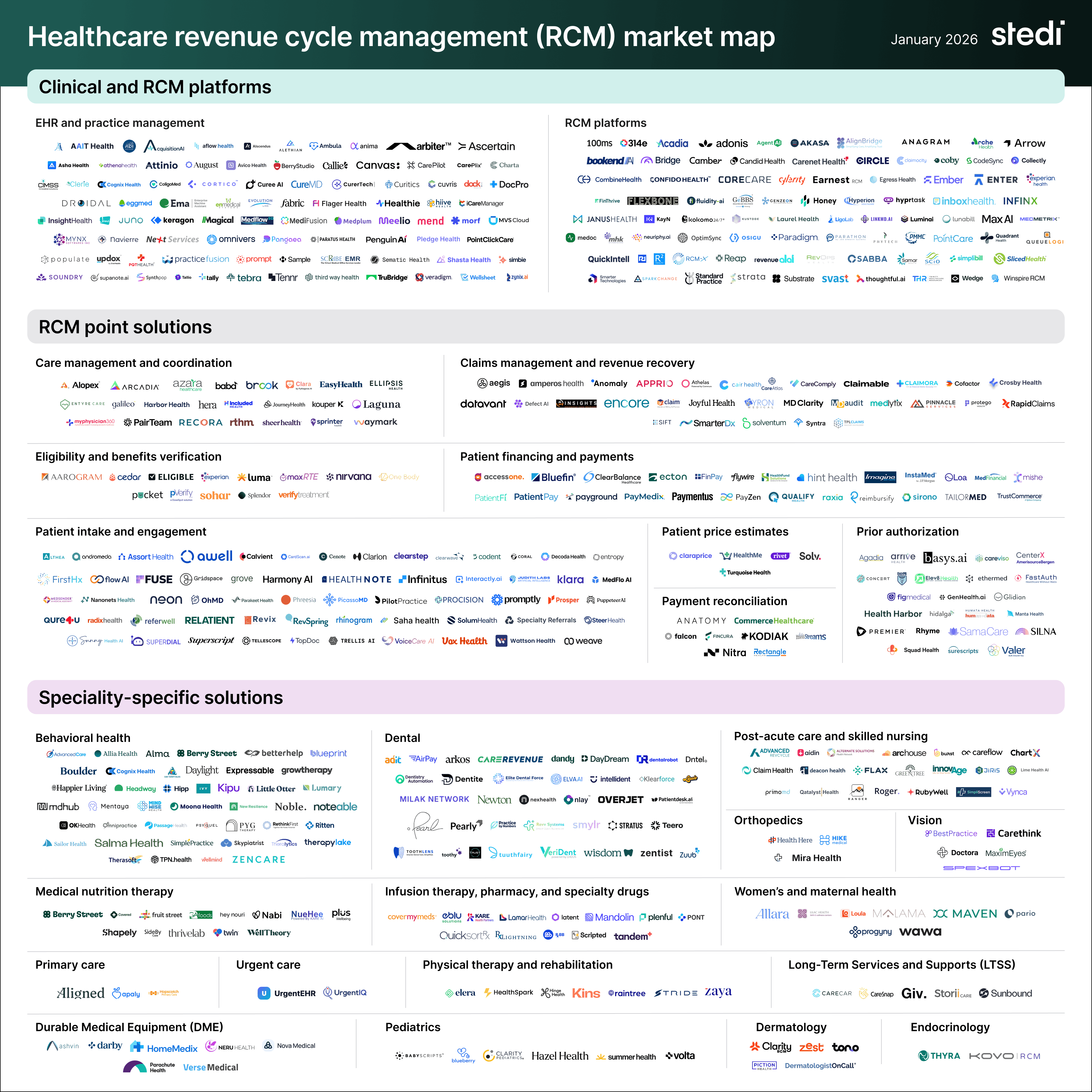
- Stedi’s RCM Market Map: Everyone loves a good market map, and Stedi just put out a great one for the white hot revenue cycle management landscape. The map covers over 500 companies, ranging from RCM platforms and EHRs to point solutions and specialty-specific tools. If you’re in the market for a new RCM solution, know someone who’s looking, or just want to be flabbergasted by the number of new entrants flooding this space – here’s the high-res version.
- Carta Goes With Claude: Carta Healthcare just launched its Claude-powered hybrid data intelligence approach in the wake of Anthropic’s unveiling of Claude for Healthcare. The move ranks Carta among the first real-world implementers of Claude models to deliver actionable data around registries and analytics. Carta complements the AI with expert clinicians to dramatically streamline manual abstraction, which has resulted in its health system partners reducing abstraction time by up to 66% while also cutting their abstraction-related costs in half.
- DPC Clinics Are Everywhere: A study in Health Affairs showed that the number of direct primary care clinics in the U.S. has been quickly climbing. Between 2018 and 2023, the number of concierge and DPC practices nationwide surged 83%, from 1,658 practices to 3,036 practices. The number of clinicians working in these practices also expanded from ~4k clinicians in 2018 to 7k clinicians in 2023, which the authors concluded is probably improving care for those who can afford it but raises some concerns about PCP access for the general public.
- Claim Health Seed Round: Claim Health raised $4.4M of seed funding to support the launch of its AI-powered revenue infrastructure for post-acute care. The Claim platform manages the full referral-to-reimbursement workflow – including intake, eligibility verification, authorization management, and reconciliation – without manual portals or paperwork. CEO Kevin Calcado told Endpoints that Claim’s real differentiator is that it “connects all of the back office revenue operations together and gives visibility to the entire administrative staff,” which allows them to get out in front of challenges before they start stacking up.
|
|
10 Bold Predictions for Healthcare AI in 2026
If 2024 was the year of proof-of-concept and 2025 was the year of early adoption and scale, 2026 is shaping up to be something different. This year, AI will become expected infrastructure and simply part of how healthcare gets done. Read these 10 predictions from clinical leaders, health system executives, and researchers shaping the next phase of the field on how the AI conversation will change in 2026.
|
|
Supporting GLP-1 Weight Loss With RPM
Looking to make GLP-1 prescribing safer and more effective long term? Explore Withings’ suite of remote patient monitoring devices, designed to deliver the continuous, clinically relevant insights care teams need to proactively monitor patients, identify risks early, and intervene with confidence.
|
|
Making the Case for AI
Healthcare organizations have a lot to gain from implementing AI that can enhance coding accuracy and quality metrics, but securing buy-in from leadership is a crucial first step. Check out Navina’s new guide by Dr. Michael S. Barr to see exactly how to demonstrate clear financial benefits, ROI potential, and alignment with organizational priorities to help ensure AI projects are successful.
|
|
|
|
|