|
LLM Privacy Risks, IntelyCare Acquisition, and More Predictions
January 12, 2026
|
|
|

|
|
Together with
|

|
|
|
“AI literacy is about to go from elective to essential: it’s not only the change management tool that makes rollouts stick, but also the risk management tool that keeps lawsuits away.”
|
|
CommonSpirit Health Hospitalist Minal Shah, MD
|
|
|
|
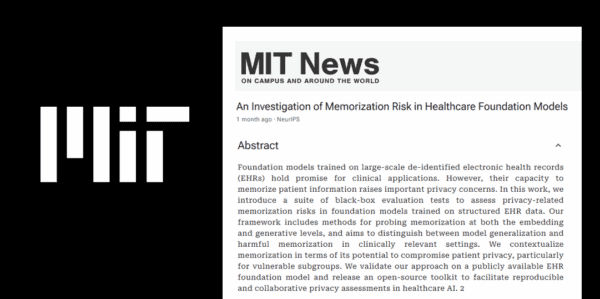
Foundation models trained on EHR data hold massive potential for clinical applications, but a new study out of MIT shows that they might have just as much potential to violate patient privacy.
Generalized knowledge makes better predictions. EHR foundation models normally draw on a collection of de-identified patient records to produce their outputs.
- That’s not a problem on its own, but unintended “memorization” also allows these models to serve answers based on a single record from their training data.
Therein lies the problem. To quantify the risk of these models revealing sensitive information, MIT researchers developed structured tests to determine how easily an attacker with partial knowledge of a patient – think lab results or demographic details – could extract further identifiable info through targeted prompts.
The tests measured memorization as a function of:
- the amount of information an attacker needs to reveal information
- the risk associated with the revealed information
What did they find? After validating the tests using EHRMamba, an EHR foundation model with publicly available training data, the researchers reached a pair of conclusions that weren’t too surprising to see.
- The more information attackers have on a patient, the greater their privacy risk.
- Some patients, particularly those with rare conditions, are more susceptible.
Not all information is harmful. The researchers found that some details, such as a patient’s age or gender, present a relatively lower risk in the event of a data breach.
- This info wasn’t very helpful in targeted prompts that probed the model for memorized records, and it isn’t very damaging if the answers reveal it.
- Other info, such as a rare disease diagnosis, was flagged as significantly more harmful. It posed a higher risk of getting the model to expose patient-specific details (especially in combination with other identifiers), and it can be especially sensitive if revealed through probing.
The Takeaway
EHR foundation models need some degree of memorization to solve complex tasks, but memorizing and revealing patient records is obviously out of the question. The tradeoff between performance and privacy is an ongoing challenge, but MIT just delivered a framework for evaluating some of the risks that can help strike the right balance.
|
|
Scale RPM With BPM Pro 2
BPM Pro 2 is the next generation of cellular blood pressure monitors, empowering care teams to scale remote patient monitoring and streamline operations. Discover why leading providers are choosing BPM Pro 2 to collect highly precise measurements and enrich data with Patient Insights from their daily lives.
|
|
Under the Hood of Navina’s AI
Navina’s AI engine harnesses over 600 proprietary algorithms to transform fragmented patient data into actionable clinical intelligence at the point of care. It’s shaped with the expertise of physicians to turn multiple data sources (EHR, HIE, claims, care gap files, etc.) into contextualized insights like suspected conditions or evidence for care gap closures – each linked back to the original source. Download the whitepaper to see examples of Navina’s AI in action.
|
|
- IntelyCare Acquires CareRev: Healthcare staffing company IntelyCare scooped up CareRev, a shift-bidding platform that gives hospitals access to on-demand workers. The acquisition should quickly expand IntelyCare’s flagship post-acute solution into a full-spectrum offering by layering on CareRev’s platform that’s purpose-built for acute care. Fun fact courtesy of HIStalk – CareRev’s founder and CEO resigned in 2023 after revealing to a colleague that he raised $50M by giving the company’s “Uber for nurses” Series A pitch while on LSD.
- RUSH + Amazon One Medical: Rush University System for Health is teaming up with Amazon One Medical to expand access to primary and specialty care in the greater Chicago area. The three-hospital system will leverage One Medical’s eight local primary care clinics to give more patients timely access to appointments and a seamless connection to its comprehensive specialty care network. RUSH said the collaboration complements its own Rush Connect virtual care service that offers same- and next-day telehealth visits across eight specialties.
- Patient Safety Trending in Right Direction: AHA and Vizient published a report showing that U.S. hospitals have been making substantial improvements in patient safety and outcomes, even as they care for larger and sicker populations. The analysis found that patients hospitalized in Q2 2025 were almost 30% more likely to survive compared with pre-pandemic baselines in 2019, resulting in ~300k additional lives saved. Hospitals treated 4% more patients with 5% higher acuity, yet they also managed to significantly reduce central line-associated bloodstream infections (-24%) and catheter-associated urinary tract infections (-25%).
- Honorable Mention 2026 Predictions: CommonSpirit hospitalist Minal Shah, MD put out some 2026 digital health predictions that were too beautiful not to add to our Crystal Ball Compilation. Our favorite forecast? “Platform vs. point solution is a false dichotomy – and I think we’re asking the wrong question. The real question isn’t which approach to take. It’s whether we’ve done the hard work of understanding what the organization actually needs before we choose a path forward. That means moving from ‘what can we do with AI?’ to ‘what should we be doing with AI?’ The cost of getting this wrong is clear: pilot churn.”
- Withings Debuts Body Scan 2: Withings just unveiled Body Scan 2 under the bright lights of CES Las Vegas, which delivers one of the most advanced home preventive health check-ups we’ve seen in just 90 seconds. Body Scan 2 focuses on 60 clinical biomarkers to decode heart pumping function, artery, metabolism, and cellular health – pillars of both short-term vitality and longevity. The CES demo showcased several solid home care use cases like hypertension risk notifications and a complete assessment of cardiac pumping efficiency via impedance cardiography (ICG).
- Scaling AI Care Navigation: DiMe announced its first new initiative of the year, bringing together health systems, payors, patient groups, and tech companies to define what “good” looks like for AI-enabled care journeys in the real world. The project is on the lookout for partners to help develop frameworks for evaluating AI navigation tools and ensuring they’re grounded in real operational constraints and evidence from real patients. The final resources will be open sourced and include implementation roadmaps to drive immediate value across the industry.
- Apella Series B: Apella hauled in $80M of Series B funding to give operating rooms an Extreme Makeover: Ambient AI Edition. The OR management platform uses computer vision and machine learning to automatically identify up to 14 surgical case events and write novel data back to the EHR, allowing perioperative teams to serve more patients (about 5% more on average). Houston Methodist participated in the round after liking what it saw during Apella’s enterprise-wide rollout in more than 200 ORs.
- Smaller Systems Lag on RCM: A national survey from HFMA and AKASA found that health systems are increasingly optimistic about GenAI for revenue cycle management, but most are just getting started on their adoption journey. Of the 519 hospital finance execs surveyed, 80% said they’re exploring, piloting, or implementing GenAI-powered tools for RCM (up 38% in two years), which means one in five orgs are still waiting behind the starting line. Smaller health systems with revenue of $500M to $1B are falling behind due to budget and technology scaling constraints, with just 20% at the pilot or implementation phase (vs. 64% of larger systems).
- How Accurate is TikTok Medical Advice? A recent analysis of TikTok videos about breast cancer screening found that – shockingly – videos created by physicians and private clinics were more reliable than those of non-physicians. In a study in Clinical Imaging, researchers used the DISCERN tool to analyze the quality of 75 TikTok videos, finding 36% higher average scores for those created by physicians than non-physicians (3.12 vs. 2.29). Videos based on the creator’s personal experience scored the lowest.
- Ambient Scribe Lawsuit: It was only a matter of time, but we now have our first patient suing a health system for using an AI scribe during their treatment. The proposed class-action lawsuit against San Diego-based Sharp HealthCare was filed by a patient that saw an AI-generated visit note in their portal, along with a disclaimer that said they’d been advised and consented to using the ambient scribe. The patient alleges that never took place, which would be a clearcut violation of California’s “all-party consent” laws for recording private conversations. So far it seems like we’ll have to wait until the trial to get Sharp’s side of the story.
|
|
Next Generation Ambient Tech and Agents
The ambient AI transformation is already sweeping across health systems, reducing administrative burdens and improving patient outcomes. So, what’s next? Tune into this on-demand session to learn how systems like Carle Health and Denver Health are leveraging Nabla to eliminate Pajama Time and build a future where agentic AI unlocks true workforce sustainability.
|
|
Enrollment Timelines, State by State
Provider enrollment delays are shaping access to care, revenue timelines, and even workforce strategy. Ever wonder how they’re impacting organizations near you? Check out Medallion’s 2025 Geography of Payor Enrollments to see state-by-state enrollment times, how delays are compounding workforce shortages, and why you should factor this into your 2026 planning.
|
|
10 Bold Predictions for Healthcare AI in 2026
If 2024 was the year of proof-of-concept and 2025 was the year of early adoption and scale, 2026 is shaping up to be something different. This year, AI will become expected infrastructure and simply part of how healthcare gets done. Read these 10 predictions from clinical leaders, health system executives, and researchers shaping the next phase of the field on how the AI conversation will change in 2026.
|
|
|
|
|


