|
An Abominable Creature, Luma Acquires Tonic, and Telehealth Flexibilities
November 17, 2025
|
|
|

|
|
Together with
|

|
|
|
“Americans already built socialized medicine – it’s just less obvious and more expensive.”
|
|
Point B Manager Andrew Tsang
|
|

|
|
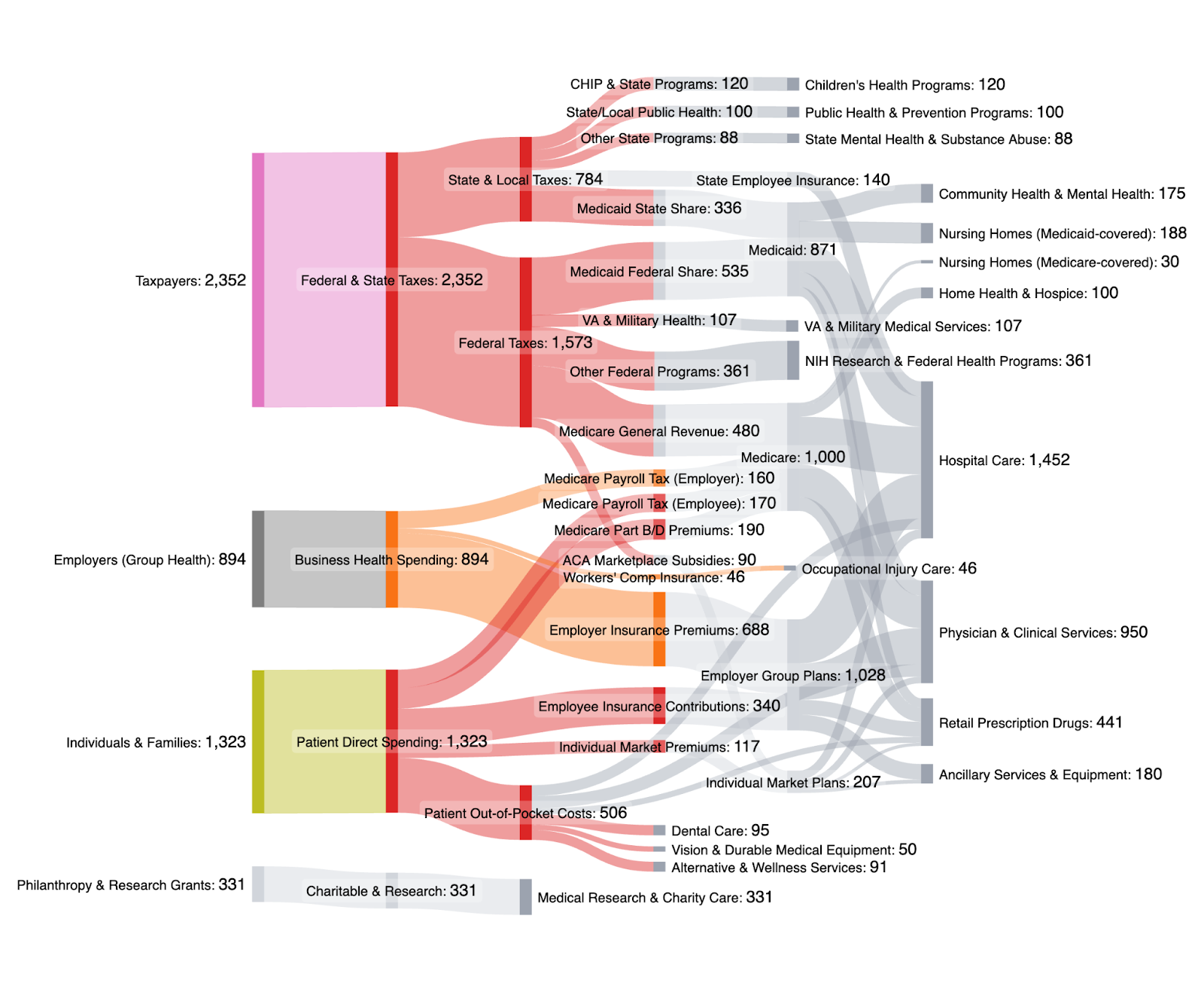
If a picture is worth a thousand words, then this chart from industry consultant Andrew Tsang might be worth a million.
America’s healthcare system is “An Abominable Creature.” That’s also the title of Tsang’s stellar blog post that meticulously maps out every dollar that flows through it.
- The flows in the diagram represent $4.9T, but they’re also a glimpse at every medical decision that was made in the U.S. last year. Every diagnosis. Every birth. Every death.
The charts don’t just map spending, they map our decisions. We built the healthcare system brick by brick with the choices we made, and although they might have all made sense individually, the end result is a monster of our own design.
Decision 1 – Workers fund healthcare twice… or more [Chart 1].
- Federal, State, and Local Taxes – $2.4T for Medicare, Medicaid, and public health.
- Payroll Taxes – employers fund Medicare even though most employees aren’t 65.
- Premiums – $688B gets deducted from paychecks for employer plans.
- Out-of-Pocket Costs – Americans shell out another $506B when they actually get care.
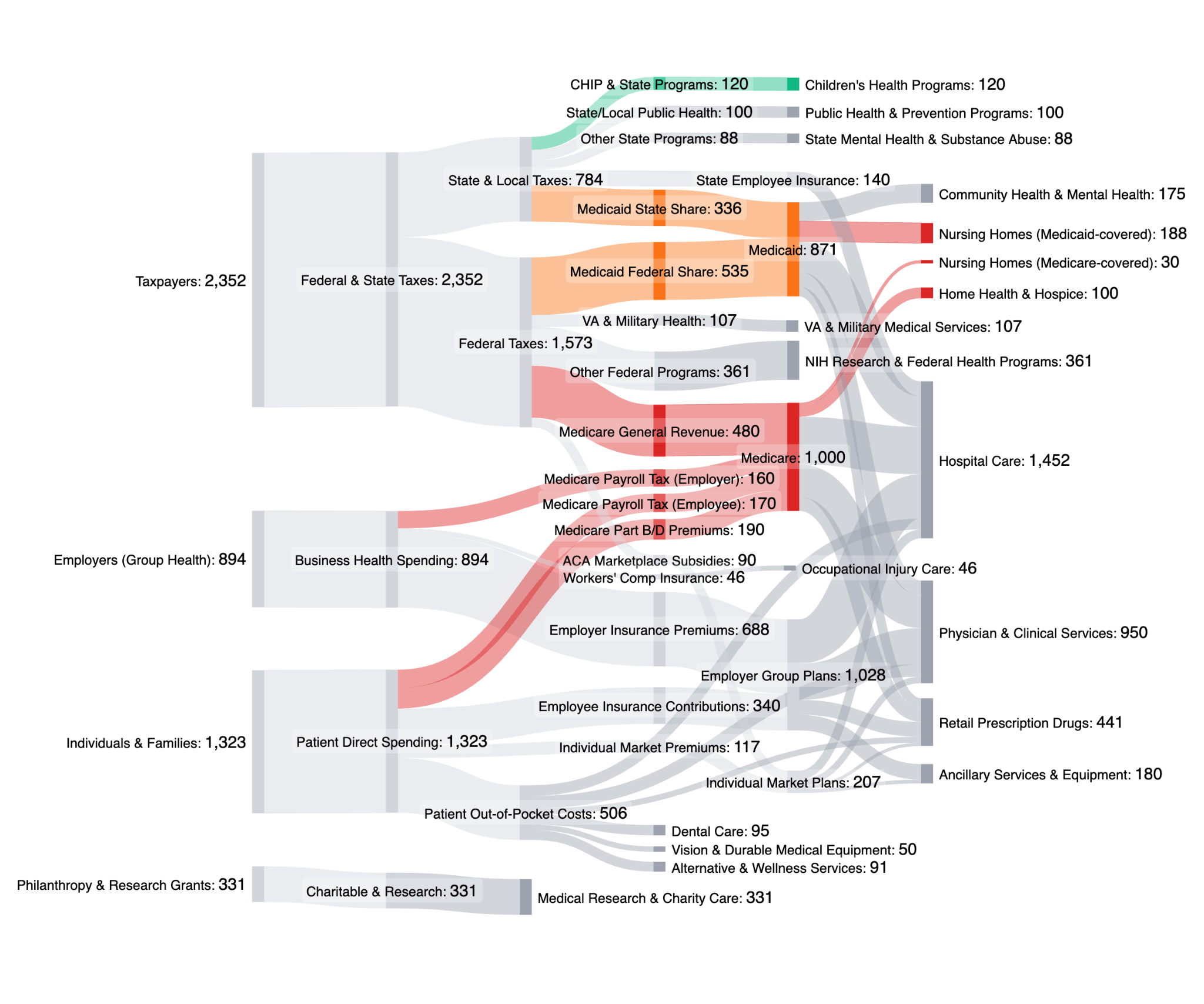
Decision 2 – We look after our seniors [Chart 2].
- Medicare accounts for $1T every year.
- Nursing homes account for $218B every year.
- Home health & hospice account for $100B (and 22% of all Medicaid spending).
Other Decisions – The full U.S. diagram can tell whatever story you want it to [Chart 3].
- Treatment is more important than prevention – $100B goes to public health while $1.5T goes to hospital care annually.
- Innovation is a bigger priority than price controls – $441B is spent on prescription drugs.
- Repairing old age is better than investing in children – $120B goes to children’s health compared to $1T for Medicare.
The Takeaway
The U.S. healthcare system was pieced together through a long chain of isolated decisions, each one solving a specific problem at the time. Tsang just gave us a beautiful illustration of the end result: a kraken with countless tentacles that all seem to have a mind of their own.
|
|
Measuring Real ROI From Ambient AI
In a groundbreaking report, Abridge shares a new methodology for measuring the ROI impact of ambient AI at a more granular level than ever before. Abridge partners are now getting a precise look at changes in wRVUs, HCC capture, time spent in notes, and much more. Four health systems also share their results across many of these metrics. To learn more about the technology behind this breakthrough and to see some of the data, download the report here.
|
|
Supporting Sustainable GLP-1 Weight Loss With Withings
Leading digital health companies and health systems are supporting safe and sustainable GLP-1 weight loss with Withings Health Solutions. See how care teams are using Withings’ suite of remote patient monitoring solutions to prevent muscle loss, combat plateaus, and drive better outcomes for their patients.
|
|
- Medicare Telehealth Returns: Medicare telehealth coverage flexibilities are back in place after the longest government shutdown in history came to an end last week. The stopgap funding law reinstated the pandemic-era policies through January 30, including changes that allow all Medicare providers to offer virtual care and the rollback of geographic restrictions. The Acute Hospital Care at Home program is also up and running again – also through the end of January – but enhanced tax credits for ACA plans are now set to expire at the end of 2025.
- Moody’s Stable Outlook for Hospitals: Moody’s latest Outlooks Report offered a stable outlook for U.S. hospitals in 2026. The ratings agency expects most hospitals to remain in positive margin territory thanks to continued outpatient growth and steadier staffing, although we’re still a ways away from pre-pandemic levels. It’s worth noting that we’re due for about $1T in federal health spending cuts by 2034 courtesy of OBBB, but those will be ramping up over time so much of the impact isn’t baked into Moody’s short term forecast.
- Luma Acquires Tonic: RCM company R1 offloaded its patient intake and follow-up subsidiary Tonic Health to Luma Health. Tonic has a significant footprint serving healthcare organizations using Oracle Health EHRs, and the acquisition expands the reach of Luma’s AI-driven access platform to 1k health systems – including more than 15 of the nation’s leading academic medical centers.
- Withings BeamO Clearance: Withings Health Solutions landed FDA clearance for its BeamO “multiscope” that blurs the line between connected health device and mass appeal consumer product. BeamO is designed to be a vitals monitoring multitool for home checkups, packing a thermometer, stethoscope, and EKG into a sleek overall package that also allows users to share clinician-ready links to their data. Withings first announced BeamO early last year and it went on to be named one of Time’s Best Inventions of 2024.
- Remote Monitoring Employees: A KFF analysis estimates that 300k U.S. adults with employer-sponsored coverage received a remote monitoring claim in 2023, representing just 0.3% of enrollees with at least six months of coverage. Of the tiny slice of the employee pie with any remote monitoring, 93% had an RPM claim (for tracking physiological data like weight or blood glucose), while 19% had an RTM claim (for self-reported data like pain or activity levels). The full report includes a solid breakdown of utilization patterns by demographics, monitoring durations, and conditions.
- Mount Sinai Goes With Microsoft: Mount Sinai Health System is rolling out Microsoft Dragon Copilot after a multi-vendor bakeoff. The NY-based academic medical center will initially focus on automating administrative tasks across all care settings, marking “a major milestone” in its ongoing digital transformation. The news follows days behind Mercy announcing that it’s working with Microsoft to co-develop ambient AI solutions tailored for nursing workflows.
- AI for Recruitment: A WellSky survey of 1,200 U.S. healthcare workers suggests that AI is becoming as important for recruitment as it is for care delivery. About 4 in 5 nurses said they prioritize easy-to-learn software when deciding whether to apply for a job, and 70% said the same across all roles. A vast majority of healthcare workers rated care coordination tools as valuable to their day-to-day (90%), with EHRs trailing close behind (89%) and AI ranking further down (58%). Respondents had mixed feelings toward AI – about half believe it can immediately help reduce burnout but a similar share worry it will replace jobs and eliminate some positions.
- AvaSure Joins Epic Toolbox: AvaSure announced that its AI-powered virtual care platform is now available within Epic Toolbox for Inpatient Virtual Care. The move allows AvaSure to deliver fully integrated experiences within existing clinical workflows, such as launching virtual visits without having to leave Epic. AvaSure’s devices can now also be paired with Epic Monitor Remote Sitter for centralized oversight and faster responses in the event of a patient fall or safety incident.
- Patient Outreach Boosts Lung Screenings: A multi-pronged patient outreach program boosted CT lung cancer screening in a new study in JACR. Seventy people eligible for screening got a combination of decision aids, text reminders, financial support info, and alerts to primary care providers. After six months, 71% had discussed screening with their provider, 51% got screening referrals, and 27% completed screening – significantly higher than the national average of 16-18%.
- AHA’s AI Guidance: The AHA recently released a science advisory in partnership with Dandelion Health urging health systems to adopt clear governance frameworks for healthcare AI deployment. Despite hundreds of FDA-cleared AI tools, only a fraction undergo rigorous clinical evaluation and just 61% of hospitals validate tools on local data pre-deployment. The advisory proposes four guiding principles to help address this: strategic alignment, ethical evaluation, usefulness/effectiveness, and financial performance.
|
|
Under the Hood of Navina’s AI
Navina’s AI engine harnesses over 600 proprietary algorithms to transform fragmented patient data into actionable clinical intelligence at the point of care. It’s shaped with the expertise of physicians to turn multiple data sources (EHR, HIE, claims, care gap files, etc.) into contextualized insights like suspected conditions or evidence for care gap closures – each linked back to the original source. Download the whitepaper to see examples of Navina’s AI in action.
|
|
Next Generation Ambient Tech and Agents
The ambient AI transformation is already sweeping across health systems, reducing administrative burdens and improving patient outcomes. So, what’s next? Tune into this on-demand session to learn how systems like Carle Health and Denver Health are leveraging Nabla to eliminate Pajama Time and build a future where agentic AI unlocks true workforce sustainability.
|
|
- 10 Strategies to Expedite Provider Credentialing: Lagging provider credentialing workflows can create a wave of unexpected care delays and financial setbacks. Sidestep these pitfalls by tuning into Medallion’s recording of 10 Key Strategies to Expedite Provider Credentialing and see how your organization can keep a well-oiled team and patient care intact through the ever-evolving changes seen in healthcare.
- Are You Invisible on AI Search? Your next patient is asking ChatGPT. But unless your healthcare company has content that answers their questions, you won’t show up. Tely AI fixes this by analyzing your niche, identifying what patients and partners look for, and publishing expert-level content to make you visible on Google AI, ChatGPT, and Perplexity. Launch your AI agent in 5 minutes and get your first article on us.
|
|
|
|
|