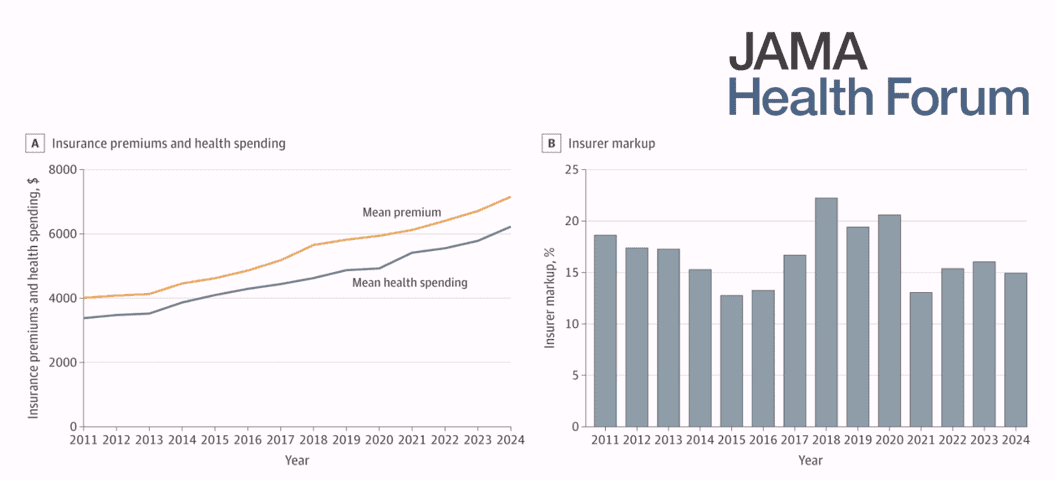
Nearly 12% of working-age U.S. adults are now without insurance coverage as rising premiums empty wallets. While many point the finger at insurers, a new JAMA Health Forum study revealed the culprit may be health spending on the whole.
- As of 2024, the median household income was $83.7k, with annual premiums for employer-sponsored individual and family plans at $8.9k and $25.6k, respectively.
- In the same year, the number of uninsured Americans under 65 years old rose to nearly 27M, reversing an almost five-year trend of declines.
- More than 60% said they were uninsured because costs were too high.
Now, researchers from Yale and the University of Wisconsin-Madison compiled data on premiums, markups, and spending for non-self-insured employers to trace what went wrong, finding that between 2011 and 2024:
- Average insurance premiums grew by 78.4% ($3.1k).
- Average health spending grew by 84.2% ($2.8k).
- The surprise was that insurer markups dropped from 18.6% in 2011 to 14.9% in 2024.
Health spending might’ve been passing the buck – rather than insurers. Skyhigh healthcare costs accounted for 91% of the overall growth in premium averages.
- These numbers come on the heels of a survey which revealed nearly half of Americans were suspicious of insurers steering ballooning health spending.
- Still, the researchers noted that, since premiums are written to cover anticipated costs or losses, they expected them to be responsive to changes in healthcare costs.
So, whodunnit? That’s a bit harder to pin, but other research shows it doesn’t seem like things are slowing down soon.
- The incidence of complex conditions is increasing as baby boomers age, and Medicare spending is increasing alongside it.
- Staffing shortages force fewer workers to provide more care, with hospitals increasing wages to try to incentivize overworked clinicians to stay.
- Those aren’t the only factors, but they’re certainly connected. The demand for care is increasing as the supply of workers is decreasing – and that doesn’t bode well for spending as a whole.
The Takeaway
Supercharged healthcare spending – not insurer markups – seems to be accounting for most of the increases in insurance premiums, and things may get worse before they get better.