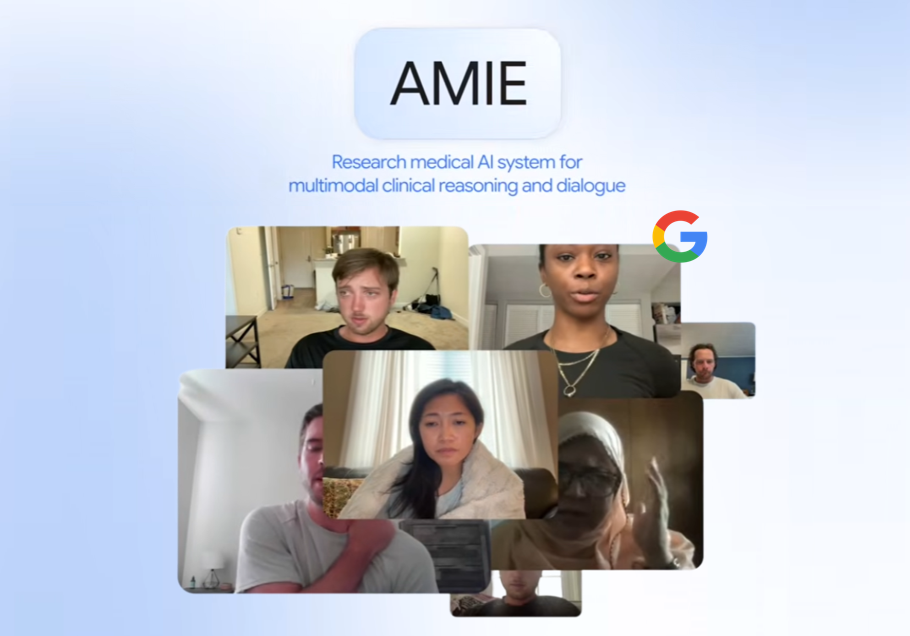
The moment has arrived. AI is now as good as physicians at conducting real-time video consultations – so long as patients stick to the script.
There’s a new expert in town. It’s Google’s flagship medical AI researcher named the Articulate Medical Intelligence Explorer, but its friends call it AMIE for short.
AMIE gets its eyes and ears from a three-agent architecture built on Gemini and Project Astra, which splits the job so no single model has to think and respond at the same time:
- A Talker agent keeps the conversation flowing with low-latency responses.
- A Planner agent continuously updates the differential diagnosis and clinical goals.
- A Perception agent watches the live audio-video stream for clinically relevant cues.
Google put AMIE through the wringer. A randomized study pitted AMIE against 10 board-certified PCPs across 100 telehealth scenarios enacted by 15 professional patient actors, with 20 independent physicians grading the encounters.
AMIE matched or beat the PCPs across the board:
- Overall clinical rubric score: 83% vs. 68%
- Top-1 diagnostic accuracy: 91% vs. 77%
- Perception and examination: 74% vs. 47%
The physical exam gap was the eye-opener. AMIE proactively coached patient actors through maneuvers like range-of-motion tests and self-palpation, while the human PCPs mostly fell back on verbal history-taking.
- Patient actors preferred AMIE for assessing and explaining their conditions, but still preferred humans for rapport, with interviews describing AMIE as having awkward pauses and odd conversational cadence.
Here’s the disclaimer. These were patient actors following scripts, not real patients. The physicians had to keep their cameras off, and AMIE still whiffed on subtle signals like tremors, nystagmus, and affect – the exact cues where perception matters most.
- That’s not exactly real-world validation, but that’s already underway through a feasibility study with Beth Israel Deaconess and a nationwide study with Included Health.
The Takeaway
When AMIE first prompted predictions that patients would soon see an “AI doctor” before a human one, the missing physical exam was the go-to rebuttal. That gap just got noticeably smaller, and it doesn’t feel like we’ll be able to write too many more of these before it disappears completely.